Roberts Adam C, Pearce Kaycey C, Choe Ronny C, Alzagatiti Joseph B, Yeung Anthony K, Bill Brent R, Glanzman David L
Department of Integrative Biology and Physiology, University of California Los Angeles, Los Angeles, CA, United States.
Center for Autism Research and Program in Neurobehavioral Genetics, Semel Institute for Neuroscience and Human Behavior at UCLA, Los Angeles, CA, United States; Department of Psychiatry, David Geffen School of Medicine at UCLA, Los Angeles, CA, United States; Department of Biology, University of Texas at Tyler, Tyler, TX, United States.
Neurobiol Learn Mem. 2016 Oct;134 Pt B(Pt B):360-8. doi: 10.1016/j.nlm.2016.08.014. Epub 2016 Aug 20.
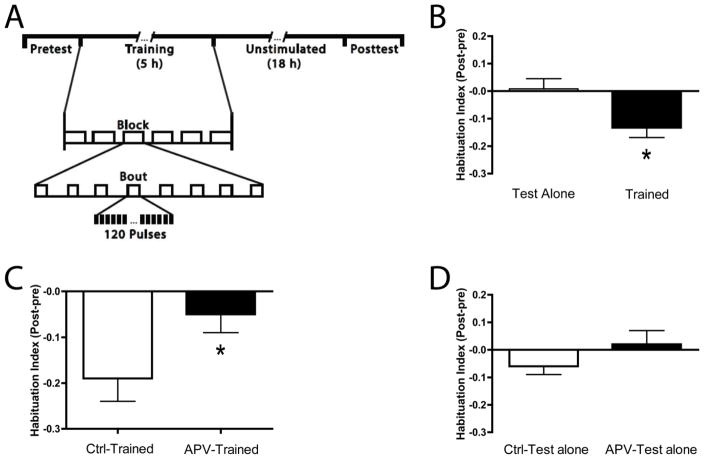
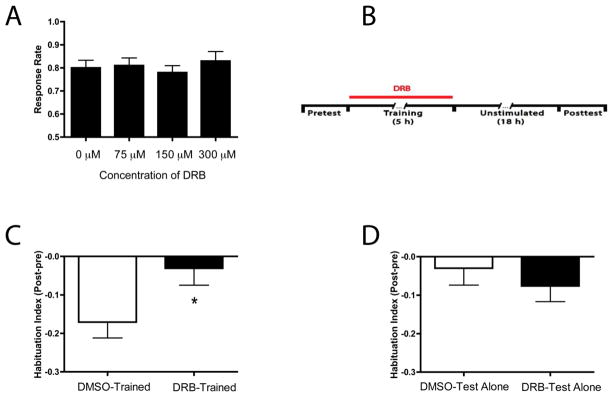
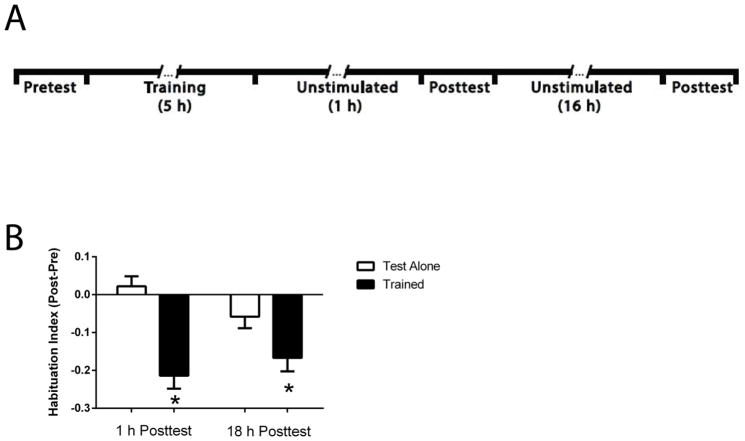
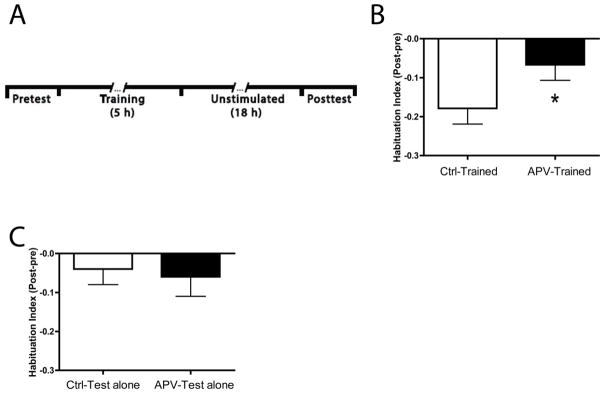
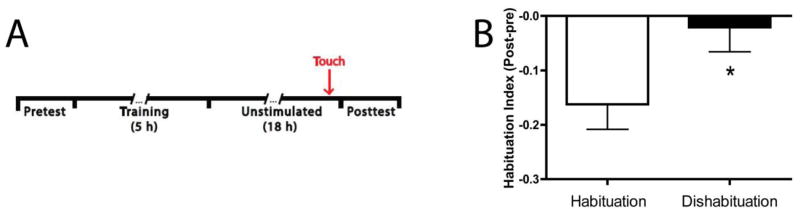
The cellular and molecular basis of long-term memory in vertebrates remains poorly understood. Knowledge regarding long-term memory has been impeded by the enormous complexity of the vertebrate brain, particularly the mammalian brain, as well as by the relative complexity of the behavioral alterations examined in most studies of long-term memory in vertebrates. Here, we demonstrate a long-term form of nonassociative learning-specifically, long-term habituation (LTH)-of a simple reflexive escape response, the C-start, in zebrafish larvae. The C-start is triggered by the activation of one of a pair of giant neurons in the zebrafish's hindbrain, the Mauthner cells. We show that LTH of the C-start requires the activity of NMDA receptors and involves macromolecular synthesis. We further show that the long-term habituated reflex can by rapidly dishabituated by a brief tactile stimulus. Our results set the stage for rigorous, mechanistic investigations of the long-term memory for habituation of a reflexive behavioral response, one that is mediated by a relatively simple, neurobiologically tractable, neural circuit. Moreover, the demonstration of NMDAR and transcriptionally dependent LTH in a translucent vertebrate organism should facilitate the use of optical recording, and optogenetic manipulation, of neuronal activity to elucidate the cellular basis of a long-term vertebrate memory.
脊椎动物长期记忆的细胞和分子基础仍知之甚少。由于脊椎动物大脑(尤其是哺乳动物大脑)极其复杂,以及在大多数脊椎动物长期记忆研究中所考察的行为改变相对复杂,有关长期记忆的知识发展受到了阻碍。在此,我们证明了斑马鱼幼体中一种简单反射性逃避反应——C 型惊吓反应(C-start)的长期非联想学习形式,即长期习惯化(LTH)。C 型惊吓反应由斑马鱼后脑一对巨型神经元之一——毛特纳细胞(Mauthner cells)的激活所触发。我们表明,C 型惊吓反应的长期习惯化需要 N-甲基-D-天冬氨酸受体(NMDA receptors)的活性,并涉及大分子合成。我们进一步表明,长期习惯化的反射可通过短暂的触觉刺激迅速去习惯化。我们的研究结果为对反射性行为反应习惯化的长期记忆进行严格的、机制性的研究奠定了基础,这种反射性行为反应由一个相对简单、神经生物学上易于处理的神经回路介导。此外,在一种透明脊椎动物中证明 NMDAR 和转录依赖性长期习惯化,应该有助于利用光学记录和光遗传学操纵神经元活动来阐明脊椎动物长期记忆的细胞基础。