Machado Marina Amaral de Ávila, Moura Cristiano Soares de, Ferré Felipe, Bernatsky Sasha, Rahme Elham, Acurcio Francisco de Assis
Programa de Pós-Graduação em Saúde Pública. Faculdade de Medicina. Universidade Federal de Minas Gerais. Belo Horizonte, MG, Brasil.
Research Institute of the McGill University Health Centre. Montreal, Quebec, Canada.
Rev Saude Publica. 2016 Aug 22;50:50. doi: 10.1590/S1518-8787.2016050006265.
To evaluate treatment persistence in patients with rheumatoid arthritis and ankylosing spondylitis who started therapies with disease-modifying antirheumatic drugs (DMARD) and tumor necrosis factor blockers (anti-TNF drugs).
This retrospective cohort study from July 2008 to September 2013 evaluated therapy persistence, which is defined as the period between the start of treatment until it is discontinued, allowing for an interval of up to 30 days between the prescription end and the start of the next prescription. Odds ratio (OR) with 95% confidence intervals (95%CI) were calculated by logistic regression models to estimate the patients' chances of persisting in their therapies after the first and after the two first years of follow-up.
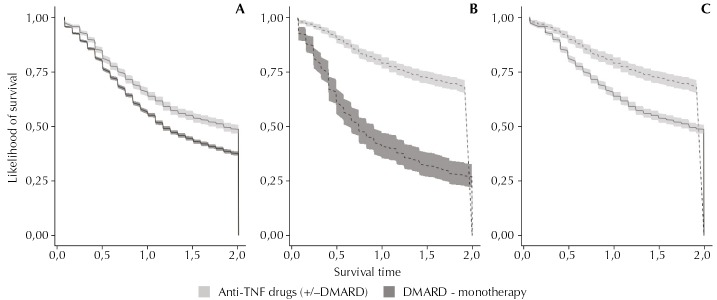
The study included 11,642 patients with rheumatoid arthritis - 2,241 of these started on anti-TNF drugs (+/-DMARD) and 9,401 patients started on DMARD - and 1,251 patients with ankylosing spondylitis - 976 of them were started on anti-TNF drugs (+/-DMARD) and 275 were started on DMARD. In the first year of follow-up, 63.5% of the patients persisted in their therapies with anti-TNF drugs (+/-DMARD) and 54.1% remained using DMARD in the group with rheumatoid arthritis. In regards to ankylosing spondylitis, 79.0% of the subjects in anti-TNF (+/-DMARD) group and 41.1% of the subjects in the DMARD group persisted with their treatments. The OR (95%CI) for therapy persistence was 1.50 (1.34-1.67) for the anti-TNF (+/-DMARD) group as compared with the DMARD group in the first year for the patients with rheumatoid arthritis, and 2.33 (1.74-3.11) for the patients with ankylosing spondylitis. A similar trend was observed at the end of the second year.
A general trend of higher rates of therapy persistence with anti-TNF drugs (+/-DMARD) was observed as compared to DMARD in the study period. We observed higher persistence rates for anti-TNF drugs (+/-DMARD) in patients with ankylosing spondylitis as compared to rheumatoid arthritis; and a higher persistence for DMARD in patients with rheumatoid arthritis as compared to ankylosing spondylitis.
Avaliar a persistência do tratamento em pacientes com artrite reumatoide e espondilite anquilosante que iniciaram terapia com medicamentos modificadores do curso da doença (MMCD) e agentes bloqueadores do fator de necrose tumoral (anti-TNF).
MÉTODOS: Este estudo de coorte retrospectiva de julho de 2008 a setembro de 2013 avaliou a persistência na terapia, definida como o tempo do início até a descontinuação, permitindo-se um intervalo de até 30 dias entre o fim da prescrição e o início da prescrição seguinte. Odds ratio (OR) com intervalos de confiança de 95% (IC95%) foram calculados por meio de modelos de regressão logística para estimar a chance de apresentar persistência na terapia após o primeiro e os dois primeiros anos de seguimento.
Foram incluídos 11.642 pacientes com artrite reumatoide - 2.241 iniciaram uso de agentes anti-TNF (+/-MMCD) e 9.401 iniciaram MMCD - e 1.251 pacientes com espondilite anquilosante - 976 iniciaram uso de agentes anti-TNF (+/-MMCD) e 275 iniciaram MMCD. No primeiro ano de acompanhamento, 63,5% persistiram em terapia com anti-TNF (+/-MMCD) e 54,1% em uso de MMCD do grupo com artrite reumatoide. Em relação à espondilite anquilosante, 79,0% do grupo anti-TNF (+/-MMCD) e 41,1% do grupo MMCD persistiram no tratamento. O OR (IC95%) para persistência na terapia foi de 1,50 (1,34-1,67) para o grupo anti-TNF (+/-MMCD) comparado com MMCD no primeiro ano em pacientes com artrite reumatoide, e de 2,33 (1,74-3,11) em pacientes com espondilite anquilosante. Foi observada tendência semelhante ao final do segundo ano.
CONCLUSÕES: Observou-se uma tendência geral de taxas mais elevadas de persistência na terapia com anti-TNF (+/-MMCD) em relação a MMCD no período estudado. Foram observadas taxas de persistência mais elevadas para os usuários de anti-TNF (+/-MMCD) em pacientes com espondilite anquilosante em relação a artrite reumatoide, e maior persistência para MMCD em pacientes com artrite reumatoide em relação à espondilite anquilosante.
评估开始使用改善病情抗风湿药(DMARD)和肿瘤坏死因子阻滞剂(抗TNF药物)治疗的类风湿关节炎和强直性脊柱炎患者的治疗持续性。
这项2008年7月至2013年9月的回顾性队列研究评估了治疗持续性,其定义为从开始治疗到停药的时间段,允许在处方结束和下一次处方开始之间有长达30天的间隔。通过逻辑回归模型计算比值比(OR)及其95%置信区间(95%CI),以估计患者在随访的第一年和前两年后持续治疗的机会。
该研究纳入了11642例类风湿关节炎患者——其中2241例开始使用抗TNF药物(±DMARD),9401例开始使用DMARD;以及1251例强直性脊柱炎患者——其中976例开始使用抗TNF药物(±DMARD),275例开始使用DMARD。在随访的第一年,类风湿关节炎组中63.5%的患者持续使用抗TNF药物(±DMARD)治疗,54.1%的患者仍在使用DMARD。对于强直性脊柱炎,抗TNF(±DMARD)组中79.0%的受试者和DMARD组中41.1%的受试者持续接受治疗。在类风湿关节炎患者中,抗TNF(±DMARD)组在第一年的治疗持续性OR(95%CI)为1.50(1.34 - 1.67),与DMARD组相比,强直性脊柱炎患者为2.33(1.74 - 3.11)。在第二年结束时观察到类似趋势。
在研究期间,观察到与DMARD相比,抗TNF药物(±DMARD)的治疗持续性总体上有更高的比率。我们观察到,与类风湿关节炎患者相比,强直性脊柱炎患者使用抗TNF药物(±DMARD)的持续性更高;与强直性脊柱炎患者相比,类风湿关节炎患者使用DMARD的持续性更高。
评估开始使用改变病情抗风湿药物(MMCD)和肿瘤坏死因子阻断剂(抗TNF)进行治疗的类风湿关节炎和强直性脊柱炎患者的治疗持续性。
这项2008年7月至2013年9月的回顾性队列研究评估了治疗持续性,定义为从开始到停药的时间,允许在处方结束和下一次处方开始之间有长达30天的间隔。通过逻辑回归模型计算95%置信区间(IC95%)的比值比(OR),以估计在随访的第一年和前两年后持续治疗的可能性。
纳入了11642例类风湿关节炎患者——2241例开始使用抗TNF药物(±MMCD),9401例开始使用MMCD;以及1251例强直性脊柱炎患者——976例开始使用抗TNF药物(±MMCD),275例开始使用MMCD。在随访的第一年,类风湿关节炎组中63.5%的患者持续使用抗TNF(±MMCD)治疗,54.1%的患者仍在使用MMCD。对于强直性脊柱炎,抗TNF(±MMCD)组中79.0%的受试者和MMCD组中41.1%的受试者持续接受治疗。在类风湿关节炎患者中,抗TNF(±MMCD)组在第一年的治疗持续性OR(IC95%)为1.50(1.34 - 1.67),与MMCD组相比,强直性脊柱炎患者为2.33(1.74 - 3.11)。在第二年结束时观察到类似趋势。
在研究期间,观察到与MMCD相比,抗TNF(±MMCD)治疗持续性的总体比率更高。与类风湿关节炎患者相比,强直性脊柱炎患者使用抗TNF(±MMCD)的持续性率更高;与强直性脊柱炎患者相比,类风湿关节炎患者使用MMCD的持续性更高。
