Rimland Joseph M, Abraha Iosief, Dell'Aquila Giuseppina, Cruz-Jentoft Alfonso, Soiza Roy, Gudmusson Adalsteinn, Petrovic Mirko, O'Mahony Denis, Todd Chris, Cherubini Antonio
Geriatrics and Geriatric Emergency Care, Italian National Research Center on Aging, Ancona, Italy.
Division of Geriatrics, Hospital Universitario Ramón y Cajal, Madrid, Spain.
PLoS One. 2016 Aug 25;11(8):e0161579. doi: 10.1371/journal.pone.0161579. eCollection 2016.
Falls are common events in older people, which cause considerable morbidity and mortality. Non-pharmacological interventions are an important approach to prevent falls. There are a large number of systematic reviews of non-pharmacological interventions, whose evidence needs to be synthesized in order to facilitate evidence-based clinical decision making.
To systematically examine reviews and meta-analyses that evaluated non-pharmacological interventions to prevent falls in older adults in the community, care facilities and hospitals.
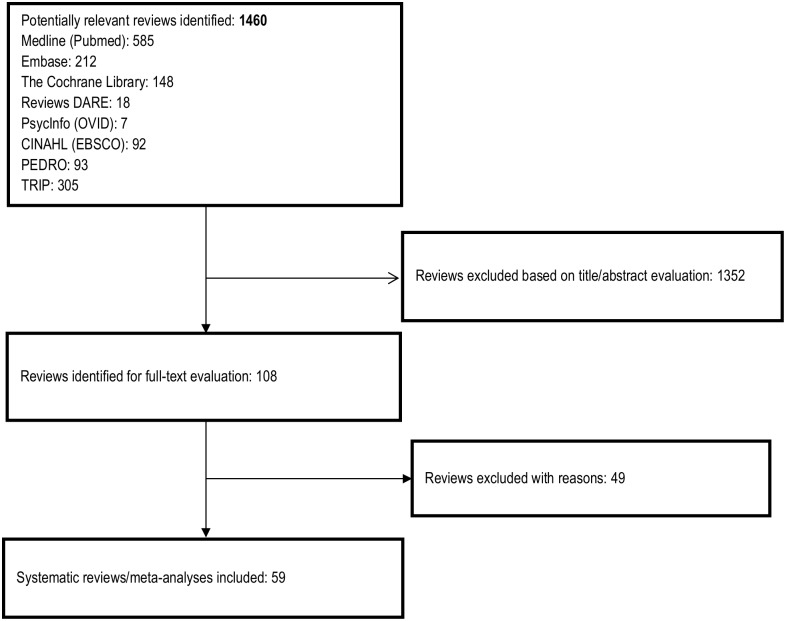
We searched the electronic databases Pubmed, the Cochrane Database of Systematic Reviews, EMBASE, CINAHL, PsycINFO, PEDRO and TRIP from January 2009 to March 2015, for systematic reviews that included at least one comparative study, evaluating any non-pharmacological intervention, to prevent falls amongst older adults. The quality of the reviews was assessed using AMSTAR and ProFaNE taxonomy was used to organize the interventions.
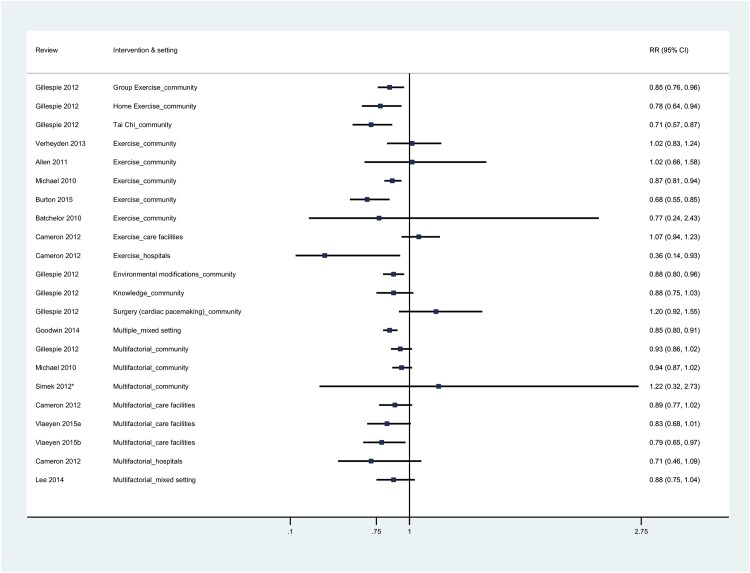
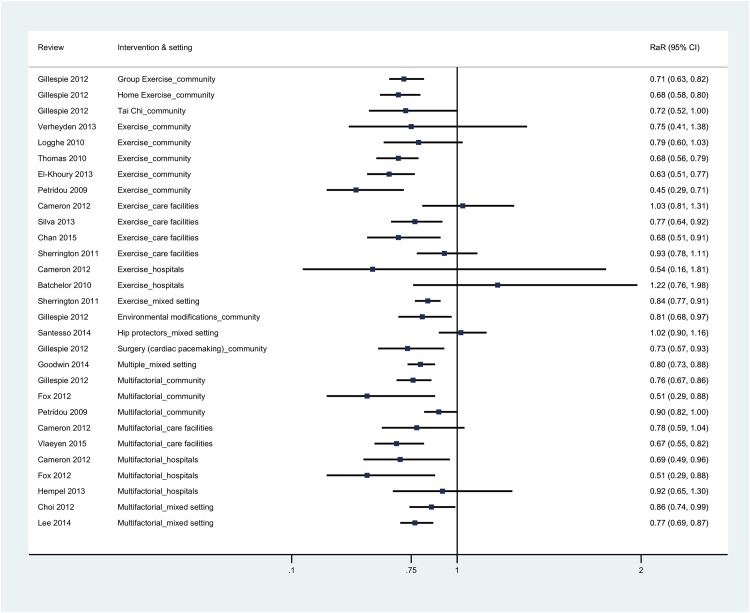
Fifty-nine systematic reviews were identified which consisted of single, multiple and multifactorial non-pharmacological interventions to prevent falls in older people. The most frequent ProFaNE defined interventions were exercises either alone or combined with other interventions, followed by environment/assistive technology interventions comprising environmental modifications, assistive and protective aids, staff education and vision assessment/correction. Knowledge was the third principle class of interventions as patient education. Exercise and multifactorial interventions were the most effective treatments to reduce falls in older adults, although not all types of exercise were equally effective in all subjects and in all settings. Effective exercise programs combined balance and strength training. Reviews with a higher AMSTAR score were more likely to contain more primary studies, to be updated and to perform meta-analysis.
The aim of this overview of reviews of non-pharmacological interventions to prevent falls in older people in different settings, is to support clinicians and other healthcare workers with clinical decision-making by providing a comprehensive perspective of findings.
跌倒在老年人中是常见事件,会导致相当高的发病率和死亡率。非药物干预是预防跌倒的重要方法。有大量关于非药物干预的系统评价,其证据需要整合以促进基于证据的临床决策。
系统审查评估社区、护理机构和医院中老年人预防跌倒的非药物干预的综述和荟萃分析。
我们检索了2009年1月至2015年3月的电子数据库PubMed、Cochrane系统评价数据库、EMBASE、CINAHL、PsycINFO、PEDRO和TRIP,以查找至少包含一项比较研究、评估任何预防老年人跌倒的非药物干预的系统评价。使用AMSTAR评估综述的质量,并使用ProFaNE分类法对干预措施进行组织。
共识别出59项系统评价,包括预防老年人跌倒的单一、多种和多因素非药物干预。ProFaNE定义的最常见干预措施是单独或与其他干预措施结合的运动,其次是环境/辅助技术干预,包括环境改造、辅助和防护用具、工作人员教育以及视力评估/矫正。知识作为患者教育是第三类主要干预措施。运动和多因素干预是减少老年人跌倒最有效的治疗方法,尽管并非所有类型的运动在所有受试者和所有环境中都同样有效。有效的运动计划结合了平衡和力量训练。AMSTAR评分较高的综述更有可能包含更多的原始研究、更新并进行荟萃分析。
本综述对不同环境中预防老年人跌倒的非药物干预进行综述的目的,是通过提供全面的研究结果视角来支持临床医生和其他医护人员进行临床决策。