
吸烟者与非吸烟者牙周炎患者血清促红细胞生成素水平的比较:一项生化研究。
Comparison of serum erythropoietin levels in smokers and nonsmokers with periodontitis: A biochemical study.
作者信息
Singh Vatsala, Tanwar Abhishek Singh, Hungund Arathi Shital, Hungund Shital Ajit, Nagaraja Chaitra
机构信息
Department of Periodontology, Darshan Dental College, Udaipur, Rajasthan, India.
Department of Dentistry, RNT Medical College, Udaipur, Rajasthan, India.
出版信息
J Indian Soc Periodontol. 2016 May-Jun;20(3):249-53. doi: 10.4103/0972-124X.181242.
AIMS
This study was carried out to compare serum erythropoietin (Epo) levels in smokers and nonsmokers with periodontitis.
MATERIALS AND METHODS
Fifty-one subjects of both sexes (age range: 30-65 years) with chronic periodontitis (CP) participated in this study. Seventeen patients with generalized CP, nonsmokers without anemia were included in Group I (control group), 17 patients with generalized CP, nonsmokers with anemia were included in Group II, and 17 patients who were smokers, having generalized CP were included in Group III. Peripheral blood samples were obtained and assessed for the number of erythrocytes (total red blood cell [TRBC]), hemoglobin (Hb), and Epo levels.
STATISTICAL ANALYSIS USED
One-way analysis of variance and Tukey-Kramer multiple comparisons test to assess the statistical difference between groups.
RESULTS
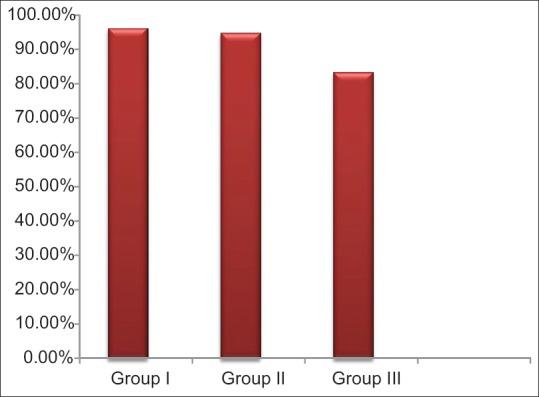
Epo levels varied considerably between the 3 groups. Highest values of Epo were seen in Group III with mean Epo value = 42.81 ± 15, followed by Group II Epo value = 35.21 ± 10.9, then Group I Epo value = 22.06 ± 4.19. Smokers in Group III with CP showed more prevalence toward higher values of Hb% (mean Hb = 12.06 ± 0.84) while there was no statistical difference in the values of TRBC values among the 3 groups (Group I TRBC value = 3.87 ± 0.38, Group II TRBC value = 4.01 ± 0.83, and Group III TRBC value = 3.88 ± 0.45).
CONCLUSION
Periodontitis patients were seen to have lower Epo values further strengthening the hypothesis that CP may lead to anemia of chronic disease. In smokers, higher Hb values were seen with higher Epo levels. It indicates that periodontitis individually and along with smoking may affect anemic status of smokers. Thus, Epo levels may be better means to assess anemic status of smokers than relying only on Hb values.
目的
本研究旨在比较患有牙周炎的吸烟者和非吸烟者的血清促红细胞生成素(Epo)水平。
材料与方法
51名患有慢性牙周炎(CP)的男女受试者(年龄范围:30 - 65岁)参与了本研究。17名患有广泛性CP的非吸烟且无贫血的患者被纳入第一组(对照组),17名患有广泛性CP的非吸烟且有贫血的患者被纳入第二组,17名患有广泛性CP的吸烟患者被纳入第三组。采集外周血样本并评估红细胞数量(总红细胞[TRBC])、血红蛋白(Hb)和Epo水平。
所用统计分析方法
采用单因素方差分析和Tukey - Kramer多重比较检验来评估组间的统计学差异。
结果
三组之间的Epo水平差异显著。Epo最高值出现在第三组,平均Epo值 = 42.81 ± 15,其次是第二组,Epo值 = 35.21 ± 10.9,然后是第一组,Epo值 = 22.06 ± 4.19。第三组患有CP的吸烟者中Hb%较高值的患病率更高(平均Hb = 12.06 ± 0.84),而三组之间的TRBC值无统计学差异(第一组TRBC值 = 3.87 ± 0.38,第二组TRBC值 = 4.01 ± 0.83,第三组TRBC值 = 3.88 ± 0.45)。
结论
牙周炎患者的Epo值较低,进一步强化了CP可能导致慢性病贫血的假说。在吸烟者中,Epo水平较高时Hb值也较高。这表明牙周炎单独以及与吸烟一起可能会影响吸烟者的贫血状态。因此,与仅依靠Hb值相比,Epo水平可能是评估吸烟者贫血状态的更好方法。

 Zotero 插件