• 文献检索
  • 文档翻译
  • 深度研究
  • 学术资讯
  • Suppr Zotero 插件Zotero 插件
  • 邀请有礼
  • 套餐&价格
  • 历史记录
应用&插件
Suppr Zotero 插件Zotero 插件浏览器插件Mac 客户端Windows 客户端微信小程序
定价
高级版会员购买积分包购买API积分包
服务
文献检索文档翻译深度研究API 文档MCP 服务
关于我们
关于 Suppr公司介绍联系我们用户协议隐私条款
关注我们

Suppr 超能文献

核心技术专利:CN118964589B侵权必究
粤ICP备2023148730 号-1Suppr @ 2026

文献检索

告别复杂PubMed语法,用中文像聊天一样搜索,搜遍4000万医学文献。AI智能推荐,让科研检索更轻松。

立即免费搜索

文件翻译

保留排版,准确专业,支持PDF/Word/PPT等文件格式,支持 12+语言互译。

免费翻译文档

深度研究

AI帮你快速写综述,25分钟生成高质量综述,智能提取关键信息,辅助科研写作。

立即免费体验

通过心踝血管指数监测的动脉僵硬度受阻塞性睡眠呼吸暂停、血糖控制和体重的影响——一项长达8年随访的病例研究。

Arterial stiffness, as monitored by cardio-ankle vascular index, is affected by obstructive sleep apnea, blood glucose control, and body weight - a case with 8 years follow up.

作者信息

Shimizu Kazuhiro, Yamamoto Tomoyuki, Shirai Kohji

机构信息

Department of Internal Medicine, Toho University Sakura Medical Center, Chiba, Japan.

Department of Vascular Function, Toho University Sakura Medical Center, Chiba, Japan; Biological Information Analysis Section, Fukuda Denshi Co., Ltd., Tokyo, Japan.

出版信息

Int Med Case Rep J. 2016 Aug 9;9:231-5. doi: 10.2147/IMCRJ.S113377. eCollection 2016.

DOI:10.2147/IMCRJ.S113377
PMID:27563259
原文链接:https://pmc.ncbi.nlm.nih.gov/articles/PMC4984825/
Abstract

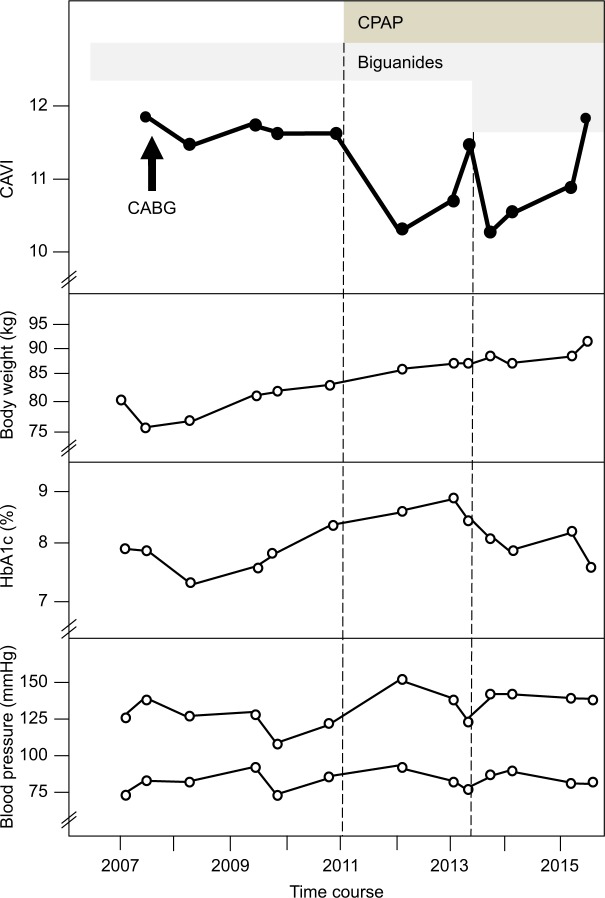
The cardio-ankle vascular index (CAVI) is an indicator of arterial stiffness from the heart to the ankles. The CAVI increases as arteriosclerosis progresses, but it can be decreased by appropriate treatment. There are several risk factors for coronary artery disease, however, the degree of stress caused by each separate risk factor to arteries cannot be assessed. CAVI increases with age and according to the severity of atherosclerosis. We found that CAVI also changes in response to the control of risk factors, which may be associated with the functional stiffness of arteries. CAVI can be a useful indicator of risk control for coronary artery disease. We followed a patient aged 71 years who had diabetes mellitus and obstructive sleep apnea (OSA) by measuring CAVI for 8 years from age 63. He underwent coronary artery bypass grafting due to angina pectoris when he was 63 years old. Before coronary artery bypass grafting, CAVI was 11.8 on the right and 11.5 on the left. Three years later he was found to have OSA and received treatment with continuous positive airway pressure. There was a marked improvement in CAVI after continuous positive airway pressure (age 68; right 10.4, left 10.2). However, following a gradual increase in body weight and worsening of diabetes mellitus, CAVI showed an increasing trend. CAVI decreased with biguanides treatment, but increased again with an increase in body weight. In conclusion, CAVI responded to the patient's conditions including obesity, diabetes mellitus, and OSA. CAVI is not only a marker of arterial stiffness, but can also be a useful indicator of physiological status; it may be effective in total risk control for coronary artery disease.

摘要

心踝血管指数(CAVI)是反映从心脏到脚踝动脉僵硬度的一个指标。随着动脉硬化的进展,CAVI会升高,但通过适当治疗可使其降低。冠状动脉疾病存在多种危险因素,然而,无法评估每个单独危险因素对动脉造成的压力程度。CAVI随年龄增长以及动脉粥样硬化的严重程度而升高。我们发现,CAVI也会因危险因素的控制而发生变化,这可能与动脉的功能性僵硬度有关。CAVI可能是冠状动脉疾病风险控制的一个有用指标。我们对一名71岁患有糖尿病和阻塞性睡眠呼吸暂停(OSA)的患者进行了跟踪,从其63岁起测量CAVI长达8年。他63岁时因心绞痛接受了冠状动脉搭桥手术。冠状动脉搭桥手术前,右侧CAVI为11.8,左侧为11.5。三年后,他被诊断出患有OSA,并接受了持续气道正压通气治疗。持续气道正压通气治疗后,CAVI有显著改善(68岁时;右侧10.4,左侧10.2)。然而,随着体重逐渐增加以及糖尿病病情恶化,CAVI呈上升趋势。使用双胍类药物治疗时CAVI下降,但随着体重增加又再次上升。总之,CAVI会因患者的肥胖、糖尿病和OSA等情况而发生变化。CAVI不仅是动脉僵硬度的一个标志物,还可能是生理状态有用的指标;它在冠状动脉疾病的总体风险控制中可能有效。
https://cdn.ncbi.nlm.nih.gov/pmc/blobs/67f2/4984825/09cc2e98857f/imcrj-9-231Fig1.jpg

相似文献

1
Arterial stiffness, as monitored by cardio-ankle vascular index, is affected by obstructive sleep apnea, blood glucose control, and body weight - a case with 8 years follow up.通过心踝血管指数监测的动脉僵硬度受阻塞性睡眠呼吸暂停、血糖控制和体重的影响——一项长达8年随访的病例研究。
Int Med Case Rep J. 2016 Aug 9;9:231-5. doi: 10.2147/IMCRJ.S113377. eCollection 2016.
2
Relationship between cardio-ankle vascular index and obstructive sleep apnea.心踝血管指数与阻塞性睡眠呼吸暂停的关系。
Rev Cardiovasc Med. 2020 Sep 30;21(3):353-363. doi: 10.31083/j.rcm.2020.03.67.
3
Relationship between Cardio-Ankle Vascular Index (CAVI) and Obstructive Sleep Apnea (OSA).心踝血管指数(CAVI)与阻塞性睡眠呼吸暂停(OSA)之间的关系。
J Med Assoc Thai. 2015 Feb;98(2):156-62.
4
Effects of weight reduction therapy on obstructive sleep apnea syndrome and arterial stiffness in patients with obesity and metabolic syndrome.减肥疗法对肥胖合并代谢综合征患者阻塞性睡眠呼吸暂停综合征及动脉僵硬度的影响。
J Atheroscler Thromb. 2013;20(11):807-20. doi: 10.5551/jat.17632. Epub 2013 Jul 25.
5
Cardio-ankle vascular index (CAVI) as a novel indicator of arterial stiffness: theory, evidence and perspectives.心血管踝臂指数(CAVI)作为一种新的动脉僵硬度指标:理论、证据和展望。
J Atheroscler Thromb. 2011;18(11):924-38. doi: 10.5551/jat.7716. Epub 2011 May 31.
6
Change in cardio-ankle vascular index by long-term continuous positive airway pressure therapy for obstructive sleep apnea.长期持续气道正压通气治疗阻塞性睡眠呼吸暂停对心踝血管指数的影响。
J Cardiol. 2011 Jul;58(1):74-82. doi: 10.1016/j.jjcc.2011.03.005. Epub 2011 May 28.
7
Establishment of the cardio-ankle vascular index in patients with obstructive sleep apnea.阻塞性睡眠呼吸暂停患者心脏-踝部血管指数的建立。
Chest. 2009 Sep;136(3):779-786. doi: 10.1378/chest.09-0178. Epub 2009 Jun 30.
8
New Horizons of Arterial Stiffness Developed Using Cardio-Ankle Vascular Index (CAVI).利用心踝血管指数(CAVI)开发的动脉僵硬度新指标。
J Atheroscler Thromb. 2020 Aug 1;27(8):732-748. doi: 10.5551/jat.RV17043. Epub 2020 Jun 26.
9
The Role of Monitoring Arterial Stiffness with Cardio-Ankle Vascular Index in the Control of Lifestyle-Related Diseases.用心脏-脚踝血管指数监测动脉僵硬度在控制生活方式相关疾病中的作用。
Pulse (Basel). 2015 Sep;3(2):118-33. doi: 10.1159/000431235. Epub 2015 Jun 20.
10
A Case Demonstrating the Cardio-Vascular Interaction by a New Cardio-Ankle Vascular Index During the Treatment of Concentric Hypertrophy.一例在治疗向心性肥厚过程中通过新型心踝血管指数展示心血管相互作用的病例
Cardiol Res. 2019 Feb;10(1):54-58. doi: 10.14740/cr812. Epub 2019 Feb 24.

引用本文的文献

1
Cardio-Vascular Interaction Evaluated by Speckle-Tracking Echocardiography and Cardio-Ankle Vascular Index in Hypertensive Patients.应用斑点追踪超声心动图和心踝血管指数评估高血压患者的心血管相互作用。
Int J Mol Sci. 2022 Nov 21;23(22):14469. doi: 10.3390/ijms232214469.
2
Rapid Rise of Cardio-Ankle Vascular Index May Be a Trigger of Cerebro-Cardiovascular Events: Proposal of Smooth Muscle Cell Contraction Theory for Plaque Rupture.心血管踝臂指数的快速上升可能是脑心事件的触发因素:斑块破裂平滑肌细胞收缩理论的提出。
Vasc Health Risk Manag. 2021 Feb 12;17:37-47. doi: 10.2147/VHRM.S290841. eCollection 2021.
3
A Case Demonstrating the Cardio-Vascular Interaction by a New Cardio-Ankle Vascular Index During the Treatment of Concentric Hypertrophy.

本文引用的文献

1
Association of cardio-ankle vascular index with cardiovascular risk factors and cardiovascular events in metabolic syndrome patients.代谢综合征患者中心踝血管指数与心血管危险因素及心血管事件的关联
Medicina (Kaunas). 2015;51(3):152-158. doi: 10.1016/j.medici.2015.05.001. Epub 2015 Jun 16.
2
Cardio-ankle vascular index predicts for the incidence of cardiovascular events in obese patients: a multicenter prospective cohort study (Japan Obesity and Metabolic Syndrome Study: JOMS).心踝血管指数可预测肥胖患者心血管事件的发生率:一项多中心前瞻性队列研究(日本肥胖与代谢综合征研究:JOMS)。
Atherosclerosis. 2015 Oct;242(2):461-8. doi: 10.1016/j.atherosclerosis.2015.08.003. Epub 2015 Aug 8.
3
一例在治疗向心性肥厚过程中通过新型心踝血管指数展示心血管相互作用的病例
Cardiol Res. 2019 Feb;10(1):54-58. doi: 10.14740/cr812. Epub 2019 Feb 24.
Clinical assessment of arterial stiffness with cardio-ankle vascular index: theory and applications.
应用心踝血管指数进行动脉僵硬度的临床评估:理论与应用
J Hypertens. 2015 Sep;33(9):1742-57; discussion 1757. doi: 10.1097/HJH.0000000000000651.
4
Effects of body weight reduction on cardio-ankle vascular index (CAVI).体重减轻对心踝血管指数(CAVI)的影响。
Obes Res Clin Pract. 2013 Mar-Apr;7(2):e139-e145. doi: 10.1016/j.orcp.2011.08.154.
5
Effects of weight reduction therapy on obstructive sleep apnea syndrome and arterial stiffness in patients with obesity and metabolic syndrome.减肥疗法对肥胖合并代谢综合征患者阻塞性睡眠呼吸暂停综合征及动脉僵硬度的影响。
J Atheroscler Thromb. 2013;20(11):807-20. doi: 10.5551/jat.17632. Epub 2013 Jul 25.
6
Change in cardio-ankle vascular index by long-term continuous positive airway pressure therapy for obstructive sleep apnea.长期持续气道正压通气治疗阻塞性睡眠呼吸暂停对心踝血管指数的影响。
J Cardiol. 2011 Jul;58(1):74-82. doi: 10.1016/j.jjcc.2011.03.005. Epub 2011 May 28.
7
Improvement of cardio-ankle vascular index by glimepiride in type 2 diabetic patients.格列美脲改善 2 型糖尿病患者的踝臂血管指数。
Int J Clin Pract. 2010 Dec;64(13):1796-801. doi: 10.1111/j.1742-1241.2010.02399.x. Epub 2010 Oct 14.
8
Improvement of postprandial hyperglycemia and arterial stiffness upon switching from premixed human insulin 30/70 to biphasic insulin aspart 30/70.由预混人胰岛素 30/70 转换为门冬胰岛素 30/70 后对餐后高血糖和动脉僵硬度的改善。
Metabolism. 2011 Jan;60(1):78-85. doi: 10.1016/j.metabol.2010.06.001. Epub 2010 Jul 29.
9
Establishment of the cardio-ankle vascular index in patients with obstructive sleep apnea.阻塞性睡眠呼吸暂停患者心脏-踝部血管指数的建立。
Chest. 2009 Sep;136(3):779-786. doi: 10.1378/chest.09-0178. Epub 2009 Jun 30.
10
Metformin therapy and clinical uses.二甲双胍疗法及临床应用。
Diab Vasc Dis Res. 2008 Sep;5(3):157-67. doi: 10.3132/dvdr.2008.027.