Ying Shibo, Xiao Xiang, Chen Tianhui, Lou Jianlin
Institute of Occupational Diseases, Zhejiang Academy of Medical Sciences, Hangzhou 310013, China.
Department of Reproductive Physiology, Zhejiang Academy of Medical Sciences, Hangzhou 310013, China.
PPAR Res. 2016;2016:2612743. doi: 10.1155/2016/2612743. Epub 2016 Aug 2.
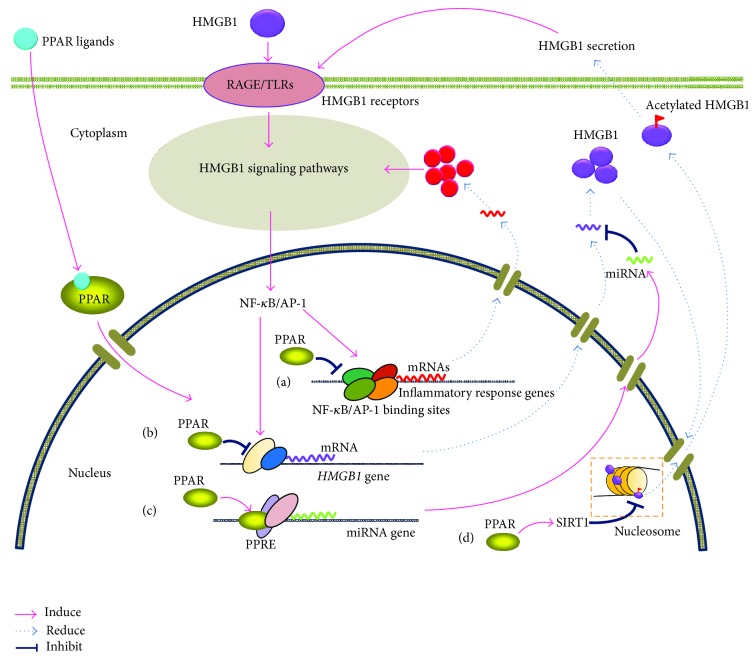
High mobility group box 1 (HMGB1), which has become one of the most intriguing molecules in inflammatory disorders and cancers and with which ligand-activated peroxisome proliferator-activated receptors (PPARs) are highly associated, is considered as a therapeutic target. Of particular interest is the fact that certain PPAR ligands have demonstrated their potent anti-inflammatory activities and potential anticancer effects. In this review article we summarize recent experimental evidence that PPAR ligands function as suppressors that target biological actions of HMGB1, including intracellular expression, receptor signaling cascades, and extracellular secretion of HMGB1 in cell lines and/or animal models. We also propose the possible mechanisms underlying PPAR involvement in inflammatory disorders and discuss the future therapeutic value of PPAR ligands targeting HMGB1 molecule for cancer prevention and treatment.
高迁移率族蛋白B1(HMGB1)已成为炎症性疾病和癌症中最引人关注的分子之一,且与配体激活的过氧化物酶体增殖物激活受体(PPARs)高度相关,它被视为一个治疗靶点。特别值得关注的是,某些PPAR配体已展现出强大的抗炎活性和潜在的抗癌作用。在这篇综述文章中,我们总结了近期的实验证据,即PPAR配体作为抑制剂,靶向HMGB1的生物学作用,包括细胞系和/或动物模型中HMGB1的细胞内表达、受体信号级联反应以及细胞外分泌。我们还提出了PPAR参与炎症性疾病的可能机制,并讨论了靶向HMGB1分子的PPAR配体在癌症预防和治疗方面的未来治疗价值。