Huang Chun-Ming, Huang Ming-Yii, Tsai Hsiang-Lin, Huang Ching-Wen, Ma Cheng-Jen, Yeh Yung-Sung, Juo Suh-Hang, Huang Chih-Jen, Wang Jaw-Yuan
Department of Radiation Oncology, Kaohsiung Medical University Hospital, Kaohsiung Medical University, Kaohsiung, Taiwan Graduate Institute of Medicine, College of Medicine, Kaohsiung Medical University, Kaohsiung, Taiwan.
Department of Radiation Oncology, Kaohsiung Medical University Hospital, Kaohsiung Medical University, Kaohsiung, Taiwan Department of Radiation Oncology, Faculty of Medicine, College of Medicine, Kaohsiung Medical University, Kaohsiung, Taiwan.
Therap Adv Gastroenterol. 2016 Sep;9(5):702-12. doi: 10.1177/1756283X16656690. Epub 2016 Jul 5.
Patients with rectal cancer who exhibit a pathologic complete response to preoperative concurrent chemoradiotherapy have excellent oncologic outcomes. In this study, we evaluated the potential advantages of adding oxaliplatin to preoperative fluoropyrimidine-based chemoradiotherapy administered in rectal cancer patients.
A total of 78 patients with rectal cancer were enrolled. Patients were administered chemoradiotherapy, which comprised radiotherapy and chemotherapy involving a 5-fluorouracil, leucovorin, and oxaliplatin regimen every 2 weeks. Surgery was performed 10-12 weeks after radiotherapy completion. Tumor regression, adverse events, surgical complications, and short-term clinical outcomes were recorded.
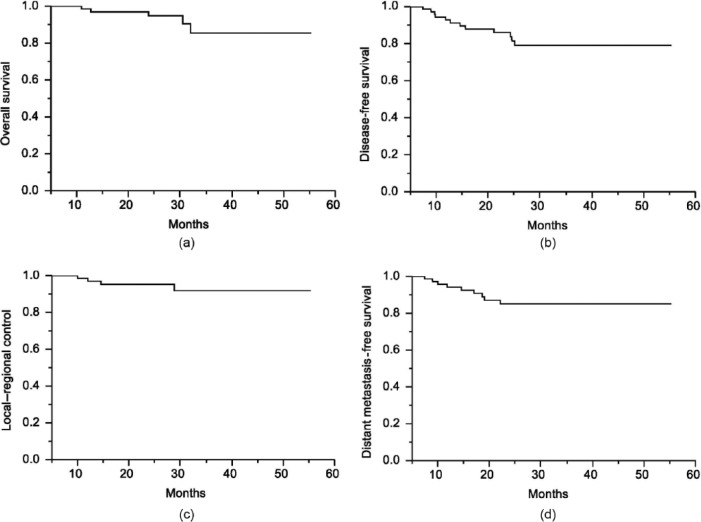
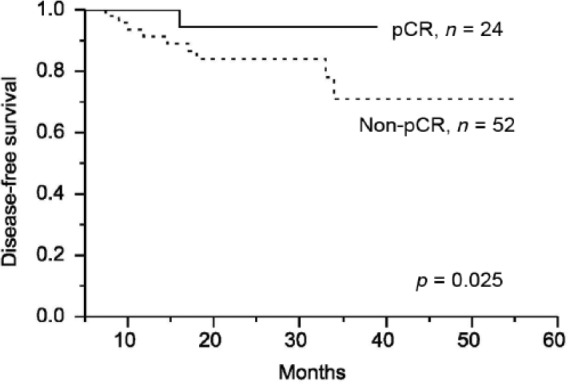
Two patients were excluded because of incomplete radiotherapy treatment or refusal of surgery. Eventually, 76 patients underwent total mesorectal excision and no perioperative mortality was observed. Of these, 20 patients (25.6%) developed grade 3 or 4 toxicity during concurrent chemoradiotherapy. Among the 76 patients who underwent surgery, 24 (31.6%) patients achieved a pathologic complete response. The sphincter preservation rate was 96.1% (73/76) in all patients and 92.2% (39/42) in patients with tumors located less than 5 cm from the anal verge. The 2-year overall and disease-free survivals were 94% and 87.4%, respectively.
The intensified multimodality therapy was well tolerated in our cohort and resulted in a considerably high pathologic complete response rate. Regardless of favorable short-term clinical outcomes, long-term oncologic outcomes will be closely monitored among the patients with a pathologic complete response.
对术前同步放化疗表现出病理完全缓解的直肠癌患者具有良好的肿瘤学结局。在本研究中,我们评估了在直肠癌患者术前基于氟嘧啶的放化疗中添加奥沙利铂的潜在优势。
共纳入78例直肠癌患者。患者接受放化疗,包括放疗和化疗,每2周采用氟尿嘧啶、亚叶酸钙和奥沙利铂方案。放疗结束后10 - 12周进行手术。记录肿瘤退缩情况、不良事件、手术并发症和短期临床结局。
2例患者因放疗治疗不完整或拒绝手术被排除。最终,76例患者接受了全直肠系膜切除术,未观察到围手术期死亡。其中,20例患者(25.6%)在同步放化疗期间出现3级或4级毒性反应。在接受手术的76例患者中,24例(31.6%)达到病理完全缓解。所有患者的括约肌保留率为96.1%(73/76),距肛缘小于5 cm的肿瘤患者的括约肌保留率为92.2%(39/42)。2年总生存率和无病生存率分别为94%和87.4%。
在我们的队列中,强化多模式治疗耐受性良好,并导致相当高的病理完全缓解率。尽管短期临床结局良好,但对于病理完全缓解的患者,将密切监测其长期肿瘤学结局。