Su Wei-Chih, Huang Ching-Wen, Ma Cheng-Jen, Chen Po-Jung, Tsai Hsiang-Lin, Chang Tsung-Kun, Chen Yen-Cheng, Li Ching-Chun, Yeh Yung-Sung, Wang Jaw-Yuan
Department of Surgery, Division of Colorectal Surgery, Kaohsiung Medical University Hospital, Kaohsiung Medical University, Kaohsiung, Taiwan.
Department of Surgery, Division of Colorectal Surgery; Department of Surgery, Faculty of Medicine, College of Medicine, Kaohsiung Medical University Hospital, Kaohsiung Medical University, Kaohsiung, Taiwan.
J Minim Access Surg. 2021 Apr-Jun;17(2):165-174. doi: 10.4103/jmas.JMAS_154_19.
Although surgical resection is the main treatment for rectal cancer, the optimal surgical protocol for elderly patients with rectal cancer remains controversial. This study evaluated the feasibility of robot-assisted surgery in elderly patients with rectal cancer.
This retrospective study enrolled 156 patients aged 28-93 years diagnosed with Stage I-III rectal cancer, who underwent robot-assisted surgery between May 2013 and December 2018 at a single institution.
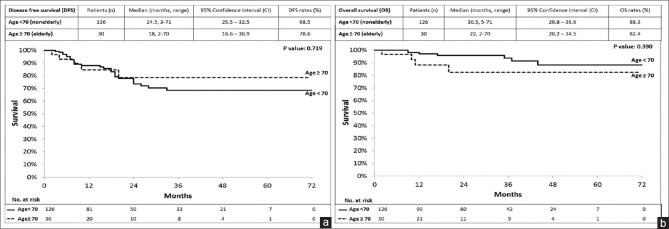
In total, 156 patients with rectal cancer, including 126 non-elderly (aged < 70 years) and 30 elderly (aged ≥70 years) patients, who underwent robot-assisted surgery were recruited. Between the patient groups, the post-operative length of hospital stay did not differ statistically significantly (P = 0.084). The incidence of overall post-operative complications was statistically significantly lower in the elderly group (P = 0.002). The disease-free and overall survival did not differ statistically significantly between the two groups (P = 0.719 and 0.390, respectively).
Robot-assisted surgery for rectal cancer was well tolerated by elderly patients, with similar results to the non-elderly patients. Oncological outcomes and survival did not depend on patient age, suggesting that robot-assisted surgery is a feasible surgical modality for treating operable rectal cancer and leads to age-independent post-operative outcomes in elderly patients.
尽管手术切除是直肠癌的主要治疗方法,但老年直肠癌患者的最佳手术方案仍存在争议。本研究评估了机器人辅助手术在老年直肠癌患者中的可行性。
这项回顾性研究纳入了156例年龄在28 - 93岁之间、诊断为I - III期直肠癌的患者,这些患者于2013年5月至2018年12月在一家机构接受了机器人辅助手术。
总共招募了156例接受机器人辅助手术的直肠癌患者,其中包括126例非老年患者(年龄<70岁)和30例老年患者(年龄≥70岁)。两组患者术后住院时间在统计学上无显著差异(P = 0.084)。老年组术后总体并发症发生率在统计学上显著更低(P = 0.002)。两组患者的无病生存率和总生存率在统计学上无显著差异(分别为P = 0.719和P = 0.390)。
老年患者对机器人辅助直肠癌手术耐受性良好,结果与非老年患者相似。肿瘤学结局和生存率不取决于患者年龄,这表明机器人辅助手术是治疗可切除直肠癌的一种可行手术方式,并且在老年患者中能带来与年龄无关的术后结局。