Mackay Mark T, Yock-Corrales Adriana, Churilov Leonid, Monagle Paul, Donnan Geoffrey A, Babl Franz E
From the Department of Neurology (M.T.M.) and Emergency Department (F.E.B.), Royal Children's Hospital Melbourne, Parkville, Australia; Murdoch Childrens Research Institute, Parkville, Australia (M.T.M., P.M., F.E.B.); Florey Institute of Neurosciences and Mental Health, Parkville, Australia (M.T.M., L.C., G.A.D.); Department of Pediatrics (M.T.M., P.M., F.E.B.) and Department of Medicine (L.C., G.A.D.), University of Melbourne, Parkville, Australia; Hospital Nacional de Ninos, San Jose, Costa Rica (A.Y.-C.); and Department of Haematology, Royal Children's Hospital, Parkville, Australia (P.M.).
Stroke. 2016 Oct;47(10):2476-81. doi: 10.1161/STROKEAHA.116.014179. Epub 2016 Sep 6.
Clinical identification of stroke in the pediatric emergency department is critical for improving access to hyperacute therapies. We identified key clinical features associated with childhood stroke or transient ischemic attack compared with mimics.
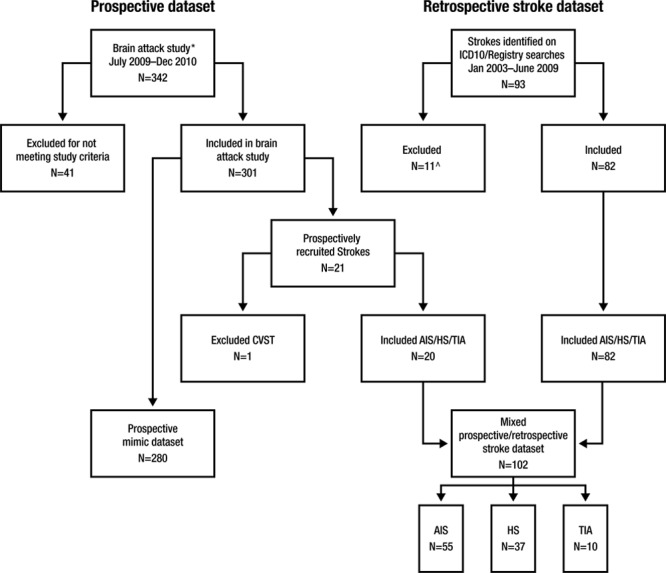
Two hundred and eighty consecutive children presenting to the emergency department with mimics, prospectively recruited over 18 months from 2009 to 2010, were compared with 102 children with stroke or transient ischemic attack, prospectively/retrospectively recruited from 2003 to 2010.
Cerebrovascular diagnoses included arterial ischemic stroke (55), hemorrhagic stroke (37), and transient ischemic attack (10). Mimic diagnoses included migraine (84), seizures (46), Bell's palsy (29), and conversion disorders (18). Being well in the week before presentation (odds ratio [OR] 5.76, 95% confidence interval [CI] 2.25-14.79), face weakness (OR 2.94, 95% CI 1.19-7.28), arm weakness (OR 8.66, 95% CI, 2.50-30.02), and inability to walk (OR 3.38, 95% CI 1.54-7.42) were independently associated with increased odds of stroke diagnosis. Other symptoms were independently associated with decreased odds of stroke diagnosis (OR 0.28, 95% CI 0.10-0.77). Associations were not observed between seizures or loss of consciousness. Factors associated with stroke differed by arterial and hemorrhagic subtypes.
Being well in the week before presentation, inability to walk, face and arm weakness are associated with increased odds of stroke. The lack of positive or negative association between stroke and seizures or loss of consciousness is an important difference to adults. Pediatric stroke pathways and bedside tools need to factor in differences between children and adults and between stroke subtypes.
在儿科急诊科对中风进行临床识别对于增加超急性治疗的可及性至关重要。我们确定了与儿童中风或短暂性脑缺血发作相关的关键临床特征,并与类似病症进行比较。
将2009年至2010年18个月期间前瞻性招募的280例连续因类似病症到急诊科就诊的儿童,与2003年至2010年期间前瞻性/回顾性招募的102例中风或短暂性脑缺血发作儿童进行比较。
脑血管疾病诊断包括动脉缺血性中风(55例)、出血性中风(37例)和短暂性脑缺血发作(10例)。类似病症诊断包括偏头痛(84例)、癫痫(46例)、贝尔麻痹(29例)和转换障碍(18例)。就诊前一周状态良好(比值比[OR]5.76,95%置信区间[CI]2.25 - 14.79)、面部无力(OR 2.94,95% CI 1.19 - 7.28)、手臂无力(OR 8.66,95% CI 2.50 - 30.02)以及无法行走(OR 3.38, 95% CI 1.54 - 7.42)与中风诊断几率增加独立相关。其他症状与中风诊断几率降低独立相关(OR 0.28,95% CI 0.10 - 0.77)。未观察到癫痫或意识丧失与中风之间的关联。与中风相关的因素在动脉型和出血型亚型之间有所不同。
就诊前一周状态良好、无法行走、面部和手臂无力与中风几率增加相关。中风与癫痫或意识丧失之间缺乏正相关或负相关是与成人的重要差异。儿科中风诊疗流程和床边工具需要考虑儿童与成人之间以及中风亚型之间的差异。