Al-Thani Mohamed Hamad, Al-Thani Al Anoud Mohammed, Cheema Sohaila, Sheikh Javaid, Mamtani Ravinder, Lowenfels Albert B, Al-Chetachi Walaa Fattah, Almalki Badria Ali, Hassan Khalifa Shamseldin Ali, Haj Bakri Ahmad Omar, Maisonneuve Patrick
Department of Public Health, Supreme Council of Health, Doha, Qatar.
Department of Global and Public Health, Weill Cornell Medical College, Doha, Qatar.
BMJ Open. 2016 Sep 6;6(9):e009514. doi: 10.1136/bmjopen-2015-009514.
To determine optimum measurements for abdominal obesity and to assess the prevalence and determinants of metabolic syndrome in Qatar.
National health survey.
Qatar National STEPwise Survey conducted by the Supreme Council of Health during 2012.
2496 Qatari citizens aged 18-64 representative of the general population.
Measure of obesity (body mass index, waist circumference or waist-to-height ratio) that best identified the presence of at least 2 other factors of metabolic syndrome; cut-off values of waist circumference; frequency of metabolic syndrome.
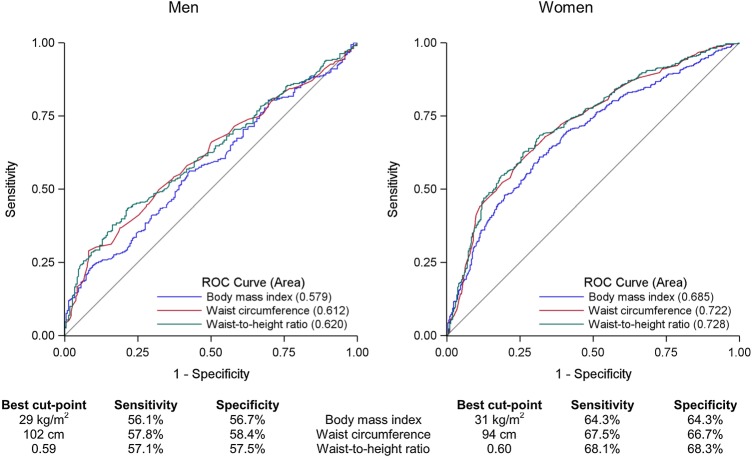
Waist circumference ≥102 for men and ≥94 cm for women was the best predictor of the presence of other determinants of metabolic syndrome (raised blood pressure, fasting blood glucose, triglycerides and reduced high-density lipoprotein cholesterol). Using these values, we identified 28% of Qataris with metabolic syndrome, which is considerably lower than the estimate of 37% calculated using the International Diabetes Federation (IDF) criteria. Restricting the analysis to participants without known elevated blood pressure, elevated blood sugar or diabetes 16.5% would be classified as having metabolic syndrome. In a multivariable logistic regression analysis, the prevalence of metabolic syndrome increased steadily with age (OR=3.40 (95% CI 2.02 to 5.74), OR=5.66 (3.65 to 8.78), OR=10.2 (5.98 to 17.6) and OR=18.2 (7.01 to 47.5) for those in the age group '30-39', '40-49', '50-59', '60-64' vs '18-29'; p<0.0001), decreased with increasing educational attainment (OR=0.61 (0.39 to 0.96) for those who attained 'secondary school or more' compared with 'less than primary school'; p=0.03) and exercise (OR=0.60 (0.42 to 0.86) for those exercising ≥3000 vs <600 MET-min/week; p=0.006) but was not associated with smoking or diet.
Waist circumference was the best measure of obesity to combine with other variables to construct a country-specific definition of metabolic syndrome in Qatar. Approximately 28% of adult Qatari citizens satisfy the criteria for metabolic syndrome, which increased significantly with age. Education and physical activity were inversely associated with this syndrome.
确定腹部肥胖的最佳测量指标,并评估卡塔尔代谢综合征的患病率及其决定因素。
全国健康调查。
2012年由最高卫生委员会开展的卡塔尔全国逐步调查。
2496名年龄在18 - 64岁之间、具有全国人口代表性的卡塔尔公民。
能最佳识别至少另外两种代谢综合征因素存在的肥胖测量指标(体重指数、腰围或腰高比);腰围的临界值;代谢综合征的发生率。
男性腰围≥102厘米、女性腰围≥94厘米是存在其他代谢综合征决定因素(血压升高、空腹血糖、甘油三酯升高和高密度脂蛋白胆固醇降低)的最佳预测指标。采用这些数值,我们识别出28%的卡塔尔人患有代谢综合征,这一比例显著低于采用国际糖尿病联盟(IDF)标准计算得出的37%的估计值。将分析限定于无已知高血压、高血糖或糖尿病的参与者,16.5%的人会被归类为患有代谢综合征。在多变量逻辑回归分析中,代谢综合征的患病率随年龄稳步上升(与“18 - 29岁”年龄组相比,“30 - 39岁”、“40 - 49岁”、“50 - 59岁”、“60 - 64岁”年龄组的比值比分别为3.40(95%可信区间2.02至5.74)、5.66(3.65至8.78)、10.2(5.98至17.6)和18.2(7.01至47.5);p<0.0001),随受教育程度的提高而降低(“中学及以上”学历者与“小学以下”学历者相比,比值比为0.61(0.39至0.96);p = 0.03),随运动量增加而降低(每周运动量≥3000代谢当量分钟者与<600代谢当量分钟者相比,比值比为0.60(0.42至0.86);p = 0.006),但与吸烟或饮食无关。
腰围是肥胖的最佳测量指标,可与其他变量结合以构建卡塔尔代谢综合征的特定国家定义。约28%的成年卡塔尔公民符合代谢综合征标准,且该比例随年龄显著增加。教育和体育活动与该综合征呈负相关。