Maier Claudia B, Barnes Hilary, Aiken Linda H, Busse Reinhard
Harkness & B. Braun Fellow in Healthcare Policy and Practice; Center for Health Outcomes and Policy, Research University of Pennsylvania, School of Nursing, Claire Fagin Hall, Philadelphia, Pennsylvania, USA Department of Healthcare Management, Technische Universität Berlin, Berlin, Germany.
Center for Health Outcomes and Policy Research, University of Pennsylvania, Philadelphia, Pennsylvania, USA.
BMJ Open. 2016 Sep 6;6(9):e011901. doi: 10.1136/bmjopen-2016-011901.
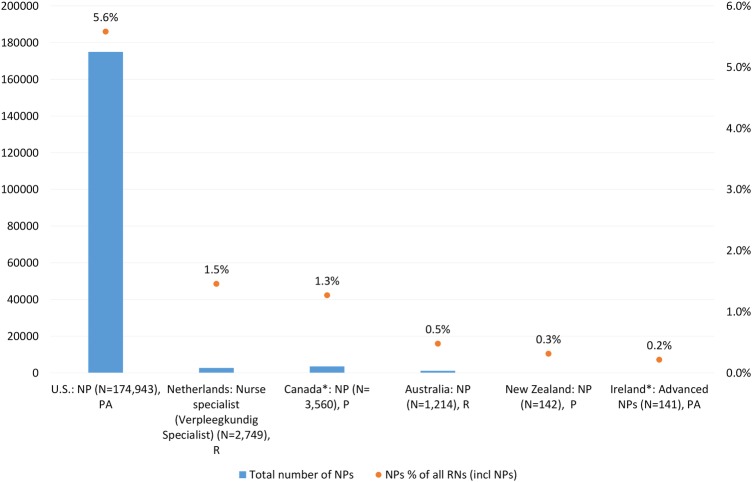
Many countries are facing provider shortages and imbalances in primary care or are projecting shortfalls for the future, triggered by the rise in chronic diseases and multimorbidity. In order to assess the potential of nurse practitioners (NPs) in expanding access, we analysed the size, annual growth (2005-2015) and the extent of advanced practice of NPs in 6 Organisation for Economic Cooperation and Development (OECD) countries.
Cross-country data analysis of national nursing registries, regulatory bodies, statistical offices data as well as OECD health workforce and population data, plus literature scoping review.
SETTING/PARTICIPANTS: NP and physician workforces in 6 OECD countries (Australia, Canada, Ireland, the Netherlands, New Zealand and USA).
The main outcomes were the absolute and relative number of NPs per 100 000 population compared with the nursing and physician workforces, the compound annual growth rates, annual and median percentage changes from 2005 to 2015 and a synthesis of the literature on the extent of advanced clinical practice measured by physician substitution effect.
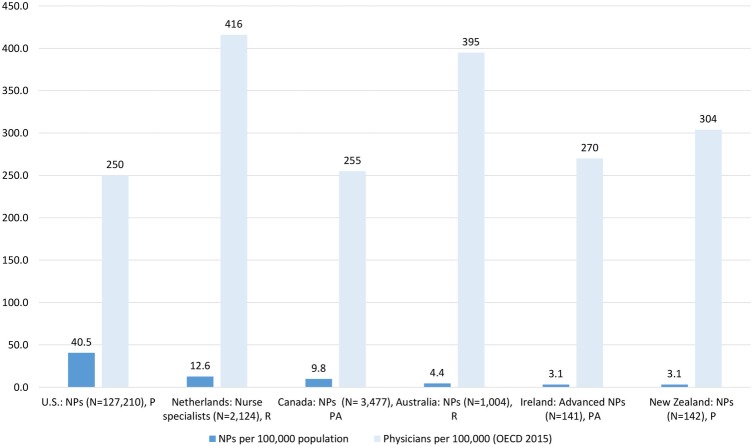
The USA showed the highest absolute number of NPs and rate per population (40.5 per 100 000 population), followed by the Netherlands (12.6), Canada (9.8), Australia (4.4), and Ireland and New Zealand (3.1, respectively). Annual growth rates were high in all countries, ranging from annual compound rates of 6.1% in the USA to 27.8% in the Netherlands. Growth rates were between three and nine times higher compared with physicians. Finally, the empirical studies emanating from the literature scoping review suggested that NPs are able to provide 67-93% of all primary care services, yet, based on limited evidence.
NPs are a rapidly growing workforce with high levels of advanced practice potential in primary care. Workforce monitoring based on accurate data is critical to inform educational capacity and workforce planning.
许多国家正面临基层医疗服务提供者短缺和失衡的问题,或者预计未来会出现短缺,这是由慢性病和多重疾病的增加引发的。为了评估执业护士(NP)在扩大医疗服务可及性方面的潜力,我们分析了6个经济合作与发展组织(OECD)国家中执业护士的规模、年增长率(2005 - 2015年)以及高级实践的程度。
对国家护理注册机构、监管机构、统计办公室数据以及经合组织卫生人力和人口数据进行跨国数据分析,外加文献范围综述。
背景/参与者:6个经合组织国家(澳大利亚、加拿大、爱尔兰、荷兰、新西兰和美国)的执业护士和医生劳动力。
主要结局是每10万人口中执业护士的绝对数量和相对数量,并与护士和医生劳动力进行比较,复合年增长率,2005年至2015年的年度和中位数百分比变化,以及通过医生替代效应衡量的高级临床实践程度的文献综述。
美国的执业护士绝对数量和人均比率最高(每10万人口中有40.5人),其次是荷兰(12.6人)、加拿大(9.8人)、澳大利亚(4.4人)以及爱尔兰和新西兰(分别为3.1人)。所有国家的年增长率都很高,从美国的年复合增长率6.1%到荷兰的27.8%不等。与医生相比,增长率高出三到九倍。最后,文献范围综述得出的实证研究表明,执业护士能够提供所有基层医疗服务的67% - 93%,然而,证据有限。
执业护士是一支快速增长的劳动力队伍,在基层医疗方面具有很高的高级实践潜力。基于准确数据的劳动力监测对于指导教育能力和劳动力规划至关重要。