Martin Georgina, Li Rachel, Cook Victoria E, Carwana Matthew, Tilley Peter, Sauve Laura, Tang Patrick, Kapur Akshat, Yang Connie L
Department of Pediatrics, University of Saskatchewan, Saskatoon, SK, Canada S7N 0W8.
Department of Pediatrics, British Columbia Children's Hospital, Vancouver, BC, Canada V6H 3V4.
Can Respir J. 2016;2016:8302179. doi: 10.1155/2016/8302179. Epub 2016 Aug 16.
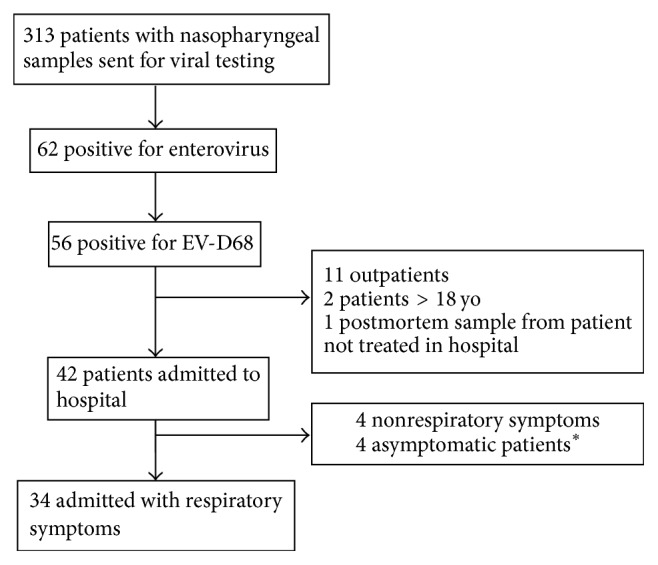
Background. In the fall of 2014, a North American outbreak of enterovirus D68 resulted in a significant number of pediatric hospital admissions for respiratory illness throughout North America. This study characterized the clinical presentation and risk factors for a severe clinical course in children admitted to British Columbia Children's Hospital during the 2014 outbreak. Methods. Retrospective chart review of patients with confirmed EV-D68 infection admitted to BCCH with respiratory symptoms in the fall of 2014. Past medical history, clinical presentation, management, and course in hospital was collected and analyzed using descriptive statistics. Comparison was made between those that did and did not require ICU admission to identify risk factors. Results. Thirty-four patients were included (median age 7.5 years). Fifty-three percent of children had a prior history of wheeze, 32% had other preexisting medical comorbidities, and 15% were previously healthy. Ten children (29%) were admitted to the pediatric intensive care unit. The presence of complex medical conditions (excluding wheezing) (P = 0.03) and copathogens was associated with PICU admission (P = 0.02). Conclusions. EV-D68 infection resulted in severe, prolonged presentations of asthma-like illness in the hospitalized pediatric population. Patients with a prior history of wheeze and preexisting medical comorbidities appear to be most severely affected, but the virus can also cause wheezing in previously well children.
背景。2014年秋季,北美地区爆发肠道病毒D68感染,导致北美各地大量儿童因呼吸道疾病入院治疗。本研究对2014年疫情期间入住不列颠哥伦比亚儿童医院的儿童的临床表现及重症临床病程的危险因素进行了特征描述。方法。对2014年秋季因呼吸道症状入住BCCH且确诊为EV-D68感染的患者进行回顾性病历审查。收集并使用描述性统计分析既往病史、临床表现、治疗及住院病程。对需要和不需要入住重症监护病房的患者进行比较,以确定危险因素。结果。共纳入34例患者(中位年龄7.5岁)。53%的儿童有喘息病史,32%有其他既往合并症,15%既往健康。10名儿童(29%)入住儿科重症监护病房。复杂疾病(不包括喘息)的存在(P = 0.03)和合并病原体与入住PICU相关(P = 0.02)。结论。EV-D68感染导致住院儿童出现严重、迁延的哮喘样疾病表现。有喘息病史和既往合并症的患者似乎受影响最严重,但该病毒也可导致既往健康儿童出现喘息。