Schütz L F, Schreiber N B, Gilliam J N, Cortinovis C, Totty M L, Caloni F, Evans J R, Spicer L J
Department of Animal Science, Oklahoma State University, Stillwater 74078.
Department of Veterinary Clinical Sciences, Oklahoma State University, Stillwater 74078.
J Dairy Sci. 2016 Nov;99(11):9143-9151. doi: 10.3168/jds.2015-10667. Epub 2016 Sep 7.
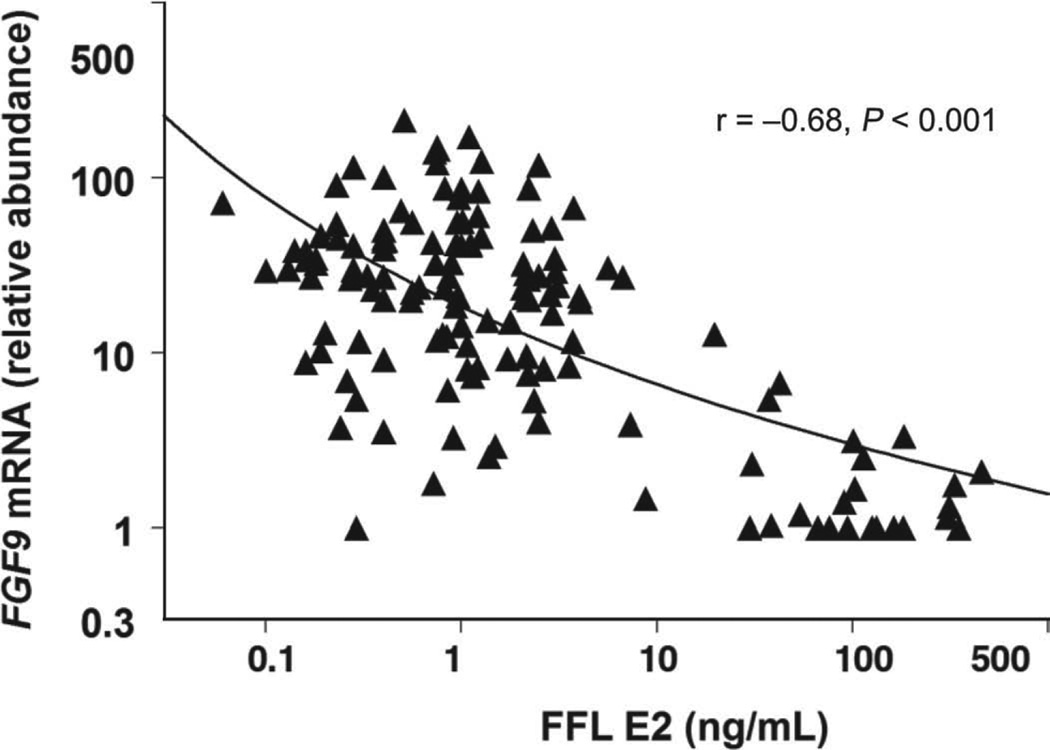
Fibroblast growth factor 9 (FGF9) has been suggested to act as an antidifferentiation factor in cattle by reducing steroidogenesis and increasing cell proliferation in granulosa (GC) and theca (TC) cells. The objective of this study was to characterize FGF9 mRNA abundance in GC and TC during development of dominant follicles in dairy cattle. Estrous cycles of nonlactating dairy cattle were synchronized, and ovaries were collected on either d 3 to 4 (n=8) or 5 to 6 (n=8) postovulation for GC and TC RNA extraction from small (1-5mm), medium (5.1-8mm), and large (8.1-18mm) follicles for PCR analysis. The FGF9 mRNA abundance was greater in GC than in TC. In GC, FGF9 mRNA abundance was greater in small, medium, and large estrogen-inactive [i.e., concentrations of estradiol (E2)<progesterone (P4)] follicles than in large E2-active (i.e., concentrations of E2>P4) follicles at both early (d 3-4) and late (d 5-6) growing phases of first dominant follicle. Abundance of FGF9 mRNA increased in medium-sized follicles from early to late growing phase of the dominant follicle. In TC, FGF9 mRNA abundance was greater in large E2-inactive follicles than in large E2-active follicles on d 3 to 4 postovulation; no significant differences in TC FGF9 mRNA existed among follicle types on d 5 to 6 postovulation. Correlations among levels of follicular fluid hormones and FGF9 mRNA levels revealed significant negative correlations between GC FGF9 mRNA abundance and follicular fluid E2 (r=-0.68), free IGF-1 (r=-0.63), and E2-to-P4 ratio (r=-0.58). In summary, abundance of FGF9 mRNA in GC and TC increases in medium-sized follicles during development of dominant follicles and is less in dominant E2-active than subordinate E2-inactive follicles, suggesting that FGF9 signaling could contribute to normal follicle development and steroidogenesis in dairy cattle.
成纤维细胞生长因子9(FGF9)被认为通过减少类固醇生成并增加颗粒细胞(GC)和卵泡膜细胞(TC)的细胞增殖,从而在牛中起到抗分化因子的作用。本研究的目的是在奶牛优势卵泡发育过程中,对GC和TC中的FGF9 mRNA丰度进行表征。对非泌乳奶牛的发情周期进行同步化处理,在排卵后第3至4天(n = 8)或第5至6天(n = 8)采集卵巢,从直径为1 - 5mm的小卵泡、5.1 - 8mm的中卵泡和8.1 - 18mm的大卵泡中提取GC和TC的RNA,用于PCR分析。GC中的FGF9 mRNA丰度高于TC。在GC中,在第一个优势卵泡的早期(第3 - 4天)和晚期(第5 - 6天)生长阶段,小、中、大雌激素非活性[即雌二醇(E2)浓度<孕酮(P4)]卵泡中的FGF9 mRNA丰度高于大E2活性(即E2浓度>P4)卵泡。优势卵泡从生长早期到晚期,中等大小卵泡中FGF9 mRNA丰度增加。在TC中,排卵后第3至4天,大E2非活性卵泡中的FGF9 mRNA丰度高于大E2活性卵泡;排卵后第5至6天,不同类型卵泡的TC FGF9 mRNA无显著差异。卵泡液激素水平与FGF9 mRNA水平之间的相关性显示,GC FGF9 mRNA丰度与卵泡液E2(r = -0.68)、游离胰岛素样生长因子-1(r = -0.63)和E2与P4的比值(r = -0.58)之间存在显著负相关。总之,在优势卵泡发育过程中,中等大小卵泡中GC和TC的FGF9 mRNA丰度增加,优势E2活性卵泡中的FGF9 mRNA丰度低于从属E2非活性卵泡,这表明FGF9信号可能有助于奶牛正常卵泡发育和类固醇生成。