Njunda Anna Longdoh, Njumkeng Charles, Nsagha Shey Dickson, Assob Jules Clement Nguedia, Kwenti Tebit Emmanuel
Department of Medical Laboratory Sciences, University of Buea, P.O. Box 63, Buea, Cameroon.
Department of Public Health and Hygiene, University of Buea, P.O. Box 63, Buea, Cameroon.
BMC Public Health. 2016 Sep 13;16:964. doi: 10.1186/s12889-016-3647-z.
Coinfection with malaria and HIV is common in Sub-Saharan Africa. In the advent of a decline in the global incidence of malaria, it is important to generate updated data on the burden of malaria in people living with HIV (PLWHIV). This study was designed to determine the prevalence of malaria in PLWHIV in Yaounde, Cameroon, as well determine the association between CD4 (+) T cell count and malaria in the study population.
In a cross sectional study performed between April 2015 and June 2016, 355 PLWHIV were enrolled and blood samples were collected for analysis. Complete blood count was performed using an automated haematology analyser (Mindray®, BC-2800) and CD4 (+) T cell count was performed using a flow cytometer (BD FASCount™). Giemsa-stained blood films were examined to detect malaria parasite. The Pearson's chi-square, student's T-test, ANOVA, and correlation analysis were all performed as part of the statistical analyses.
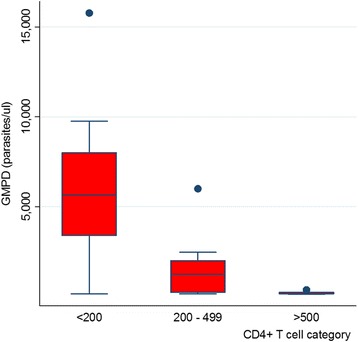
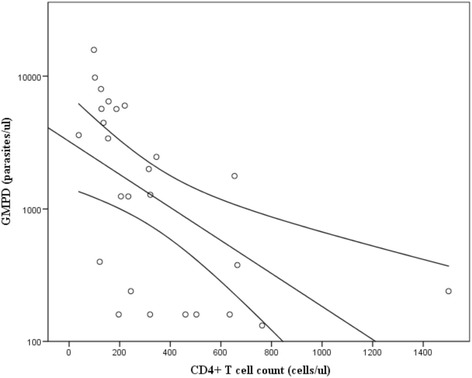
The prevalence of malaria observed in the study was 7.3 % (95 % CI: 4.8-10.6). No significant association was observed between the prevalence of malaria and age or gender. The prevalence of malaria was higher in participants who were not sleeping in insecticide treated bed nets, ITNs (p < 0.001); and in participants who were not on cotrimoxazole prophylaxis (p = 0.002). The prevalence of malaria (p < 0.001) and malaria parasite density (p = 0.005) were observed to be progressively higher in participants with CD4 (+) T cell count below 200cells/μl. Furthermore, the mean CD4 (+) T cell count was observed to be lower in participants coinfected with malaria compared to non-coinfected participants (323.5 vs 517.7) (p < 0.001). In this study, a negative correlation was observed between malaria parasite density and CD4 (+) T cell count (p = 0.019).
A low prevalence of malaria was observed in the study population. Some of the factors accounting for the low prevalence of malaria in this study population may include the health seeking habit of PLWHIV, the use of cotrimoxazole based chemoprophylaxis, and their cautious use of ITNs.
疟疾与艾滋病毒合并感染在撒哈拉以南非洲很常见。在全球疟疾发病率下降的情况下,获取有关艾滋病毒感染者(PLWHIV)疟疾负担的最新数据非常重要。本研究旨在确定喀麦隆雅温得PLWHIV中疟疾的患病率,并确定研究人群中CD4(+)T细胞计数与疟疾之间的关联。
在2015年4月至2016年6月进行的一项横断面研究中,招募了355名PLWHIV,并采集血样进行分析。使用自动血液分析仪(迈瑞®,BC - 2800)进行全血细胞计数,使用流式细胞仪(BD FASCount™)进行CD4(+)T细胞计数。检查吉姆萨染色的血涂片以检测疟原虫。作为统计分析的一部分,进行了Pearson卡方检验、学生t检验、方差分析和相关性分析。
研究中观察到的疟疾患病率为7.3%(95%CI:4.8 - 10.6)。未观察到疟疾患病率与年龄或性别之间存在显著关联。未睡在经杀虫剂处理的蚊帐(ITN)中的参与者疟疾患病率较高(p < 0.001);未接受复方新诺明预防的参与者疟疾患病率较高(p = 0.002)。CD4(+)T细胞计数低于200个细胞/μl的参与者中,疟疾患病率(p < 0.001)和疟原虫密度(p = 0.005)逐渐升高。此外,与未合并感染疟疾的参与者相比,合并感染疟疾的参与者的平均CD4(+)T细胞计数较低(323.5对517.7)(p < 0.001)。在本研究中,观察到疟原虫密度与CD4(+)T细胞计数之间存在负相关(p = 0.019)。
研究人群中疟疾患病率较低。本研究人群中疟疾患病率较低的一些因素可能包括PLWHIV的就医习惯、使用基于复方新诺明的化学预防措施以及谨慎使用ITN。