Ben May Department for Cancer Research, University of Chicago, Chicago, Illinois, United States of America.
Department of Oncology, University of Cambridge, Cambridge, United Kingdom.
PLoS One. 2013 Dec 11;8(12):e82125. doi: 10.1371/journal.pone.0082125. eCollection 2013.
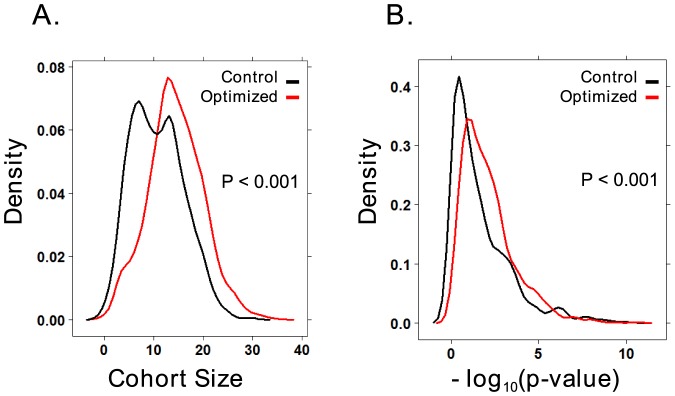
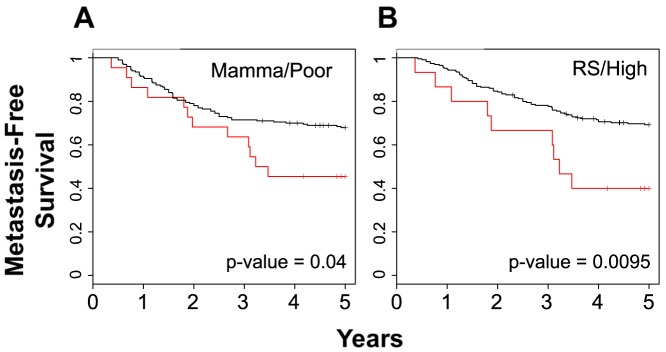
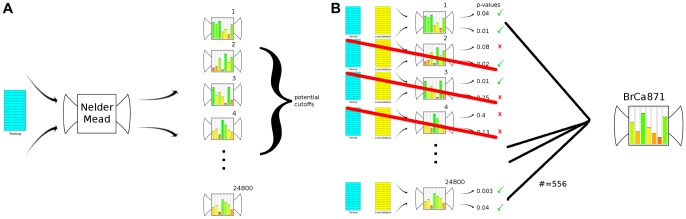
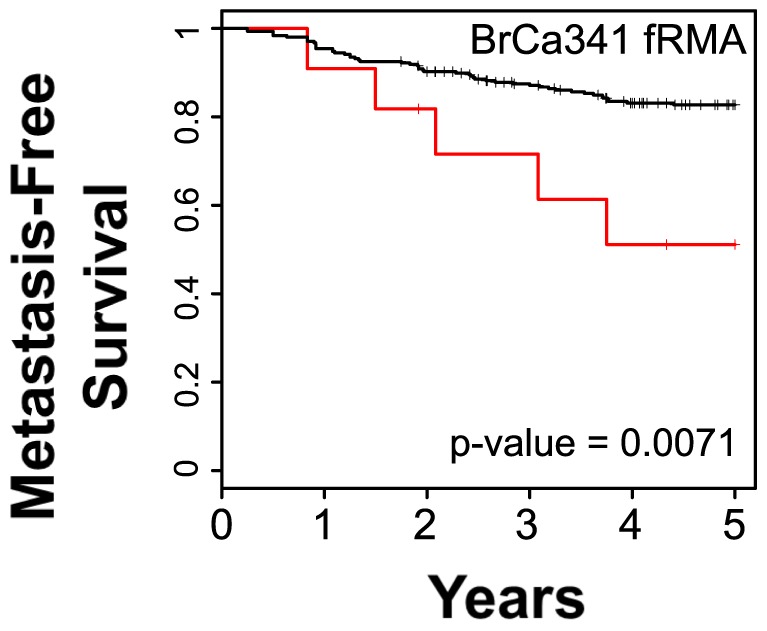
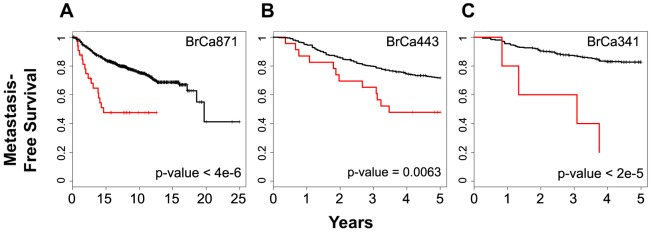
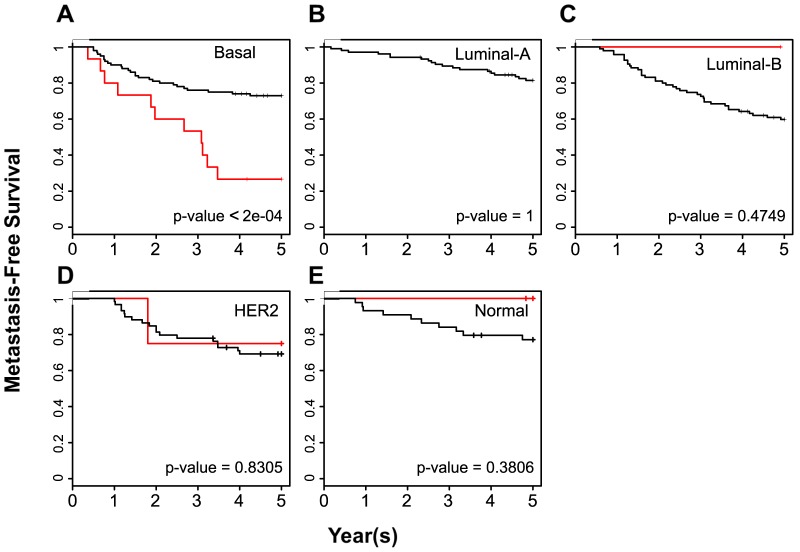
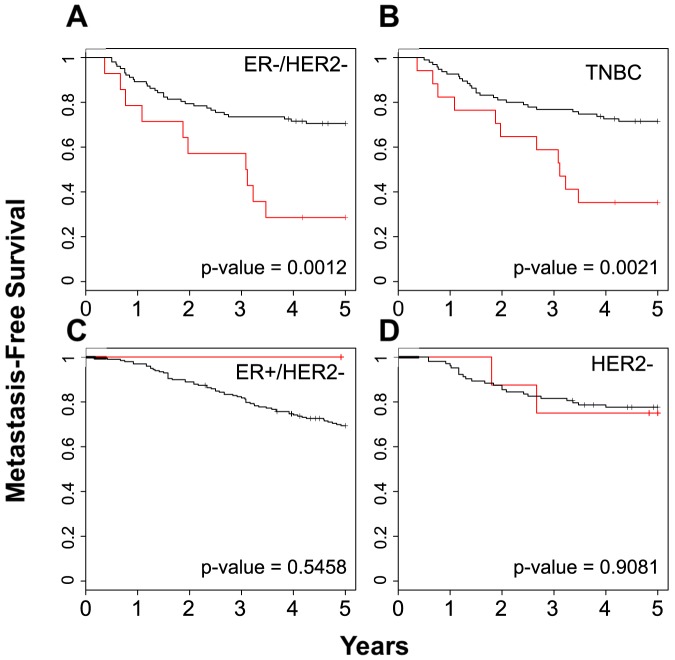
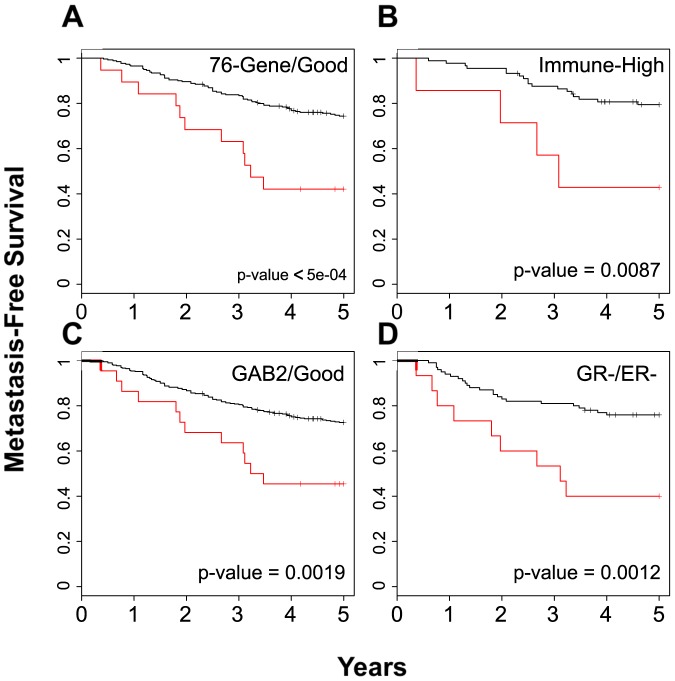
Although triple negative breast cancers (TNBC) are the most aggressive subtype of breast cancer, they currently lack targeted therapies. Because this classification still includes a heterogeneous collection of tumors, new tools to classify TNBCs are urgently required in order to improve our prognostic capability for high risk patients and predict response to therapy. We previously defined a gene expression signature, RKIP Pathway Metastasis Signature (RPMS), based upon a metastasis-suppressive signaling pathway initiated by Raf Kinase Inhibitory Protein (RKIP). We have now generated a new BACH1 Pathway Metastasis gene signature (BPMS) that utilizes targets of the metastasis regulator BACH1. Specifically, we substituted experimentally validated target genes to generate a new BACH1 metagene, developed an approach to optimize patient tumor stratification, and reduced the number of signature genes to 30. The BPMS significantly and selectively stratified metastasis-free survival in basal-like and, in particular, TNBC patients. In addition, the BPMS further stratified patients identified as having a good or poor prognosis by other signatures including the Mammaprint® and Oncotype® clinical tests. The BPMS is thus complementary to existing signatures and is a prognostic tool for high risk ER-HER2- patients. We also demonstrate the potential clinical applicability of the BPMS as a single sample predictor. Together, these results reveal the potential of this pathway-based BPMS gene signature to identify high risk TNBC patients that can respond effectively to targeted therapy, and highlight BPMS genes as novel drug targets for therapeutic development.
尽管三阴性乳腺癌(TNBC)是乳腺癌中最具侵袭性的亚型,但目前缺乏针对其的靶向治疗方法。由于这种分类仍然包含了异质性的肿瘤集合,因此迫切需要新的工具来对 TNBC 进行分类,以便提高我们对高危患者的预后能力,并预测对治疗的反应。我们之前基于由 Raf 激酶抑制剂蛋白 (RKIP) 启动的抑制转移信号通路,定义了一个基因表达特征,RKIP 通路转移特征签名(RPMS)。现在,我们生成了一个新的 BACH1 通路转移基因签名(BPMS),它利用了转移调节剂 BACH1 的靶标。具体来说,我们用经过实验验证的靶基因替换,生成了一个新的 BACH1 元基因,开发了一种优化患者肿瘤分层的方法,并将签名基因的数量减少到 30 个。BPMS 显著且选择性地对基底样和特别是 TNBC 患者的无转移生存进行分层。此外,BPMS 进一步分层了其他签名(包括 Mammaprint®和 Oncotype®临床测试)确定为预后良好或不良的患者。因此,BPMS 是对现有签名的补充,是 ER-HER2-患者高危风险的预后工具。我们还证明了 BPMS 作为单个样本预测器的潜在临床适用性。综上所述,这些结果揭示了基于该通路的 BPMS 基因签名在识别能够对靶向治疗有效反应的高危 TNBC 患者方面的潜力,并强调了 BPMS 基因作为治疗开发的新药物靶点的潜力。