Clemente Diana B P, Casas Maribel, Vilahur Nadia, Begiristain Haizea, Bustamante Mariona, Carsin Anne-Elie, Fernández Mariana F, Fierens Frans, Gyselaers Wilfried, Iñiguez Carmen, Janssen Bram G, Lefebvre Wouter, Llop Sabrina, Olea Nicolás, Pedersen Marie, Pieters Nicky, Santa Marina Loreto, Souto Ana, Tardón Adonina, Vanpoucke Charlotte, Vrijheid Martine, Sunyer Jordi, Nawrot Tim S
Center for Environmental Sciences, Hasselt University, Diepenbeek, Belgium.
Environ Health Perspect. 2016 May;124(5):659-65. doi: 10.1289/ehp.1408981. Epub 2015 Aug 28.
Mitochondria are sensitive to environmental toxicants due to their lack of repair capacity. Changes in mitochondrial DNA (mtDNA) content may represent a biologically relevant intermediate outcome in mechanisms linking air pollution and fetal growth restriction.
We investigated whether placental mtDNA content is a possible mediator of the association between prenatal nitrogen dioxide (NO2) exposure and birth weight.
We used data from two independent European cohorts: INMA (n = 376; Spain) and ENVIRONAGE (n = 550; Belgium). Relative placental mtDNA content was determined as the ratio of two mitochondrial genes (MT-ND1 and MTF3212/R3319) to two control genes (RPLP0 and ACTB). Effect estimates for individual cohorts and the pooled data set were calculated using multiple linear regression and mixed models. We also performed a mediation analysis.
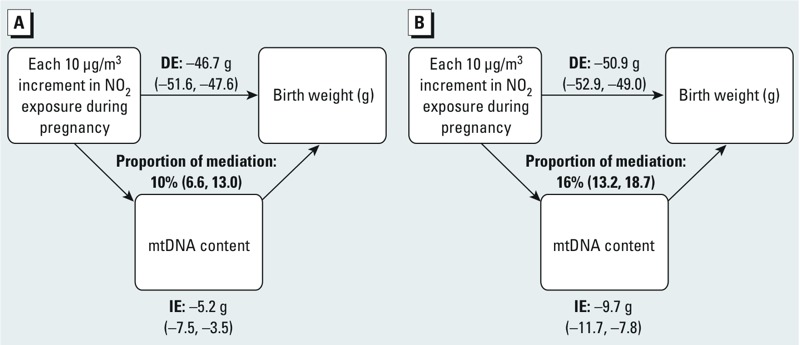
Pooled estimates indicated that a 10-μg/m3 increment in average NO2 exposure during pregnancy was associated with a 4.9% decrease in placental mtDNA content (95% CI: -9.3, -0.3%) and a 48-g decrease (95% CI: -87, -9 g) in birth weight. However, the association with birth weight was significant for INMA (-66 g; 95% CI: -111, -23 g) but not for ENVIRONAGE (-20 g; 95% CI: -101, 62 g). Placental mtDNA content was associated with significantly higher mean birth weight (pooled analysis, interquartile range increase: 140 g; 95% CI: 43, 237 g). Mediation analysis estimates, which were derived for the INMA cohort only, suggested that 10% (95% CI: 6.6, 13.0 g) of the association between prenatal NO2 and birth weight was mediated by changes in placental mtDNA content.
Our results suggest that mtDNA content can be one of the potential mediators of the association between prenatal air pollution exposure and birth weight.
Clemente DB, Casas M, Vilahur N, Begiristain H, Bustamante M, Carsin AE, Fernández MF, Fierens F, Gyselaers W, Iñiguez C, Janssen BG, Lefebvre W, Llop S, Olea N, Pedersen M, Pieters N, Santa Marina L, Souto A, Tardón A, Vanpoucke C, Vrijheid M, Sunyer J, Nawrot TS. 2016. Prenatal ambient air pollution, placental mitochondrial DNA content, and birth weight in the INMA (Spain) and ENVIRONAGE (Belgium) birth cohorts. Environ Health Perspect 124:659-665; http://dx.doi.org/10.1289/ehp.1408981.
线粒体由于缺乏修复能力,对环境毒物敏感。线粒体DNA(mtDNA)含量的变化可能是空气污染与胎儿生长受限之间联系机制中的一个生物学相关中间结果。
我们研究胎盘mtDNA含量是否是产前二氧化氮(NO₂)暴露与出生体重之间关联的一个可能中介因素。
我们使用了来自两个独立欧洲队列的数据:INMA队列(n = 376;西班牙)和ENVIRONAGE队列(n = 550;比利时)。相对胎盘mtDNA含量通过两个线粒体基因(MT-ND1和MTF3212/R3319)与两个对照基因(RPLP0和ACTB)的比值来确定。使用多元线性回归和混合模型计算各个队列及合并数据集的效应估计值。我们还进行了中介分析。
合并估计值表明,孕期平均NO₂暴露每增加10 μg/m³,胎盘mtDNA含量降低4.9%(95%置信区间:-9.3,-0.3%),出生体重降低48 g(95%置信区间:-87,-9 g)。然而,与出生体重的关联在INMA队列中显著(-66 g;95%置信区间:-111,-23 g),而在ENVIRONAGE队列中不显著(-20 g;95%置信区间:-101,62 g)。胎盘mtDNA含量与显著更高的平均出生体重相关(合并分析,四分位数间距增加:140 g;95%置信区间:43,237 g)。仅针对INMA队列得出的中介分析估计值表明,产前NO₂与出生体重之间关联的10%(95%置信区间:6.6,13.0 g)由胎盘mtDNA含量的变化介导。
我们的结果表明,mtDNA含量可能是产前空气污染暴露与出生体重之间关联的潜在中介因素之一。
Clemente DB, Casas M, Vilahur N, Begiristain H, Bustamante M, Carsin AE, Fernández MF, Fierens F, Gyselaers W, Iñiguez C, Janssen BG, Lefebvre W, Llop S, Olea N, Pedersen M, Pieters N, Santa Marina L, Souto A, Tardón A, Vanpoucke C, Vrijheid M, Sunyer J, Nawrot TS. 2016. Prenatal ambient air pollution, placental mitochondrial DNA content, and birth weight in the INMA (Spain) and ENVIRONAGE (Belgium) birth cohorts. Environ Health Perspect 124:659-665; http://dx.doi.org/10.1289/ehp.1408981.