Plawecki Maëlle, Lheritier Elise, Clavarino Giovanna, Jourde-Chiche Noémie, Ouili Saber, Paul Stéphane, Gout Evelyne, Sarrot-Reynauld Françoise, Bardin Nathalie, Boëlle Pierre-Yves, Chiche Laurent, Bouillet Laurence, Thielens Nicole M, Cesbron Jean-Yves, Dumestre-Pérard Chantal
Laboratoire d'Immunologie, pôle de Biologie, CHU Grenoble Alpes, Grenoble, France.
BNI team, TIMC-IMAG UMR5525 Université Grenoble Alpes, France.
PLoS One. 2016 Sep 15;11(9):e0160879. doi: 10.1371/journal.pone.0160879. eCollection 2016.
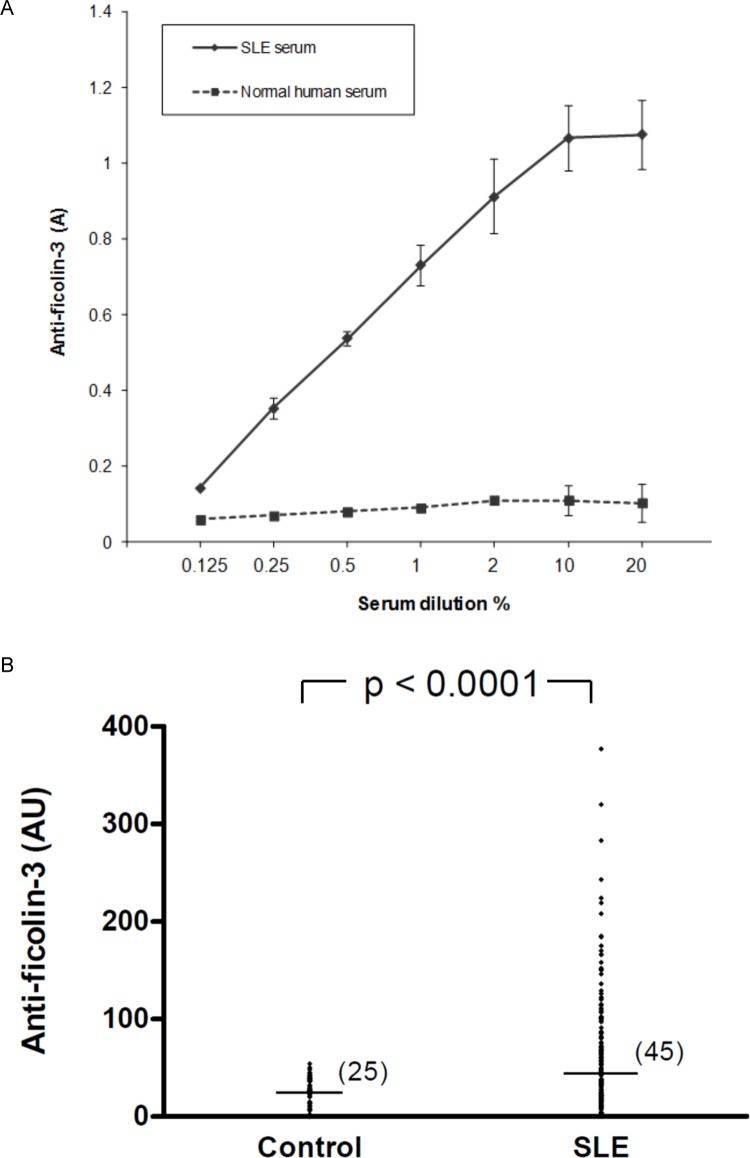
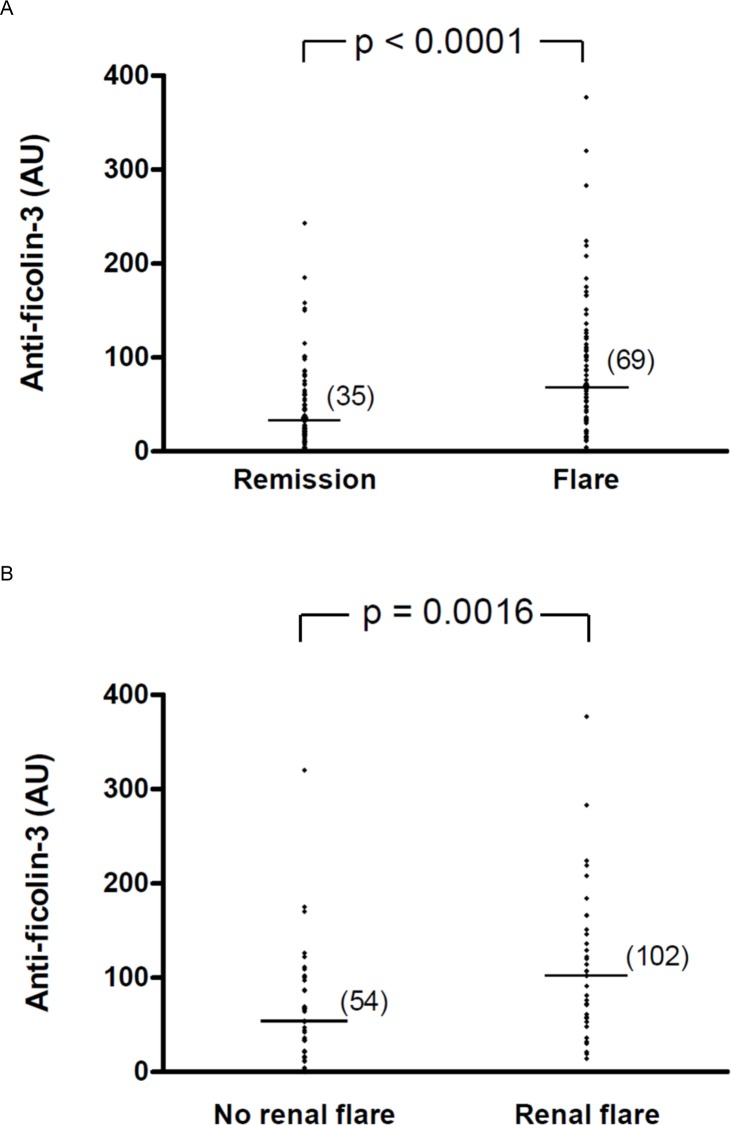
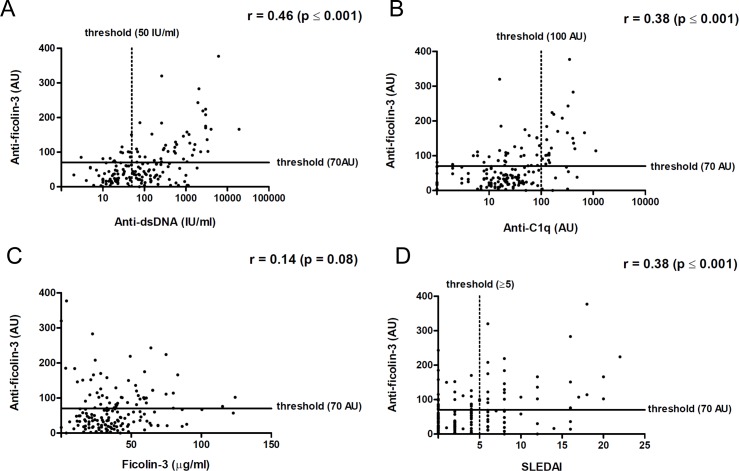
Systemic lupus erythematosus (SLE) is a chronic autoimmune disease characterized by the production of multiple autoantibodies. Antibodies against Ficolin-3 were previously identified in the sera of some SLE patients, but their prevalence and significance have not been yet investigated. The aims of this study were to determine the prevalence of anti-ficolin-3 antibodies among SLE patients and to investigate their potential as diagnostic and/or prognostic biomarkers in SLE. In this retrospective study, sera from SLE patients (n = 165) were selected from a preexisting declared biological collection. Samples from healthy controls (n = 48) were matched with SLE sera. Disease activity was determined according to the SLEDAI score. Anti-ficolin-3, anti-dsDNA and anti-C1q antibodies levels were measured in sera by ELISA. First, a highly significant difference was found in the anti-ficolin-3 levels between SLE patients and healthy subjects. Anti-ficolin-3 antibodies were detected as positive in 56 of 165 (34%) SLE patients. The titer of anti-ficolin-3 antibodies was correlated with the SLEDAI score (r = 0.38, p<0.0001). The presence of anti-ficolin-3 antibodies was associated with anti-C1q and anti-dsDNA antibodies. Regarding associations with clinical manifestations, the presence of active lupus nephritis was significantly associated with the presence of anti-ficolin-3 antibodies (p≤0.001). This association with renal involvement was higher with anti-ficolin-3 or anti-C1q antibodies than with other auto-antibodies. Interestingly, the combination of anti-ficolin-3 and anti-C1q antibodies demonstrated higher specificity than any other serological biomarker. These results suggest that anti-ficolin-3 antibodies could be useful for the diagnosis of active nephritis in SLE patients.
系统性红斑狼疮(SLE)是一种慢性自身免疫性疾病,其特征是产生多种自身抗体。先前在一些SLE患者的血清中鉴定出了抗Ficolin-3抗体,但它们的患病率和意义尚未得到研究。本研究的目的是确定SLE患者中抗Ficolin-3抗体的患病率,并研究其作为SLE诊断和/或预后生物标志物的潜力。在这项回顾性研究中,从预先存在的已申报生物样本库中选取了SLE患者(n = 165)的血清。健康对照(n = 48)的样本与SLE血清进行匹配。根据SLEDAI评分确定疾病活动度。通过ELISA检测血清中抗Ficolin-3、抗双链DNA和抗C1q抗体水平。首先,发现SLE患者和健康受试者之间抗Ficolin-3水平存在高度显著差异。165例SLE患者中有56例(34%)检测到抗Ficolin-3抗体呈阳性。抗Ficolin-3抗体的滴度与SLEDAI评分相关(r = 0.38,p<0.0001)。抗Ficolin-3抗体的存在与抗C1q和抗双链DNA抗体相关。关于与临床表现的关联,活动性狼疮肾炎的存在与抗Ficolin-3抗体的存在显著相关(p≤0.001)。抗Ficolin-3或抗C1q抗体与肾脏受累的这种关联高于其他自身抗体。有趣的是,抗Ficolin-3和抗C1q抗体的组合显示出比任何其他血清生物标志物更高的特异性。这些结果表明,抗Ficolin-3抗体可能有助于诊断SLE患者的活动性肾炎。