Karim Helmet, Tudorascu Dana Larisa, Aizenstein Howard, Walker Sarah, Good Rachel, Andreescu Carmen
Department of Bioengineering, University of Pittsburgh, Pittsburgh, PA.
Department of Psychiatry, University of Pittsburgh School of Medicine, Pittsburgh, PA; Department of Internal Medicine, University of Pittsburgh School of Medicine, Pittsburgh, PA; Biostatistics Department, University of Pittsburgh School of Medicine, Pittsburgh, PA.
Am J Geriatr Psychiatry. 2016 Nov;24(11):1040-1050. doi: 10.1016/j.jagp.2016.07.015. Epub 2016 Jul 21.
Generalized anxiety disorder (GAD) in older adults is associated with persistent deficits in emotion reactivity (ER) and regulation, yet the neural basis of these deficits has not been explored. This study focuses on the neural basis of ER deficits in late-life GAD and the association with cerebrovascular burden.
Twenty elderly nonanxious participants and 17 late-life GAD participants were included. The faces-shapes functional magnetic resonance imaging task was used to assess ER; the Hamilton Anxiety Rating Scale and the Penn State Worry Questionnaire to measure global anxiety and worry, respectively; linear regression models to examine the association between ER and global anxiety severity and between ER and worry severity; and mediation analysis to explore the effect of ER on the relationship between global anxiety/worry severity and cerebrovascular burden.
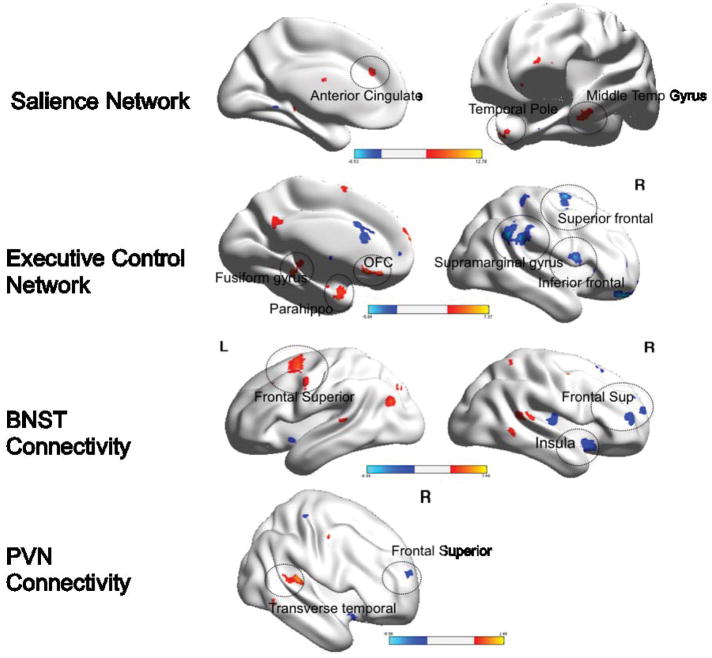
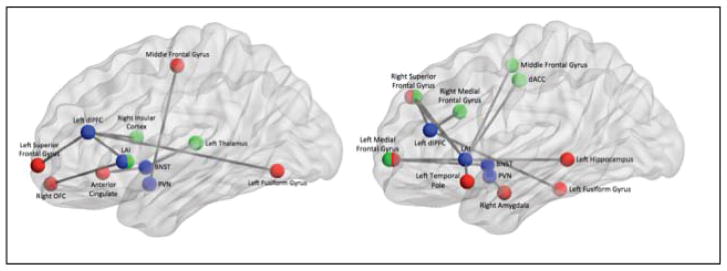
A positive association was found between ER and global anxiety in the left parahippocampus, left and right precuneus, and right superior occipital gyrus. A negative association was found between ER and worry severity in the left and right precuneus. The association between cerebrovascular burden and anxiety/worry severity was indirectly mediated by increased ER in limbic and paralimbic areas and by decreased ER in prefrontal regulatory regions.
These results indicate that ER is associated with different neural activation patterns for worry and global anxiety and that ER-related functional connectivity indirectly mediates the relationship between cerebrovascular burden and late-life GAD. This latter result supports a yet-unexplored cerebrovascular pathway involved in the pathophysiology of late-life anxiety.
老年人广泛性焦虑障碍(GAD)与情绪反应性(ER)及调节方面的持续性缺陷相关,但这些缺陷的神经基础尚未得到探究。本研究聚焦于老年期GAD中ER缺陷的神经基础及其与脑血管负担的关联。
纳入20名老年非焦虑参与者和17名老年期GAD参与者。采用面孔 - 形状功能磁共振成像任务评估ER;分别用汉密尔顿焦虑量表和宾夕法尼亚州立大学忧虑问卷测量总体焦虑和忧虑;用线性回归模型检验ER与总体焦虑严重程度之间以及ER与忧虑严重程度之间的关联;用中介分析探究ER对总体焦虑/忧虑严重程度与脑血管负担之间关系的影响。
在左侧海马旁回、左右楔前叶和右侧枕上回发现ER与总体焦虑呈正相关。在左右楔前叶发现ER与忧虑严重程度呈负相关。脑血管负担与焦虑/忧虑严重程度之间的关联由边缘和边缘旁区域ER增加以及前额叶调节区域ER减少间接介导。
这些结果表明,ER与忧虑和总体焦虑的不同神经激活模式相关,且与ER相关的功能连接间接介导了脑血管负担与老年期GAD之间的关系。后一结果支持了一条尚未被探索的、参与老年期焦虑病理生理学的脑血管途径。