Ellard Kristen K, Barlow David H, Whitfield-Gabrieli Susan, Gabrieli John D E, Deckersbach Thilo
Department of Psychiatry, Massachusetts General Hospital/Harvard Medical School, Boston, MA, USA.
Department of Psychology, Boston University, Boston, MA, USA.
Soc Cogn Affect Neurosci. 2017 Jun 1;12(6):1009-1021. doi: 10.1093/scan/nsx025.
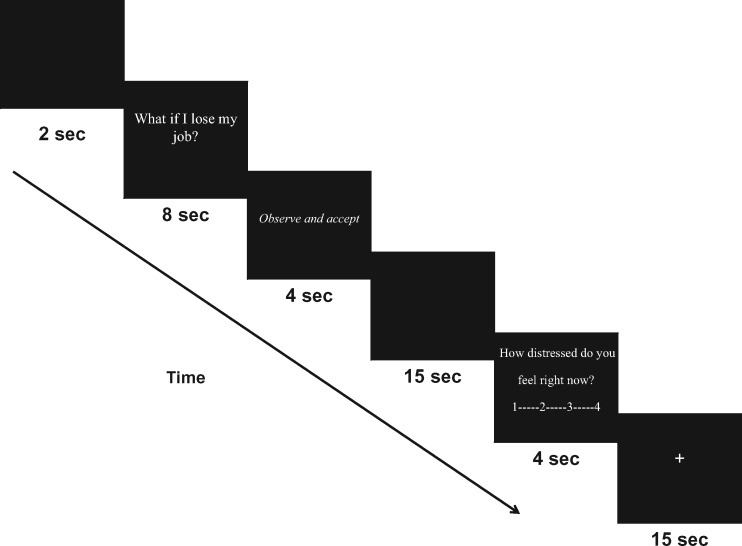
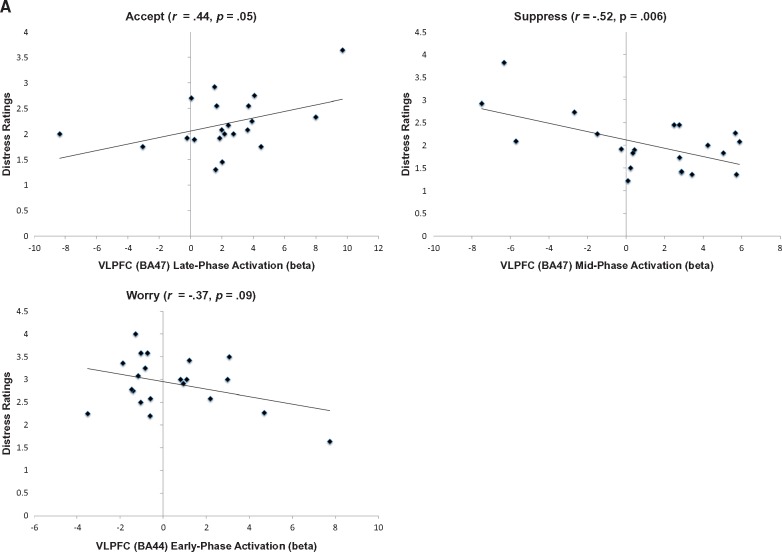
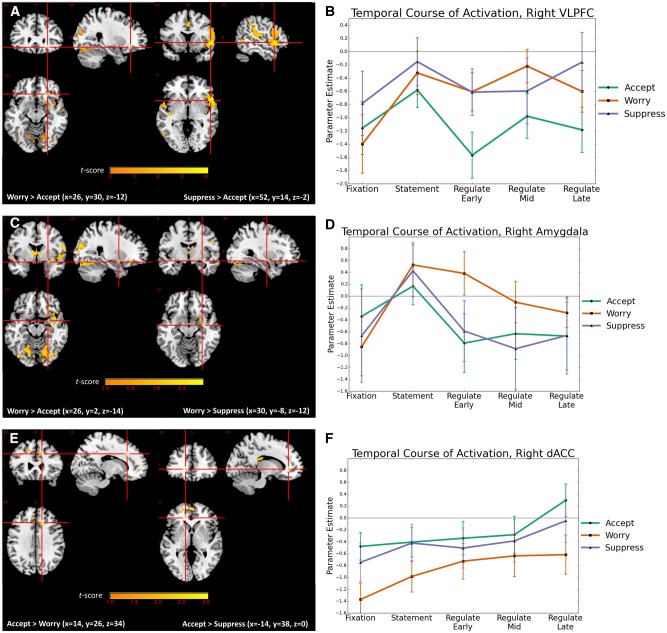
Recent emotion dysregulation models of generalized anxiety disorder (GAD) propose chronic worry in GAD functions as a maladaptive attempt to regulate anxiety related to uncertain or unpredictable outcomes. Emotion acceptance is an adaptive emotion regulation strategy increasingly incorporated into newer cognitive behavioral therapy (CBT) approaches to GAD to counter chronic worry. The current study explores the mechanisms of emotion acceptance as an alternate emotion regulation strategy to worry or emotion suppression using functional magnetic resonance imaging. Twenty-one female participants diagnosed with GAD followed counterbalanced instructions to regulate responses to personally relevant worry statements by engaging in either emotion acceptance, worry or emotion suppression. Emotion acceptance resulted in lower ratings of distress than worry and was associated with increased dorsal anterior cingulate cortex (dACC) activation and increased ventrolateral prefrontal cortex (VLPFC)-amygdala functional connectivity. In contrast, worry showed significantly greater distress ratings than acceptance or suppression and was associated with increased precuneus, VLPFC, amygdala and hippocampal activation. Suppression did not significantly differ from acceptance in distress ratings or amygdala recruitment, but resulted in significantly greater insula and VLPFC activation and decreased VLPFC-amygdala functional connectivity. Emotion acceptance closely aligned with activation and connectivity patterns reported in studies of contextual extinction learning and mindful awareness.
近期广泛性焦虑障碍(GAD)的情绪调节失调模型提出,GAD中的慢性担忧是一种适应不良的尝试,旨在调节与不确定或不可预测结果相关的焦虑。情绪接纳是一种适应性情绪调节策略,越来越多地被纳入到针对GAD的新型认知行为疗法(CBT)中,以对抗慢性担忧。本研究使用功能磁共振成像探索情绪接纳作为一种替代情绪调节策略(以替代担忧或情绪抑制)的机制。21名被诊断为GAD的女性参与者按照平衡指令,通过进行情绪接纳、担忧或情绪抑制来调节对个人相关担忧陈述的反应。与担忧相比,情绪接纳导致的痛苦评分更低,并且与背侧前扣带回皮质(dACC)激活增加以及腹外侧前额叶皮质(VLPFC)-杏仁核功能连接增加有关。相比之下,担忧的痛苦评分显著高于接纳或抑制,并且与楔前叶、VLPFC、杏仁核和海马体激活增加有关。抑制在痛苦评分或杏仁核激活方面与接纳没有显著差异,但导致岛叶和VLPFC激活显著增加,以及VLPFC-杏仁核功能连接减少。情绪接纳与情境消退学习和正念觉知研究中报告的激活和连接模式密切一致。