Emotion and Development Branch, National Institute of Mental Health, Bethesda, MD, USA.
Department of Psychiatry & Neuroscience Institute, University of Cape Town, Cape Town, South Africa.
Transl Psychiatry. 2021 Oct 1;11(1):502. doi: 10.1038/s41398-021-01622-1.
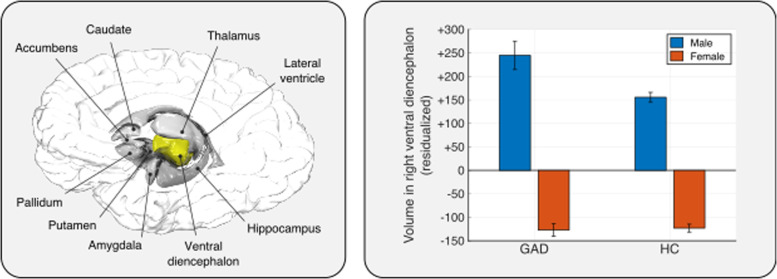
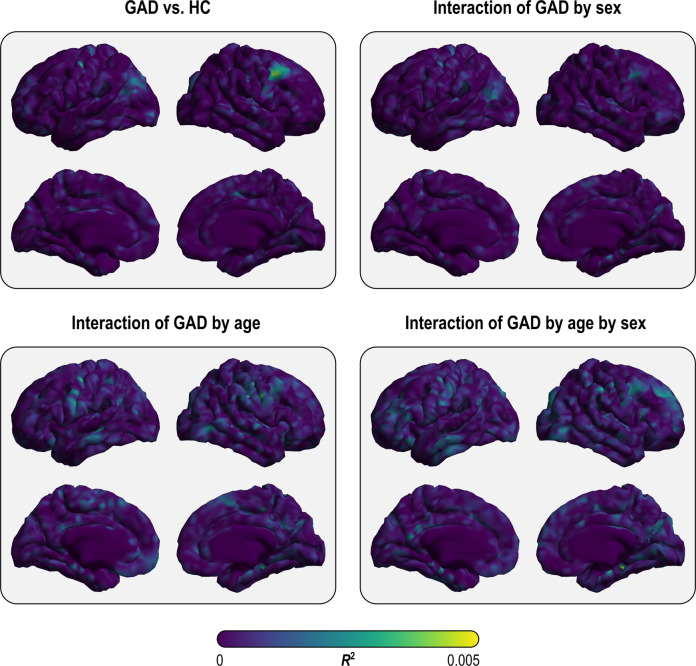
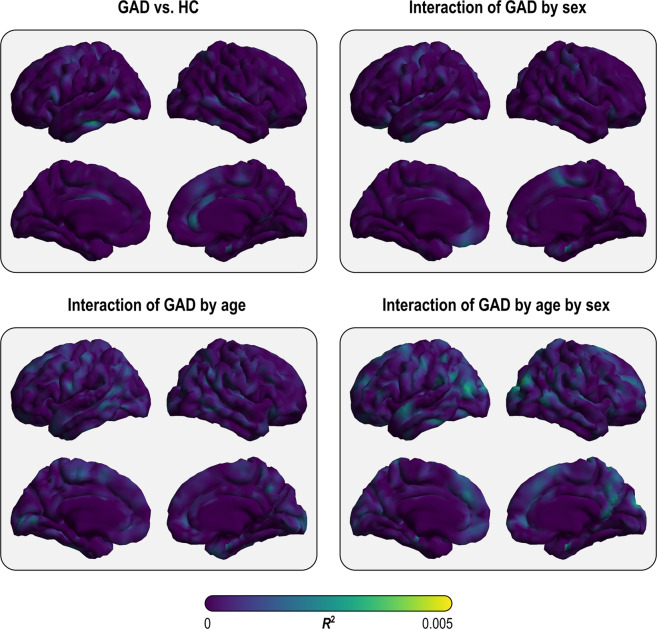
The goal of this study was to compare brain structure between individuals with generalized anxiety disorder (GAD) and healthy controls. Previous studies have generated inconsistent findings, possibly due to small sample sizes, or clinical/analytic heterogeneity. To address these concerns, we combined data from 28 research sites worldwide through the ENIGMA-Anxiety Working Group, using a single, pre-registered mega-analysis. Structural magnetic resonance imaging data from children and adults (5-90 years) were processed using FreeSurfer. The main analysis included the regional and vertex-wise cortical thickness, cortical surface area, and subcortical volume as dependent variables, and GAD, age, age-squared, sex, and their interactions as independent variables. Nuisance variables included IQ, years of education, medication use, comorbidities, and global brain measures. The main analysis (1020 individuals with GAD and 2999 healthy controls) included random slopes per site and random intercepts per scanner. A secondary analysis (1112 individuals with GAD and 3282 healthy controls) included fixed slopes and random intercepts per scanner with the same variables. The main analysis showed no effect of GAD on brain structure, nor interactions involving GAD, age, or sex. The secondary analysis showed increased volume in the right ventral diencephalon in male individuals with GAD compared to male healthy controls, whereas female individuals with GAD did not differ from female healthy controls. This mega-analysis combining worldwide data showed that differences in brain structure related to GAD are small, possibly reflecting heterogeneity or those structural alterations are not a major component of its pathophysiology.
这项研究的目的是比较广泛性焦虑障碍(GAD)患者和健康对照者的大脑结构。先前的研究结果不一致,可能是由于样本量小,或临床/分析异质性所致。为了解决这些问题,我们通过 ENIGMA-Anxiety 工作组,将来自全球 28 个研究地点的数据进行了合并,使用了单一的、预先注册的大型分析。使用 FreeSurfer 对儿童和成人(5-90 岁)的结构磁共振成像数据进行了处理。主要分析包括区域和顶点皮质厚度、皮质表面积和皮质下体积作为因变量,GAD、年龄、年龄平方、性别及其相互作用作为自变量。混杂变量包括智商、受教育年限、用药情况、共病和全脑测量。主要分析(1020 名 GAD 患者和 2999 名健康对照者)包括每个地点的随机斜率和每个扫描仪的随机截距。二次分析(1112 名 GAD 患者和 3282 名健康对照者)包括每个扫描仪的固定斜率和随机截距,并使用相同的变量。主要分析未显示 GAD 对大脑结构有影响,也未显示涉及 GAD、年龄或性别的相互作用。二次分析显示,与男性健康对照者相比,男性 GAD 患者右侧腹侧间脑体积增加,而女性 GAD 患者与女性健康对照者无差异。这项全球范围内的数据合并大型分析表明,与 GAD 相关的大脑结构差异较小,可能反映了异质性,或者这些结构改变不是其病理生理学的主要组成部分。