Maroko Andrew R, Doan Thao M, Arno Peter S, Hubel Megan, Yi Shirley, Viola Deborah
CUNY School of Public Health and Health Policy, 55 W 125th St, New York, NY 10027. Email:
Center for Regional Healthcare Innovation, Westchester Medical Center Health Network, Hawthorne, New York.
Prev Chronic Dis. 2016 Sep 15;13:E128. doi: 10.5888/pcd13.160221.
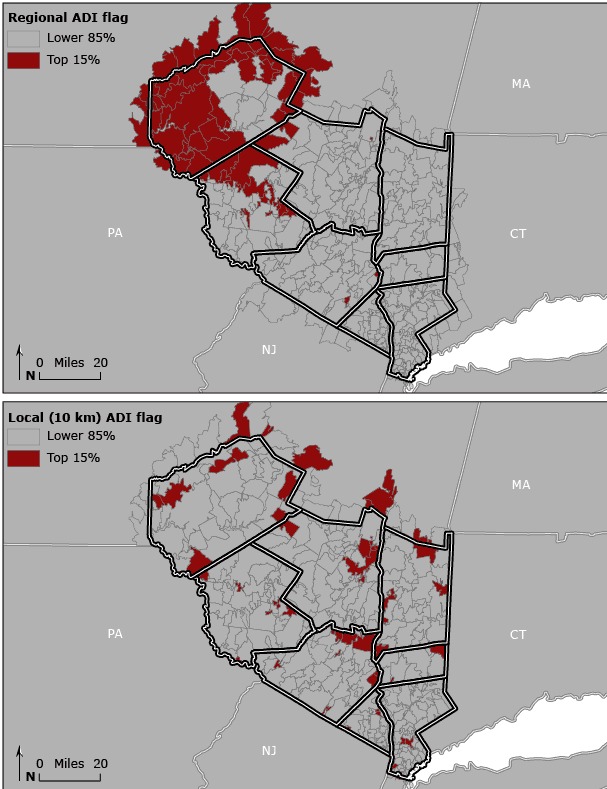
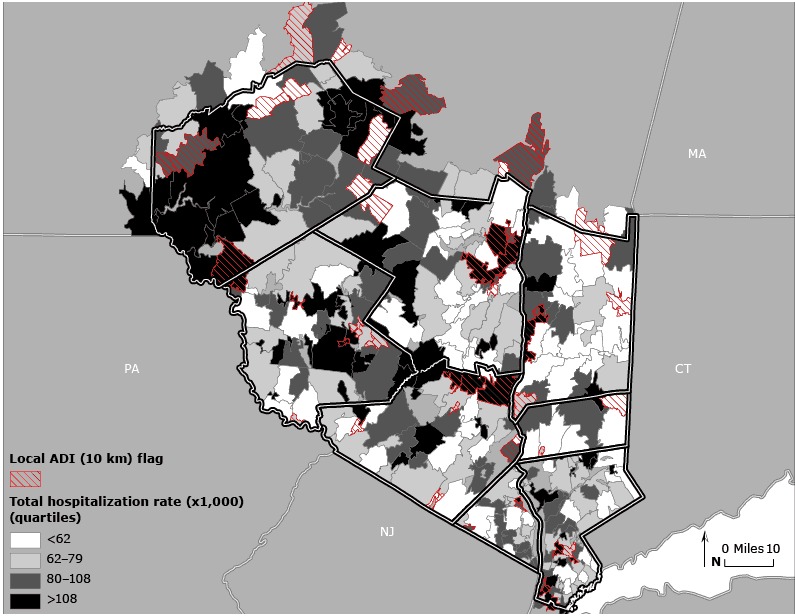
We assessed the appropriate geographic scale to apply an area deprivation index (ADI), which reflects a geographic area's level of socioeconomic deprivation and is associated with health outcomes, to identify and screen patients for social determinants of health. We estimated the relative strength of the association between the ADI at various geographic levels and a range of hospitalization rates by using age-adjusted odds ratios in an 8-county region of New York State. The 10-km local ADI estimates had the strongest associations with all hospitalization rates (higher odds ratios) followed by estimates at 20 km, 30 km, and the regional scale. A locally sensitive ADI is an ideal measure to identify and screen for the health care and social services needs and to advance the integration of social determinants of health with clinical treatment and disease prevention.
我们评估了应用区域剥夺指数(ADI)的合适地理尺度,该指数反映了地理区域的社会经济剥夺水平且与健康结果相关,用于识别和筛查患者的健康社会决定因素。我们通过使用纽约州一个八县地区的年龄调整优势比,估计了不同地理层面的ADI与一系列住院率之间关联的相对强度。10公里的本地ADI估计值与所有住院率的关联最强(优势比更高),其次是20公里、30公里及区域尺度的估计值。局部敏感的ADI是识别和筛查医疗保健及社会服务需求、推动健康社会决定因素与临床治疗和疾病预防相结合的理想指标。