Zhang Ningyuan, Chen Hua, Xu Zhipeng, Wang Bin, Sun Haixiang, Hu Yali
Reproductive Medicine Center, Nanjing Drum Tower Hospital, Nanjing University Medical School, Nanjing, Jiangsu, China (mainland).
Med Sci Monit. 2016 Sep 16;22:3288-95. doi: 10.12659/msm.900581.
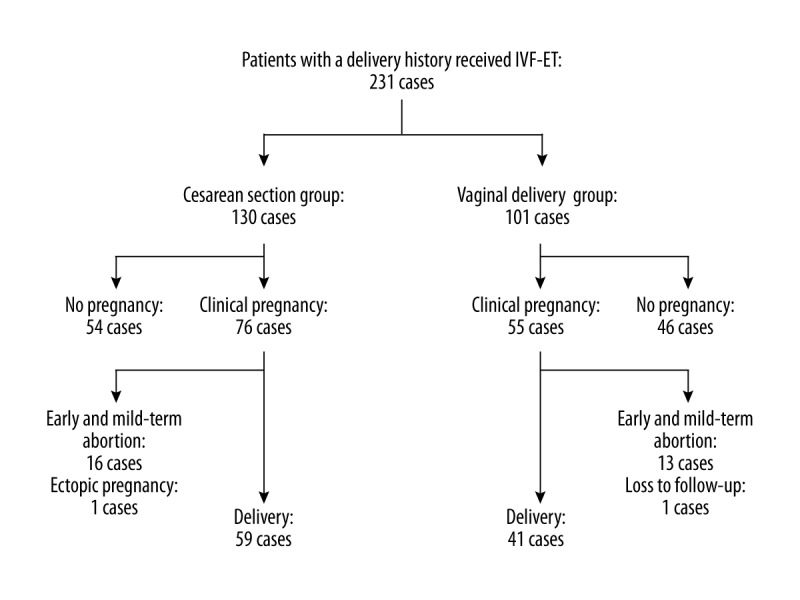
BACKGROUND What role should previous cesarean section play in affecting clinical pregnancy outcomes and avoiding the complications of in vitro fertilization? In this article, we focus on elective single-embryo transfer (eSET) versus double-embryo transfer (DET) and assess the clinical efficacy and safety of eSET in patients who have a previous cesarean scar. MATERIAL AND METHODS The pregnancy, delivery, and neonatal outcomes of 130 patients who had a previous cesarean scar and received in vitro fertilization-embryo transfer (IVF-ET) were retrospectively analyzed. The number of transferred embryos was chosen depending on patients' desire after acknowledging all benefits and risks, including eSET (eSET group, n=56) and DET (DET group, n=74). A total of 101 patients with previous vaginal delivery receiving IVF-ET in the same period were included as a control group. RESULTS The pregnancy rates, multiple birth rates, abortion rates, ectopic pregnancy rates, gestational age at delivery, preterm birth rates, neonatal birth weight, and take-home baby rates were similar between the previous cesarean section group and the previous vaginal delivery group. A previous cesarean section scar did not affect embryo implantation and pregnancy outcomes in IVF. In the eSET and DET groups of previous cesarean section patients, the embryo implantation rates, pregnancy rates, abortion rates, and take-home baby rates were similar. However, the rate of multiple pregnancies reached 50% in the DET group, which led to more preterm births and lower birth weight. CONCLUSIONS Elective single-embryo transfer is a well-accepted strategy to avoid multiple pregnancies and improve the obstetric and neonatal outcomes of singleton pregnancy in IVF patients with a previous cesarean section.
既往剖宫产在影响临床妊娠结局及避免体外受精并发症方面应发挥何种作用?在本文中,我们聚焦于选择性单胚胎移植(eSET)与双胚胎移植(DET),并评估既往有剖宫产瘢痕患者行eSET的临床疗效及安全性。
回顾性分析130例既往有剖宫产瘢痕且接受体外受精-胚胎移植(IVF-ET)患者的妊娠、分娩及新生儿结局。根据患者在知晓包括eSET(eSET组,n = 56)和DET(DET组,n = 74)在内的所有益处和风险后的意愿来选择移植胚胎数量。同期纳入101例既往经阴道分娩且接受IVF-ET的患者作为对照组。
既往剖宫产组与既往经阴道分娩组在妊娠率、多胎出生率、流产率、异位妊娠率、分娩孕周、早产率、新生儿出生体重及活产率方面相似。既往剖宫产瘢痕不影响IVF中的胚胎着床及妊娠结局。在既往剖宫产患者的eSET组和DET组中,胚胎着床率、妊娠率、流产率及活产率相似。然而,DET组的多胎妊娠率达50%,导致更多早产及更低出生体重。
选择性单胚胎移植是一种广为接受的策略,可避免多胎妊娠并改善既往有剖宫产史的IVF患者单胎妊娠的产科及新生儿结局。