Cook David A, Wittich Christopher M, Daniels Wendlyn L, West Colin P, Harris Ann M, Beebe Timothy J
Mayo Clinic Online Learning, Mayo Clinic College of Medicine, Rochester, MN, United States.
J Med Internet Res. 2016 Sep 16;18(9):e244. doi: 10.2196/jmir.6318.
Most research on how to enhance response rates in physician surveys has been done using paper surveys. Uncertainties remain regarding how to enhance response rates in Internet-based surveys.
To evaluate the impact of a low-cost nonmonetary incentive and paper mail reminders (formal letter and postcard) on response rates in Internet-based physician surveys.
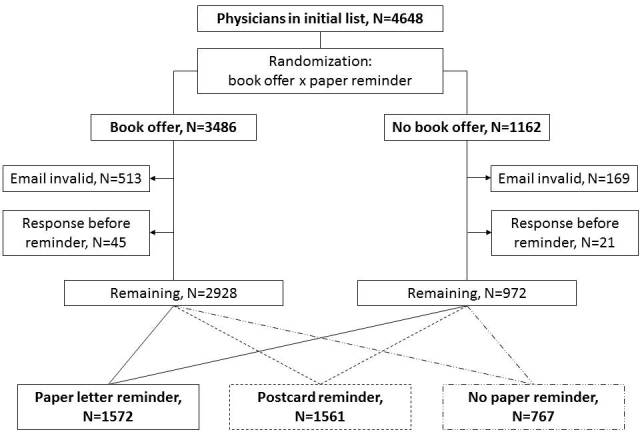
We executed a factorial-design randomized experiment while conducting a nationally representative Internet-based physician survey. We invited 3966 physicians (randomly selected from a commercial database of all licensed US physicians) via email to complete an Internet-based survey. We used 2 randomly assigned email messages: one message offered a book upon survey completion, whereas the other did not mention the book but was otherwise identical. All nonrespondents received several email reminders. Some physicians were further assigned at random to receive 1 reminder via paper mail (either a postcard or a letter) or no paper reminder. The primary outcome of this study was the survey response rate.
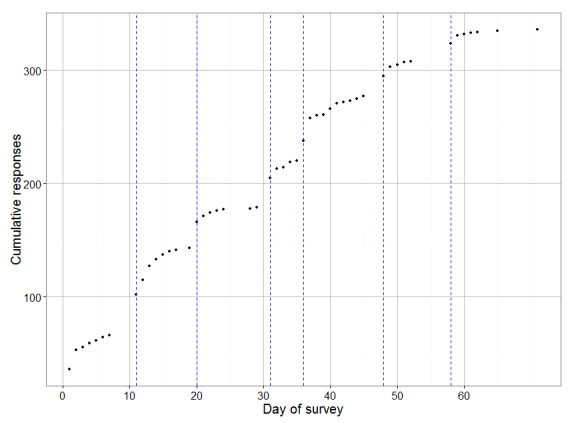
Of the 3966 physicians who were invited, 451 (11.4%) responded to at least one survey question and 336 (8.5%) completed the entire survey. Of those who were offered a book, 345/2973 (11.6%) responded compared with 106/993 (10.7%) who were not offered a book (odds ratio 1.10, 95% CI 0.87-1.38, P=.42). Regarding the paper mail reminder, 168/1572 (10.7%) letter recipients, 148/1561 (9.5%) postcard recipients, and 69/767 (9.0%) email-only recipients responded (P=.35). The response rate for those receiving letters or postcards was similar (odds ratio 1.14, 95% CI 0.91-1.44, P=.26).
Offering a modest nonmonetary incentive and sending a paper reminder did not improve survey response rate. Further research on how to enhance response rates in Internet-based physician surveys is needed.
大多数关于如何提高医生调查问卷回复率的研究都是使用纸质调查问卷进行的。对于如何提高基于互联网的调查问卷的回复率仍存在不确定性。
评估低成本非货币激励措施和纸质邮件提醒(正式信函和明信片)对基于互联网的医生调查问卷回复率的影响。
在进行一项具有全国代表性的基于互联网的医生调查时,我们执行了一项析因设计随机试验。我们通过电子邮件邀请了3966名医生(从美国所有持牌医生的商业数据库中随机选择)完成一项基于互联网的调查。我们使用了2条随机分配的电子邮件:一条信息表示在调查完成后提供一本书,而另一条没有提及这本书,但其他方面相同。所有未回复者都收到了几条电子邮件提醒。一些医生还被随机分配接受1次纸质邮件提醒(要么是明信片要么是信函)或不接受纸质提醒。本研究的主要结果是调查问卷回复率。
在受邀的3966名医生中,451名(11.4%)对至少一个调查问题做出了回复,336名(8.5%)完成了整个调查。在那些被提供一本书的人中,345/2973(11.6%)做出了回复,而未被提供书的人中106/993(10.7%)做出了回复(优势比1.10,95%置信区间0.87 - 1.38,P = 0.42)。关于纸质邮件提醒,168/1572(10.7%)信函接收者、148/1561(9.5%)明信片接收者和69/767(9.0%)仅接收电子邮件者做出了回复(P = 0.35)。接收信函或明信片者的回复率相似(优势比1.14,95%置信区间0.91 - 1.44,P = 0.26)。
提供适度的非货币激励措施和发送纸质提醒并不能提高调查问卷回复率。需要对如何提高基于互联网的医生调查问卷回复率进行进一步研究。