Zurita Jeannete, Barba Pedro, Ortega-Paredes David, Mora Marcelo, Rivadeneira Sebastián
Pontificia Universidad Católica del Ecuador, Facultad de Medicina, Quito, Ecuador; Unidad de Investigaciones en Biomedicina, Zurita & Zurita Laboratorios, Quito, Ecuador.
Unidad de Investigaciones en Biomedicina, Zurita & Zurita Laboratorios, Quito, Ecuador.
Braz J Infect Dis. 2016 Nov-Dec;20(6):525-533. doi: 10.1016/j.bjid.2016.08.006. Epub 2016 Sep 13.
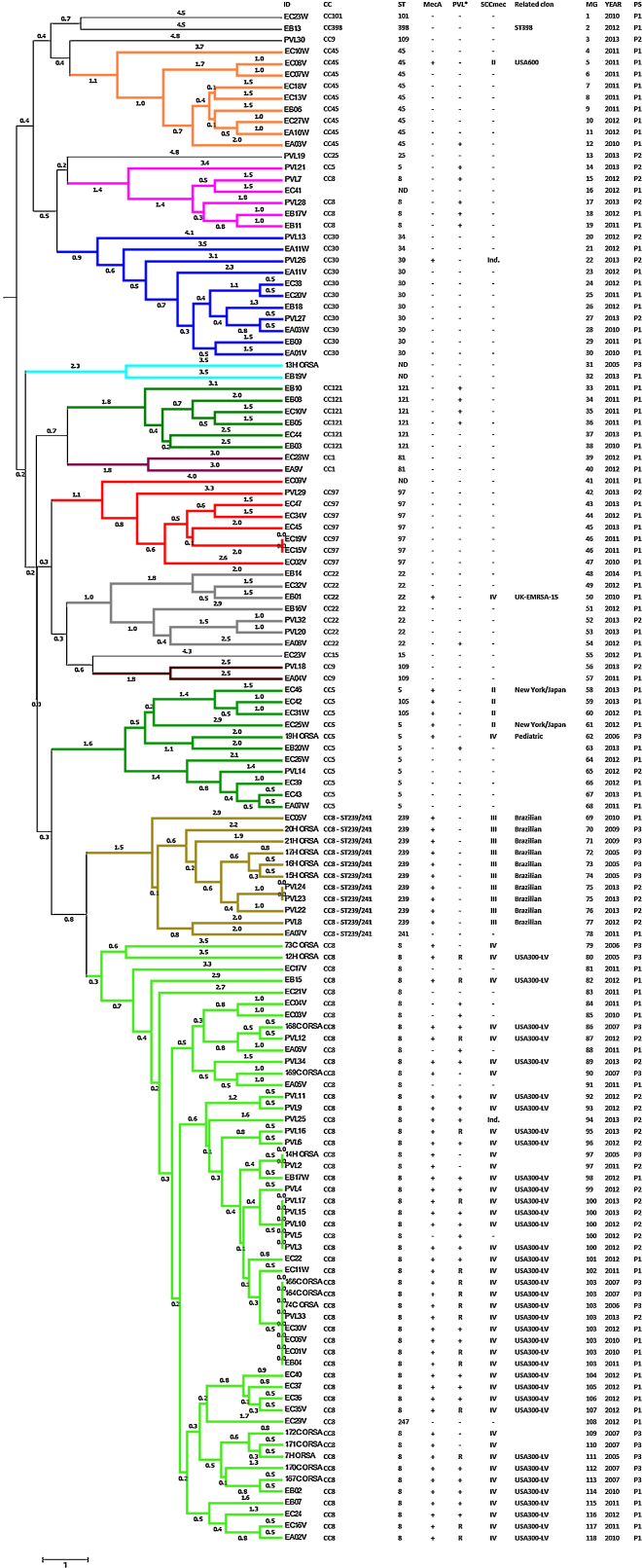
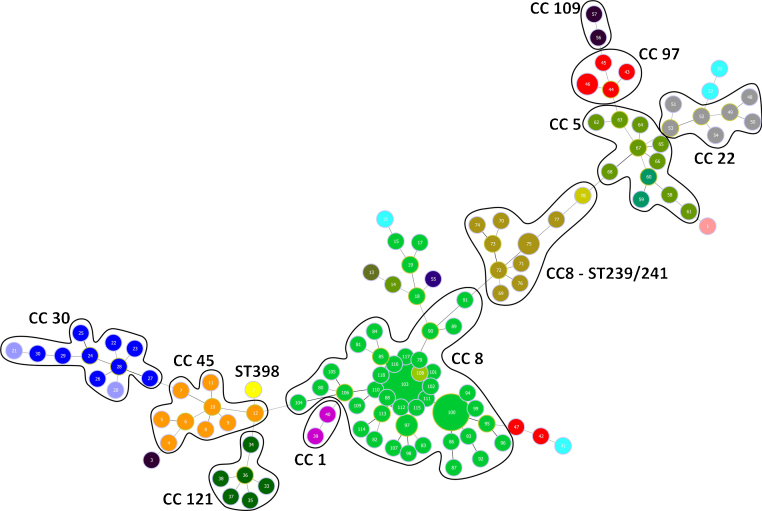
The spread of pandemic Staphylococcus aureus clones, mainly methicillin-resistant S. aureus (MRSA), must be kept under surveillance to assemble an accurate, local epidemiological analysis. In Ecuador, the prevalence of the USA300 Latin American variant clone (USA300-LV) is well known; however, there is little information about other circulating clones. The aim of this work was to identify the sequence types (ST) using a Multiple-Locus Variable number tandem repeat Analysis 14-locus genotyping approach. We analyzed 132 S. aureus strains that were recovered from 2005 to 2013 and isolated in several clinical settings in Quito, Ecuador. MRSA isolates composed 46.97% (62/132) of the study population. Within MRSA, 37 isolates were related to the USA300-LV clone (ST8-MRSA-IV, Panton-Valentine Leukocidin [PVL] +) and 10 were related to the Brazilian clone (ST239-MRSA-III, PVL-). Additionally, two isolates (ST5-MRSA-II, PVL-) were related to the New York/Japan clone. One isolate was related to the Pediatric clone (ST5-MRSA-IV, PVL-), one isolate (ST45-MRSA-II, PVL-) was related to the USA600 clone, and one (ST22-MRSA-IV, PVL-) was related to the epidemic UK-EMRSA-15 clone. Moreover, the most prevalent MSSA sequence types were ST8 (11 isolates), ST45 (8 isolates), ST30 (8 isolates), ST5 (7 isolates) and ST22 (6 isolates). Additionally, we found one isolate that was related to the livestock associated S. aureus clone ST398. We conclude that in addition to the high prevalence of clone LV-ST8-MRSA-IV, other epidemic clones are circulating in Quito, such as the Brazilian, Pediatric and New York/Japan clones. The USA600 and UK-EMRSA-15 clones, which were not previously described in Ecuador, were also found. Moreover, we found evidence of the presence of the livestock associated clone ST398 in a hospital environment.
必须对大流行的金黄色葡萄球菌克隆株,主要是耐甲氧西林金黄色葡萄球菌(MRSA)的传播进行监测,以开展准确的本地流行病学分析。在厄瓜多尔,USA300拉丁美洲变异克隆株(USA300-LV)的流行情况广为人知;然而,关于其他传播克隆株的信息却很少。这项工作的目的是使用多位点可变数目串联重复序列分析14位点基因分型方法来鉴定序列类型(ST)。我们分析了2005年至2013年期间从厄瓜多尔基多的多个临床环境中分离出的132株金黄色葡萄球菌菌株。MRSA分离株占研究群体的46.97%(62/132)。在MRSA中,37株与USA300-LV克隆株相关(ST8-MRSA-IV,杀白细胞素[PVL]+),10株与巴西克隆株相关(ST239-MRSA-III,PVL-)。此外,两株分离株(ST5-MRSA-II,PVL-)与纽约/日本克隆株相关。一株与儿科克隆株相关(ST5-MRSA-IV,PVL-),一株(ST45-MRSA-II,PVL-)与USA600克隆株相关,一株(ST22-MRSA-IV,PVL-)与流行的英国-EMRSA-15克隆株相关。此外,最常见的甲氧西林敏感金黄色葡萄球菌序列类型为ST8(11株)、ST45(8株)、ST30(8株)、ST5(7株)和ST22(6株)。此外,我们发现一株与家畜相关的金黄色葡萄球菌克隆株ST398相关。我们得出结论,除了LV-ST8-MRSA-IV克隆株的高流行率外,其他流行克隆株也在基多传播,如巴西、儿科和纽约/日本克隆株。还发现了此前在厄瓜多尔未描述过的USA600和英国-EMRSA-15克隆株。此外,我们发现了在医院环境中存在家畜相关克隆株ST398的证据。