Wang Dong Hao, Jackson James R, Twining Cornelia, Rudstam Lars G, Zollweg-Horan Emily, Kraft Clifford, Lawrence Peter, Kothapalli Kumar, Wang Zhen, Brenna J Thomas
Department of Food Science, Cornell University , Ithaca, New York 14853, United States.
Department of Natural Resources, Cornell University Biological Field Station , Bridgeport, New York 13030, United States.
J Agric Food Chem. 2016;64(40):7512-7519. doi: 10.1021/acs.jafc.6b03491. Epub 2016 Oct 4.
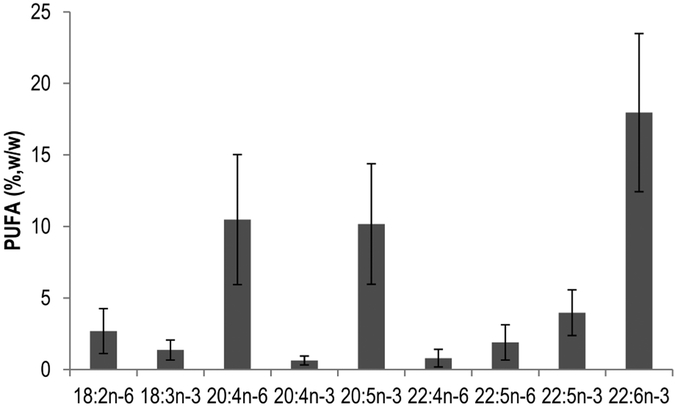
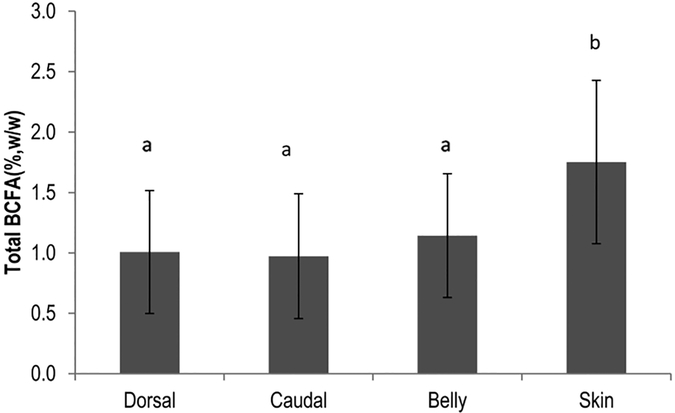
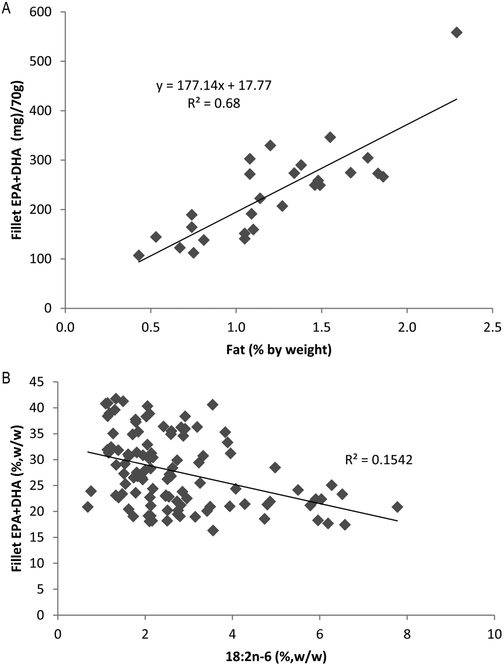
The fatty acid profiles of wild freshwater fish are poorly characterized as a human food source for several classes of fatty acids, particularly for branched chain fatty acids (BCFA), a major bioactive dietary component known to enter the US food supply primarily via dairy and beef fat. We evaluated the fatty acid content of 27 freshwater fish species captured in the northeastern US with emphasis on the BCFA and bioactive polyunsaturated fatty acids (PUFA) most associated with fish, specifically n-3 (omega-3) eicosapentaenoic acid (EPA) and docosahexaenoic acid (DHA). Mean BCFA content across all species was 1.0 ± 0.5% (mean ± SD) of total fatty acids in edible muscle, with rainbow smelt (Osmerus mordax) and pumpkinseed (Lepomis gibbosus) the highest at >2% BCFA. In comparison, EPA + DHA constituted 28% ± 7% of total fatty acids. Across all fish species, the major BCFA were iso-15:0, anteiso-15:0, iso-16:0, iso-17:0 and anteiso-17:0. Fish skin had significantly higher BCFA content than muscle tissues, at 1.8% ± 0.7%, but lower EPA and DHA. Total BCFA in fish skins was positively related with that in muscle (r = 0.6). The straight chain saturates n-15:0 and n-17:0 which have been identified previously as markers for dairy consumption were relatively high with means of 0.4% and 0.6%, respectively, and may be an underappreciated marker for seafood intake. Consuming a standardized portion, 70 g (2.5 oz), of wild freshwater fish contributes only small amounts of BCFA, 2.5-24.2 mg, to the American diet, while it adds surprisingly high amounts of EPA + DHA (107 mg to 558 mg).
野生淡水鱼的脂肪酸谱作为人类食物来源,对于几类脂肪酸的特征描述甚少,尤其是支链脂肪酸(BCFA),这是一种主要的生物活性膳食成分,已知主要通过乳制品和牛肉脂肪进入美国食品供应体系。我们评估了在美国东北部捕获的27种淡水鱼的脂肪酸含量,重点关注与鱼类最相关的BCFA和生物活性多不饱和脂肪酸(PUFA),特别是n-3(欧米伽-3)二十碳五烯酸(EPA)和二十二碳六烯酸(DHA)。所有物种可食用肌肉中BCFA的平均含量为总脂肪酸的1.0±0.5%(平均值±标准差),其中彩虹胡瓜鱼(Osmerus mordax)和南瓜籽鱼(Lepomis gibbosus)的BCFA含量最高,超过2%。相比之下,EPA+DHA占总脂肪酸的28%±7%。在所有鱼类物种中,主要的BCFA为异-15:0、反异-15:0、异-16:0、异-17:0和反异-17:0。鱼皮中的BCFA含量显著高于肌肉组织,为1.8%±0.7%,但EPA和DHA含量较低。鱼皮中的总BCFA与肌肉中的总BCFA呈正相关(r=0.6)。先前已被确定为乳制品消费标志物的直链饱和脂肪酸n-15:0和n-17:0相对较高,平均值分别为0.4%和0.6%,可能是一个未被充分认识的海鲜摄入量标志物。食用一份70克(2.5盎司)的野生淡水鱼,仅为美国饮食贡献少量的BCFA,即2.5至24.2毫克,而它添加的EPA+DHA量却惊人地高(107毫克至558毫克)。