Gu Fei-Fei, Chen Ye, Dong De-Ping, Song Zhen, Guo Xiao-Kui, Ni Yu-Xing, Han Li-Zhong
Department of Clinical Microbiology, Ruijin Hospital, Shanghai Jiao Tong University School of Medicine, Shanghai 200025, China.
Laboratory, Haian Hospital, Nantong University, Nantong, Jiangsu 226600, China.
Chin Med J (Engl). 2016 Oct 5;129(19):2319-24. doi: 10.4103/0366-6999.190673.
Staphylococcus aureus is one of the predominant causes of skin and soft tissue infections (SSTIs), but limited data were available regarding the characterization of S. aureus from SSTIs patients in Jiangsu Province in China. We aimed to investigate the molecular epidemiology of S. aureus among SSTIs patients in two hospitals of Jiangsu Province.
Sixty-two patients with SSTIs from two Chinese hospitals in Jiangsu Province were enrolled in this study, and 62 S. aureus isolates were collected from February 2014 to January 2015. S. aureus isolates were characterized by antimicrobial susceptibility testing, toxin gene detection, and molecular typing with sequence type, Staphylococcus protein A gene type, accessory gene regulator (agr) group, and Staphylococcal cassette chromosome mec t ype.
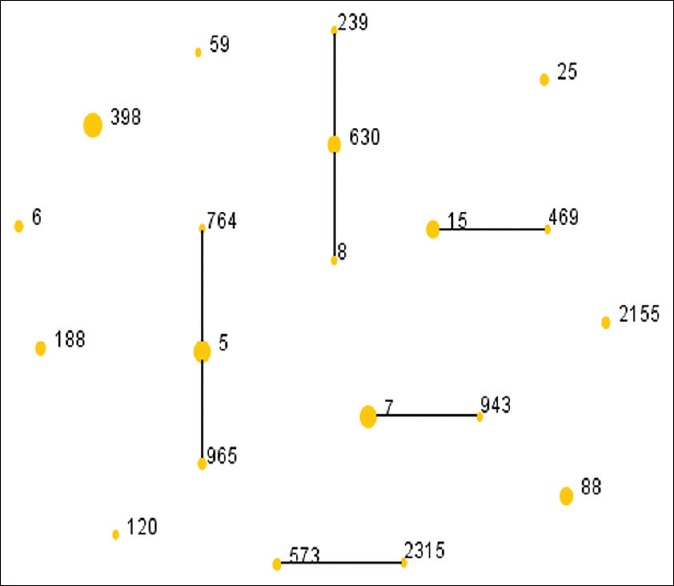
Sixteen (25.8%) methicillin-resistant S. aureus (MRSA) isolates were detected, and there was no isolate found resistant to vancomycin, teicoplanin, sulfamethoxazole-trimethoprim, and linezolid. The sei was the toxin gene most frequently found, and no lukS/F-PV-positive isolates were detected among the SSTIs' patients. Molecular analysis revealed that ST398 (10/62, 16.1%; 2 MRSA and 8 methicillin-susceptible S. aureus) to be the dominant clone, followed by ST5 (8/62, 12.9%) and ST7 (8/62, 12.9%).
The livestock ST398 was the most common clone among patients with S. aureus SSTIs in Jiangsu Province, China. Surveillance and further studies on the important livestock ST398 clone in human infections are necessarily requested.
金黄色葡萄球菌是皮肤和软组织感染(SSTIs)的主要病因之一,但关于中国江苏省SSTIs患者中金黄色葡萄球菌特征的数据有限。我们旨在调查江苏省两家医院SSTIs患者中金黄色葡萄球菌的分子流行病学。
本研究纳入了江苏省两家中国医院的62例SSTIs患者,并于2014年2月至2015年1月收集了62株金黄色葡萄球菌分离株。通过抗菌药物敏感性试验、毒素基因检测以及序列类型、葡萄球菌蛋白A基因类型、辅助基因调节因子(agr)组和葡萄球菌盒式染色体mec类型的分子分型对金黄色葡萄球菌分离株进行特征分析。
检测到16株(25.8%)耐甲氧西林金黄色葡萄球菌(MRSA)分离株,未发现对万古霉素、替考拉宁、磺胺甲恶唑-甲氧苄啶和利奈唑胺耐药的分离株。sei是最常发现的毒素基因,在SSTIs患者中未检测到lukS/F-PV阳性分离株。分子分析显示,ST398(10/62,16.1%;2株MRSA和8株甲氧西林敏感金黄色葡萄球菌)是主要克隆,其次是ST5(8/62,12.9%)和ST7(8/62,12.9%)。
在中国江苏省,家畜源ST398是金黄色葡萄球菌SSTIs患者中最常见的克隆。有必要对人类感染中重要的家畜源ST398克隆进行监测和进一步研究。