Hartmann S, Biliouris K, Lesko L J, Nowak-Göttl U, Trame M N
Center for Pharmacometrics and Systems Pharmacology, Department of Pharmaceutics, University of Florida, Orlando, Florida, USA.
University of Schleswig-Holstein, Institute of Clinical Chemistry, Thrombosis and Hemostasis Treatment Center, Campus Kiel and Lübbeck, Germany.
CPT Pharmacometrics Syst Pharmacol. 2016 Oct;5(10):554-564. doi: 10.1002/psp4.12111. Epub 2016 Sep 20.
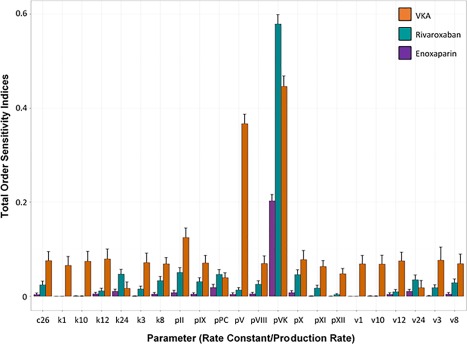
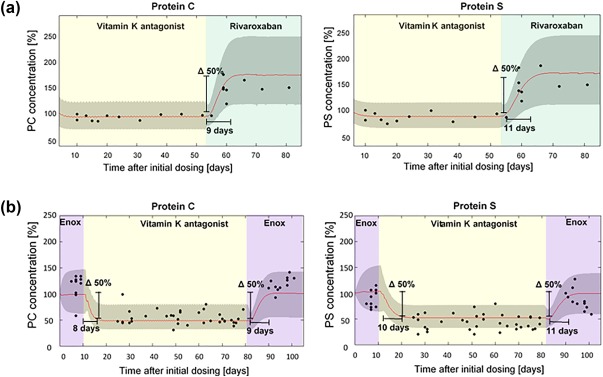
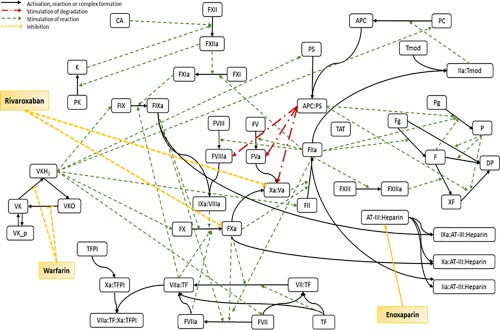
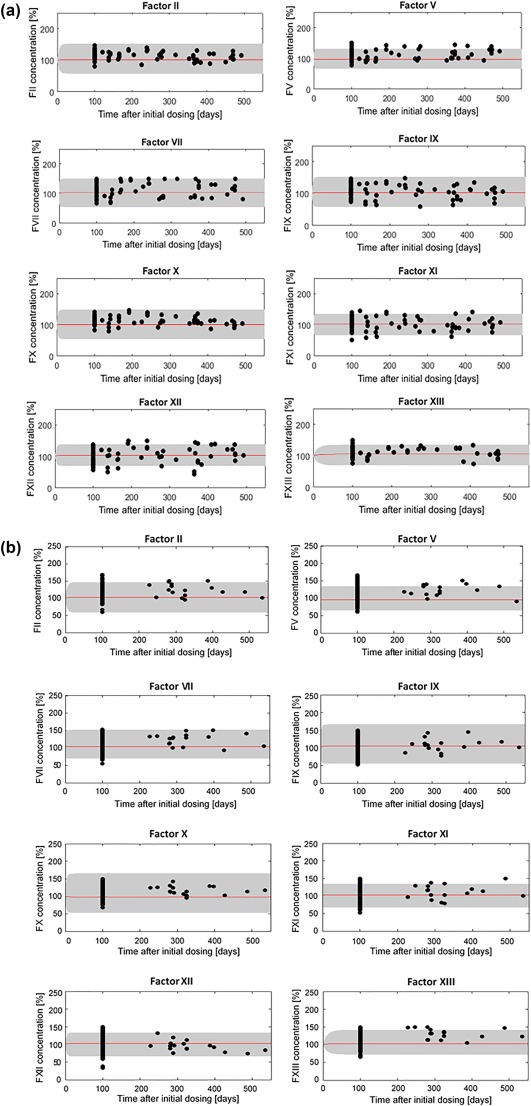
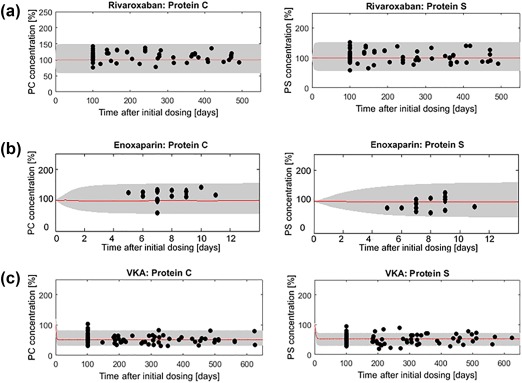
Warfarin is the anticoagulant of choice for venous thromboembolism (VTE) treatment, although its suppression of the endogenous clot-dissolution complex APC:PS may ultimately lead to longer time-to-clot dissolution profiles, resulting in increased risk of re-thrombosis. This detrimental effect might not occur during VTE treatment using other anticoagulants, such as rivaroxaban or enoxaparin, given their different mechanisms of action within the coagulation network. A quantitative systems pharmacology model was developed describing the coagulation network to monitor clotting factor levels under warfarin, enoxaparin, and rivaroxaban treatment. The model allowed for estimation of all factor rate constants and production rates. Predictions of individual coagulation factor time courses under steady-state warfarin, enoxaparin, and rivaroxaban treatment reflected the suppression of protein C and protein S under warfarin compared to rivaroxaban and enoxaparin. The model may be used as a tool during clinical practice to predict effects of anticoagulants on individual clotting factor time courses and optimize antithrombotic therapy.
华法林是治疗静脉血栓栓塞症(VTE)的首选抗凝剂,尽管其对内源性纤溶复合物活化蛋白C:蛋白S(APC:PS)的抑制作用最终可能导致血栓溶解时间延长,从而增加再次血栓形成的风险。在使用其他抗凝剂(如利伐沙班或依诺肝素)进行VTE治疗期间,可能不会出现这种有害影响,因为它们在凝血网络中的作用机制不同。开发了一个定量系统药理学模型来描述凝血网络,以监测华法林、依诺肝素和利伐沙班治疗下的凝血因子水平。该模型可以估算所有因子的速率常数和生成速率。稳态下华法林、依诺肝素和利伐沙班治疗时个体凝血因子时间进程的预测结果表明,与利伐沙班和依诺肝素相比,华法林会抑制蛋白C和蛋白S。该模型可在临床实践中用作工具,以预测抗凝剂对个体凝血因子时间进程的影响,并优化抗栓治疗。