Holeman Isaac, Cookson Tara Patricia, Pagliari Claudia
Cambridge Judge Business School, Cambridge, UK; Medic Mobile, San Francisco, CA, USA; Edinburgh Global Health Academy & Usher Institute of Population Health Sciences and Informatics, University of Edinburgh, Edinburgh, Scotland, UK.
Department of Geography, University of Cambridge, Cambridge, UK.
J Glob Health. 2016 Dec;6(2):020408. doi: 10.7189/jogh.06.020408.
Poor governance impedes the provision of equitable and cost-effective health care in many low- and middle-income countries (LMICs). Although systemic problems such as corruption and inefficiency have been characterized as intractable, "good governance" interventions that promote transparency, accountability and public participation have yielded encouraging results. Mobile phones and other Information and Communication Technologies (ICTs) are beginning to play a role in these interventions, but little is known about their use and effects in the context of LMIC health care.
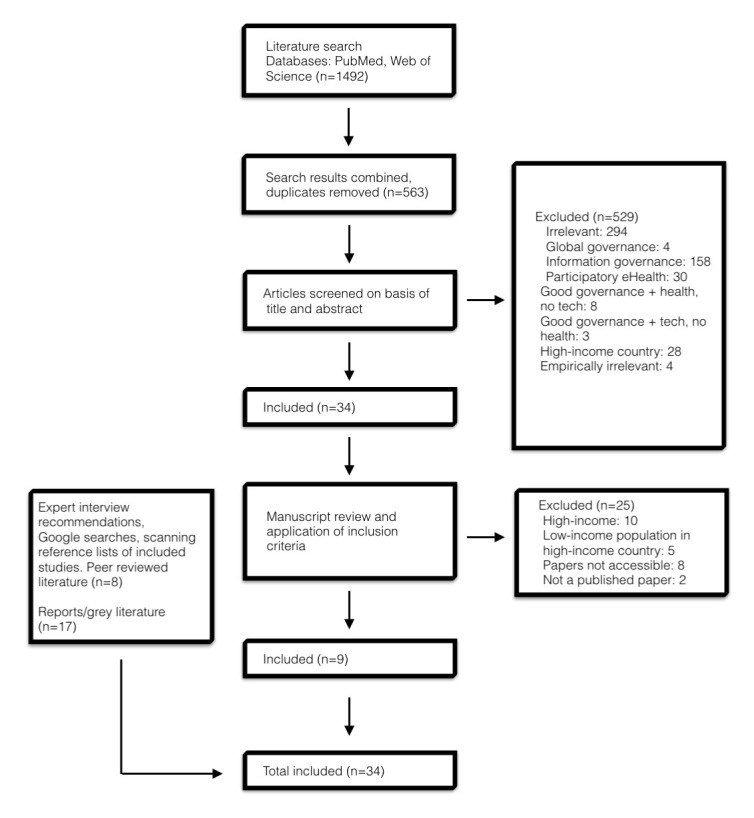
Multi-stage scoping review: Research questions and scope were refined through a landscape scan of relevant implementation activities and by analyzing related concepts in the literature. Relevant studies were identified through iterative Internet searches (Google, Google Scholar), a systematic search of academic databases (PubMed, Web of Science), social media crowdsourcing (targeted LinkedIn and Twitter appeals) and reading reference lists and websites of relevant organizations. Parallel expert interviews helped to verify concepts and emerging findings and identified additional studies for inclusion. Results were charted, analyzed thematically and summarized.
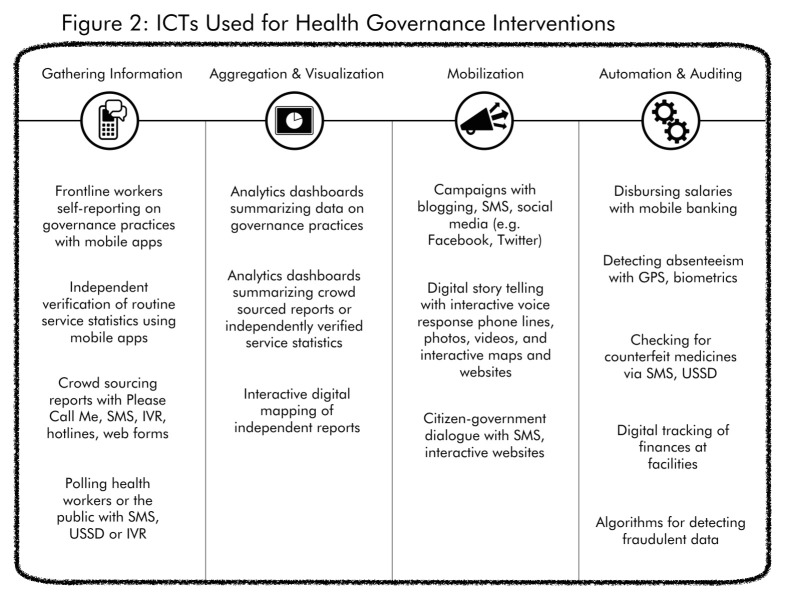
We identified 34 articles from a wide range of disciplines and sectors, including 17 published research articles and 17 grey literature reports. Analysis of these articles revealed 15 distinct ways of using ICTs for good governance activities in LMIC health care. These use cases clustered into four conceptual categories: 1) gathering and verifying information on services to improve transparency and auditability 2) aggregating and visualizing data to aid communication and decision making 3) mobilizing citizens in reporting poor practices to improve accountability and quality and 4) automating and auditing processes to prevent fraud. Despite a considerable amount of implementation activity, we identified little formal evaluative research.
Innovative digital approaches are increasingly being used to facilitate good governance in the health sectors of LMICs but evidence of their effectiveness is still limited. More empirical studies are needed to measure concrete impacts, document mechanisms of action, and elucidate the political and sociotechnical dynamics that make designing and implementing ICTs for good governance so complex. Many digital good governance interventions are driven by an assumption that transparency alone will effect change; however responsive feedback mechanisms are also likely to be necessary.
治理不善阻碍了许多低收入和中等收入国家(LMICs)提供公平且具成本效益的医疗保健服务。尽管诸如腐败和低效率等系统性问题被认为难以解决,但促进透明度、问责制和公众参与的“善治”干预措施已取得了令人鼓舞的成果。手机和其他信息通信技术(ICTs)开始在这些干预措施中发挥作用,但对于它们在LMICs医疗保健背景下的使用情况和效果却知之甚少。
多阶段范围审查:通过对相关实施活动的全景扫描以及分析文献中的相关概念,对研究问题和范围进行了细化。通过迭代式互联网搜索(谷歌、谷歌学术)、对学术数据库(PubMed、科学网)的系统搜索、社交媒体众包(在领英和推特上进行有针对性的呼吁)以及阅读相关组织的参考文献列表和网站,确定了相关研究。并行的专家访谈有助于核实概念和新出现的研究结果,并确定了其他纳入研究。对结果进行了图表绘制、主题分析和总结。
我们从广泛的学科和领域中确定了34篇文章,其中包括17篇已发表的研究文章和17篇灰色文献报告。对这些文章的分析揭示了在LMICs医疗保健中利用ICTs进行善治活动的15种不同方式。这些用例可分为四个概念类别:1)收集和核实服务信息以提高透明度和可审计性;2)汇总和可视化数据以辅助沟通和决策;3)动员公民举报不良行为以提高问责制和质量;4)使流程自动化和进行审计以防止欺诈。尽管有大量的实施活动,但我们发现几乎没有正式的评估研究。
创新的数字方法越来越多地被用于促进LMICs卫生部门的善治,但其有效性的证据仍然有限。需要更多的实证研究来衡量具体影响、记录作用机制,并阐明使为实现善治而设计和实施ICTs如此复杂的政治和社会技术动态。许多数字善治干预措施是基于仅透明度就能带来变革的假设;然而,响应式反馈机制可能也是必要的。