Nakajima Hiroaki, Terazawa Shuko, Niwano Takao, Yamamoto Yorihiro, Imokawa Genji
Toyo Beauty Co. Ltd., R&D Division, Osaka, Japan.
School of Bioscience and Biotechnology, Tokyo University of Technology, Tokyo, Japan.
PLoS One. 2016 Sep 20;11(9):e0161580. doi: 10.1371/journal.pone.0161580. eCollection 2016.
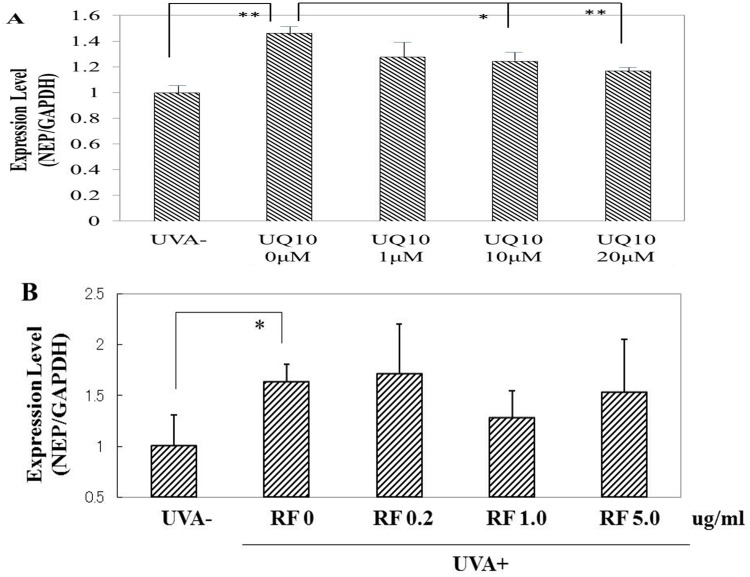
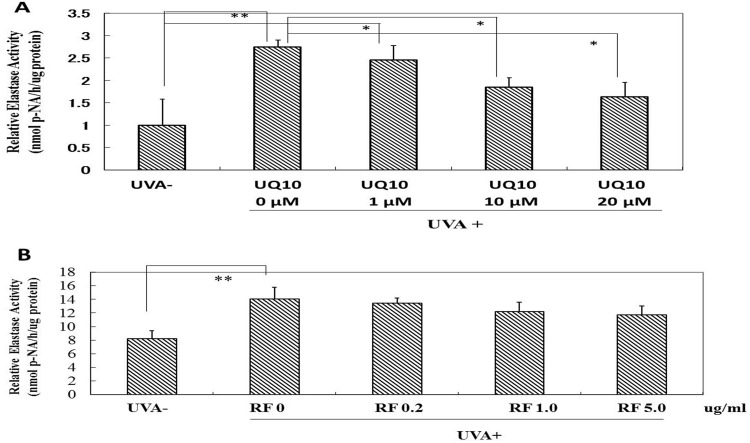
We recently reported that the over-expression of skin fibroblast-derived neutral endopeptidase (NEP) plays a pivotal role in impairing the three-dimensional architecture of dermal elastic fibers during the biological mechanism of ultraviolet (UV)-induced skin wrinkling. In that process, a UVB-associated epithelial-mesenchymal cytokine interaction as well as a direct UVA-induced cellular stimulation are associated with the up-regulation of NEP in human fibroblasts. In this study, we characterized the mode of action of ubiquinol10 which may abrogate the up-regulation of NEP by dermal fibroblasts, resulting in a reported in vivo anti-wrinkling action, and compared that with 3 other anti-oxidants, astaxanthin (AX), riboflavin (RF) and flavin mononucleotide (FMN). Post-irradiation treatment with all 4 of those anti-oxidants elicited an interrupting effect on the UVB-associated epithelial-mesenchymal cytokine interaction leading to the up-regulation of NEP in human fibroblasts but with different modes of action. While AX mainly served as an inhibitor of the secretion of wrinkle-inducing cytokines, such as interleukin-1α (IL-1α) and granulocyte macrophage colony stimulatory factor (GM-CSF) in UVB-exposed epidermal keratinocytes, ubiquinol10, RF and FMN predominantly interrupted the IL-1α and GM-CSF-stimulated expression of NEP in dermal fibroblasts. On the other hand, as for the UVA-associated mechanism, similar to the abrogating effects reported for AX and FMN, ubiquinol10 but not RF had the potential to abrogate the increased expression of NEP and matrix-metalloproteinase-1 in UVA-exposed human fibroblasts. Our findings strongly support the in vivo anti-wrinkling effects of ubiquinol10 and AX on human and animal skin and provide convincing proof of the UV-induced wrinkling mechanism that essentially focuses on the over-expression of NEP by dermal fibroblasts as an intrinsic causative factor.
我们最近报道,在紫外线(UV)诱导皮肤皱纹的生物学机制中,皮肤成纤维细胞衍生的中性内肽酶(NEP)的过表达在损害真皮弹性纤维的三维结构中起关键作用。在该过程中,UVB相关的上皮-间充质细胞因子相互作用以及直接的UVA诱导的细胞刺激与人成纤维细胞中NEP的上调有关。在本研究中,我们表征了泛醇10的作用模式,其可能消除真皮成纤维细胞对NEP的上调,从而产生已报道的体内抗皱作用,并将其与其他3种抗氧化剂虾青素(AX)、核黄素(RF)和黄素单核苷酸(FMN)进行比较。用这4种抗氧化剂中的所有抗氧化剂进行辐照后处理,均对UVB相关的上皮-间充质细胞因子相互作用产生中断作用,导致人成纤维细胞中NEP上调,但作用模式不同。虽然AX主要作为皱纹诱导细胞因子分泌的抑制剂,如在UVB照射的表皮角质形成细胞中白细胞介素-1α(IL-1α)和粒细胞巨噬细胞集落刺激因子(GM-CSF),但泛醇10、RF和FMN主要中断IL-1α和GM-CSF刺激的真皮成纤维细胞中NEP的表达。另一方面,至于UVA相关机制,与报道的AX和FMN的消除作用类似,泛醇10而非RF有潜力消除UVA照射的人成纤维细胞中NEP和基质金属蛋白酶-1表达的增加。我们的研究结果有力地支持了泛醇10和AX对人和动物皮肤的体内抗皱作用,并为UV诱导皱纹机制提供了令人信服的证据,该机制主要集中在真皮成纤维细胞中NEP的过表达作为内在致病因素。