Kroll Ryan R, Boyd J Gordon, Maslove David M
Department of Medicine, Queen's University, Kingston, ON, Canada.
J Med Internet Res. 2016 Sep 20;18(9):e253. doi: 10.2196/jmir.6025.
As the sensing capabilities of wearable devices improve, there is increasing interest in their application in medical settings. Capabilities such as heart rate monitoring may be useful in hospitalized patients as a means of enhancing routine monitoring or as part of an early warning system to detect clinical deterioration.
To evaluate the accuracy of heart rate monitoring by a personal fitness tracker (PFT) among hospital inpatients.
We conducted a prospective observational study of 50 stable patients in the intensive care unit who each completed 24 hours of heart rate monitoring using a wrist-worn PFT. Accuracy of heart rate recordings was compared with gold standard measurements derived from continuous electrocardiographic (cECG) monitoring. The accuracy of heart rates measured by pulse oximetry (Spo2.R) was also measured as a positive control.
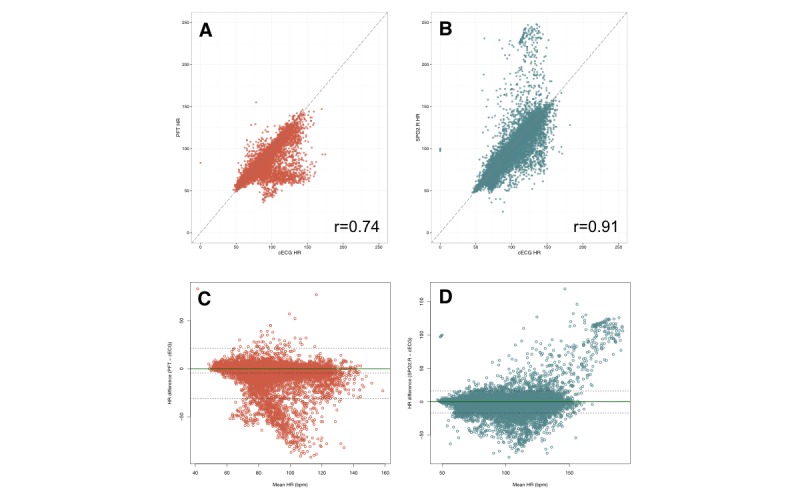
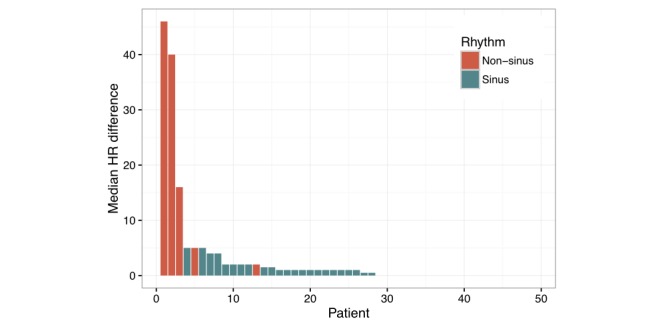
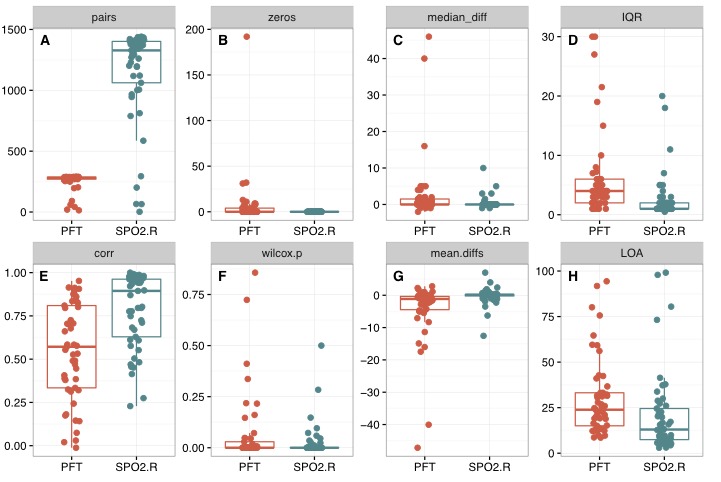
On a per-patient basis, PFT-derived heart rate values were slightly lower than those derived from cECG monitoring (average bias of -1.14 beats per minute [bpm], with limits of agreement of 24 bpm). By comparison, Spo2.R recordings produced more accurate values (average bias of +0.15 bpm, limits of agreement of 13 bpm, P<.001 as compared with PFT). Personal fitness tracker device performance was significantly better in patients in sinus rhythm than in those who were not (average bias -0.99 bpm vs -5.02 bpm, P=.02).
Personal fitness tracker-derived heart rates were slightly lower than those derived from cECG monitoring in real-world testing and not as accurate as Spo2.R-derived heart rates. Performance was worse among patients who were not in sinus rhythm. Further clinical evaluation is indicated to see if PFTs can augment early warning systems in hospitals.
ClinicalTrials.gov NCT02527408; https://clinicaltrials.gov/ct2/show/NCT02527408 (Archived by WebCite at http://www.webcitation.org/6kOFez3on).
随着可穿戴设备传感能力的提高,人们对其在医疗环境中的应用兴趣日益浓厚。诸如心率监测等功能对于住院患者可能有用,可作为加强常规监测的手段,或作为检测临床病情恶化的早期预警系统的一部分。
评估个人健身追踪器(PFT)在医院住院患者中进行心率监测的准确性。
我们对重症监护病房的50例病情稳定的患者进行了一项前瞻性观察研究,这些患者每人使用腕戴式PFT完成了24小时的心率监测。将心率记录的准确性与连续心电图(cECG)监测得出的金标准测量值进行比较。还测量了通过脉搏血氧饱和度仪(Spo2.R)测得的心率准确性作为阳性对照。
在每位患者中,PFT得出的心率值略低于cECG监测得出的值(平均偏差为每分钟-1.14次心跳 [bpm],一致性界限为24 bpm)。相比之下,Spo2.R记录产生的值更准确(平均偏差为+0.15 bpm,一致性界限为13 bpm,与PFT相比P<0.001)。窦性心律患者中个人健身追踪器设备的性能明显优于非窦性心律患者(平均偏差-0.99 bpm对-5.02 bpm,P = 0.02)。
在实际测试中,个人健身追踪器得出的心率略低于cECG监测得出的心率,且不如Spo2.R得出的心率准确。在非窦性心律患者中性能较差。需要进一步进行临床评估,以确定PFT是否可以增强医院的早期预警系统。
ClinicalTrials.gov NCT02527408;https://clinicaltrials.gov/ct2/show/NCT02527408(由WebCite存档于http://www.webcitation.org/6kOFez3on)。