Basile Marco, Valerio Francesco, Balestrieri Rosario, Posillico Mario, Bucci Rodolfo, Altea Tiziana, De Cinti Bruno, Matteucci Giorgio
Istituto di Biologia Agroambientale e Forestale, Consiglio Nazionale delle Ricerche, Monterotondo Scalo, Italy; Coordinamento MItO2000, Parma, Italy; Chair of Wildlife Ecology and Management, Albert-Ludwigs-Universität Freiburg, Freiburg, Germany.
CIBIO/InBIO-UE-Research Center in Biodiversity and Genetic Resources, Pole of Évora Applied Population and Community Ecology Laboratory, University of Évora UBC-Conservation Biology Lab, Department of Biology , Évora , Portugal.
PeerJ. 2016 Sep 8;4:e2398. doi: 10.7717/peerj.2398. eCollection 2016.
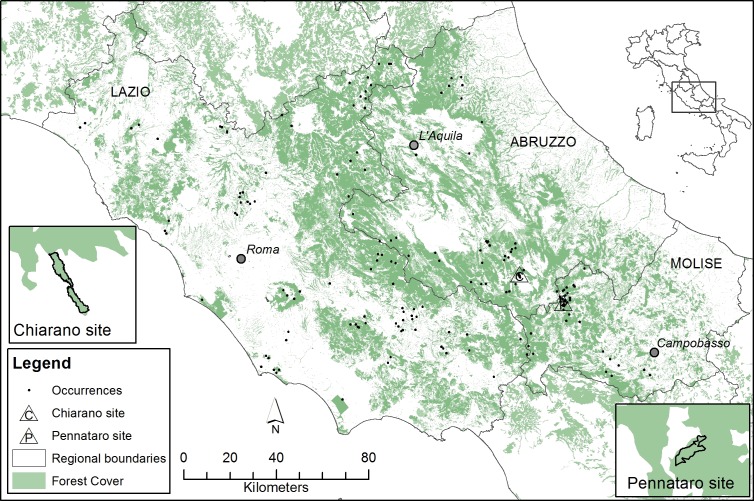
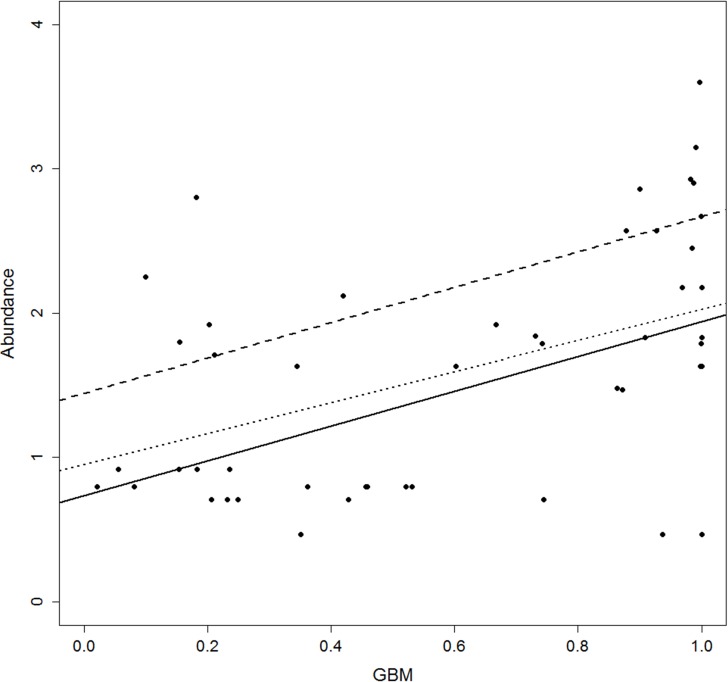
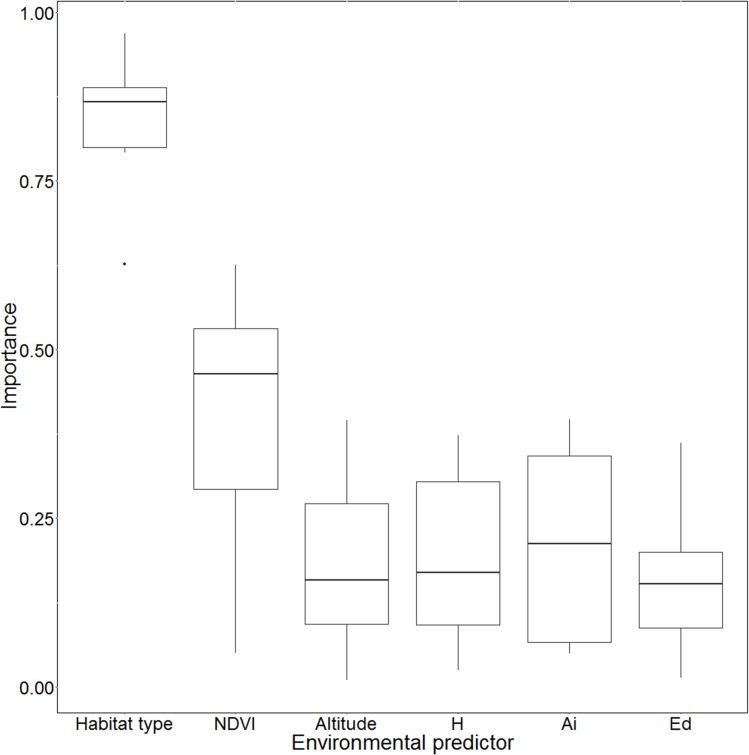
Environmental heterogeneity affects not only the distribution of a species but also its local abundance. High heterogeneity due to habitat alteration and fragmentation can influence the realized niche of a species, lowering habitat suitability as well as reducing local abundance. We investigate whether a relationship exists between habitat suitability and abundance and whether both are affected by fragmentation. Our aim was to assess the predictive power of such a relationship to derive advice for environmental management. As a model species we used a forest specialist, the short-toed treecreeper (Family: Certhiidae; Certhia brachydactyla Brehm, 1820), and sampled it in central Italy. Species distribution was modelled as a function of forest structure, productivity and fragmentation, while abundance was directly estimated in two central Italian forest stands. Different algorithms were implemented to model species distribution, employing 170 occurrence points provided mostly by the MITO2000 database: an artificial neural network, classification tree analysis, flexible discriminant analysis, generalized boosting models, generalized linear models, multivariate additive regression splines, maximum entropy and random forests. Abundance was estimated also considering detectability, through N-mixture models. Differences between forest stands in both abundance and habitat suitability were assessed as well as the existence of a relationship. Simpler algorithms resulted in higher goodness of fit than complex ones. Fragmentation was highly influential in determining potential distribution. Local abundance and habitat suitability differed significantly between the two forest stands, which were also significantly different in the degree of fragmentation. Regression showed that suitability has a weak significant effect in explaining increasing value of abundance. In particular, local abundances varied both at low and high suitability values. The study lends support to the concept that the degree of fragmentation can contribute to alter not only the suitability of an area for a species, but also its abundance. Even if the relationship between suitability and abundance can be used as an early warning of habitat deterioration, its weak predictive power needs further research. However, we define relationships between a species and some landscape features (i.e., fragmentation, extensive rejuvenation of forests and tree plantations) which could be easily controlled by appropriate forest management planning to enhance environmental suitability, at least in an area possessing high conservation and biodiversity values.
环境异质性不仅影响物种的分布,还影响其局部丰度。由于栖息地改变和破碎化导致的高异质性会影响物种的实际生态位,降低栖息地适宜性并减少局部丰度。我们研究栖息地适宜性和丰度之间是否存在关系,以及两者是否都受到破碎化的影响。我们的目的是评估这种关系的预测能力,以便为环境管理提供建议。作为模型物种,我们使用了一种森林专家——短趾旋木雀(科:旋木雀科;短趾旋木雀,布雷姆,1820年),并在意大利中部对其进行采样。物种分布被建模为森林结构、生产力和破碎化的函数,而丰度则在意大利中部的两个森林林分中直接估计。采用不同的算法对物种分布进行建模,利用主要由MITO2000数据库提供的170个出现点:人工神经网络、分类树分析、灵活判别分析、广义提升模型、广义线性模型、多元加法回归样条、最大熵和随机森林。还通过N - 混合模型在考虑可探测性的情况下估计丰度。评估了两个森林林分在丰度和栖息地适宜性方面的差异以及关系的存在。较简单的算法比较复杂的算法具有更高的拟合优度。破碎化在确定潜在分布方面具有高度影响力。两个森林林分在局部丰度和栖息地适宜性方面存在显著差异,在破碎化程度上也有显著不同。回归分析表明,适宜性在解释丰度增加值方面具有微弱的显著影响。特别是,局部丰度在适宜性值较低和较高时都有所变化。该研究支持了这样一种观点,即破碎化程度不仅会改变一个地区对物种的适宜性,还会改变其丰度。即使适宜性和丰度之间的关系可以用作栖息地退化的早期预警,但其微弱的预测能力仍需进一步研究。然而,我们定义了物种与一些景观特征(即破碎化、森林的广泛更新和人工林)之间的关系,通过适当的森林管理规划可以很容易地控制这些特征,以提高环境适宜性,至少在具有高保护和生物多样性价值的地区是这样。