
Toll样受体4基因多态性与系统性红斑狼疮易感性的关联:一项荟萃分析。
Association between Toll-Like Receptor 4 Polymorphisms and Systemic Lupus Erythematosus Susceptibility: A Meta-Analysis.
作者信息
Hu Weiping, Wu Senchao, Zhang Yanlin, Sigdel Keshav Raj, Lin Yong, Zhong Hongbin
机构信息
Department of Nephrology, First Affiliated Hospital of Xiamen University, Xiamen, Fujian 361003, China.
Department of Nephrology, Longyan First Hospital Affiliated to Fujian Medical University, Longyan, Fujian 36400, China.
出版信息
Biomed Res Int. 2016;2016:7842587. doi: 10.1155/2016/7842587. Epub 2016 Aug 29.
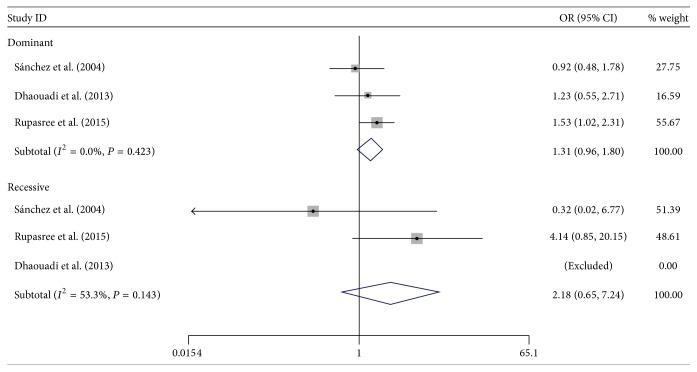
Family aggregation was observed among systemic lupus erythematosus (SLE) cases, suggesting the genetic factor may contribute to the susceptibility. Toll-like receptors (TLR) play key role in human immune system; in order to gain better insight on the association between TLR4 polymorphisms and SLE risk, a meta-analysis was conducted. In total 4 case-control studies have been included, involving 503 SLE cases and 636 healthy controls. The association between TLR4 polymorphisms and SLE risk was evaluated by calculating pooled odd ratio (OR) and its 95% confidential interval (CI). The Q-test and I (2) statistic were used to estimate the degree of heterogeneity. Publication bias among enrolled studies was examined by using Egger's test and Begg's test. Overall, there was no evidence of positive association between SLE risk and D299G and T399I polymorphisms in TLR4. The meta-analysis reported a null association between TLR4 polymorphisms and SLE risk in included study populations, but the role of TLR4 polymorphisms in developing SLE among other populations remains undetermined. Moreover, some laboratory studies still discovered the involvement of TLR4 in SLE process. Therefore, the association between TLR4 polymorphisms and SLE risk requires further investigation both in laboratory and in epidemiological efforts.
系统性红斑狼疮(SLE)病例中观察到家族聚集现象,提示遗传因素可能与易感性有关。Toll样受体(TLR)在人体免疫系统中起关键作用;为了更好地了解TLR4基因多态性与SLE风险之间的关联,进行了一项荟萃分析。总共纳入了4项病例对照研究,涉及503例SLE病例和636例健康对照。通过计算合并比值比(OR)及其95%置信区间(CI)来评估TLR4基因多态性与SLE风险之间的关联。采用Q检验和I²统计量来估计异质性程度。使用Egger检验和Begg检验来检验纳入研究中的发表偏倚。总体而言,没有证据表明SLE风险与TLR4中的D299G和T399I基因多态性之间存在正相关。该荟萃分析报告在纳入的研究人群中TLR4基因多态性与SLE风险之间无关联,但TLR4基因多态性在其他人群发生SLE中的作用仍未确定。此外,一些实验室研究仍发现TLR4参与了SLE过程。因此,TLR4基因多态性与SLE风险之间的关联需要在实验室和流行病学研究中进一步调查。



 Zotero 插件