Buettner Manuela, Lochner Matthias
Central Animal Facility, Institute of Laboratory Animal Science, Hannover Medical School , Hannover , Germany.
Institute of Infection Immunology, TWINCORE, Centre for Experimental and Clinical Infection Research, a joint venture between the Medical School Hannover (MHH) and the Helmholtz Centre for Infection Research (HZI) , Hannover , Germany.
Front Immunol. 2016 Sep 6;7:342. doi: 10.3389/fimmu.2016.00342. eCollection 2016.
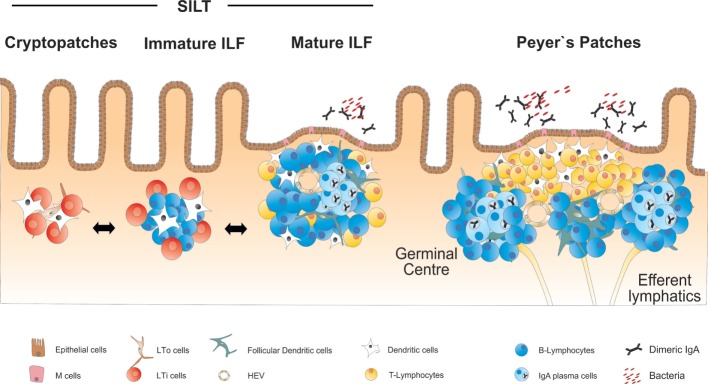
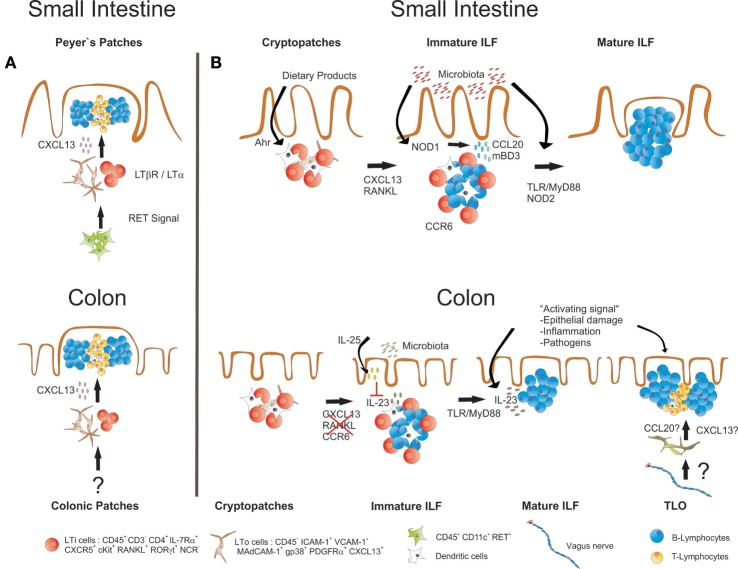
The immune system of the gut has evolved a number of specific lymphoid structures that contribute to homeostasis in the face of microbial colonization and food-derived antigenic challenge. These lymphoid organs encompass Peyer's patches (PP) in the small intestine and their colonic counterparts that develop in a programed fashion before birth. In addition, the gut harbors a network of lymphoid tissues that is commonly designated as solitary intestinal lymphoid tissues (SILT). In contrast to PP, SILT develop strictly after birth and consist of a dynamic continuum of structures ranging from small cryptopatches (CP) to large, mature isolated lymphoid follicles (ILF). Although the development of PP and SILT follow similar principles, such as an early clustering of lymphoid tissue inducer (LTi) cells and the requirement for lymphotoxin beta (LTβ) receptor-mediated signaling, the formation of CP and their further maturation into ILF is associated with additional intrinsic and environmental signals. Moreover, recent data also indicate that specific differences exist in the regulation of ILF formation between the small intestine and the colon. Importantly, intestinal inflammation in both mice and humans is associated with a strong expansion of the lymphoid network in the gut. Recent experiments in mice suggest that these structures, although they resemble large, mature ILF in appearance, may represent de novo-induced tertiary lymphoid organs (TLO). While, so far, it is not clear whether intestinal TLO contribute to the exacerbation of inflammatory pathology, it has been shown that ILF provide the critical microenvironment necessary for the induction of an effective host response upon infection with enteric bacterial pathogens. Regarding the importance of ILF for intestinal immunity, interfering with the development and maturation of these lymphoid tissues may offer novel means for manipulating the immune response during intestinal infection or inflammation.
肠道免疫系统已经进化出许多特定的淋巴结构,这些结构有助于在面对微生物定植和食物源性抗原挑战时维持体内平衡。这些淋巴器官包括小肠中的派尔集合淋巴结(PP)及其在出生前以程序化方式发育的结肠对应物。此外,肠道还拥有一个淋巴组织网络,通常被称为孤立性肠道淋巴组织(SILT)。与PP不同,SILT严格在出生后发育,由从小的隐窝斑(CP)到大型成熟孤立淋巴滤泡(ILF)的动态连续结构组成。尽管PP和SILT的发育遵循相似的原则,如淋巴组织诱导细胞(LTi)的早期聚集以及对淋巴毒素β(LTβ)受体介导信号的需求,但CP的形成及其进一步成熟为ILF与额外的内在和环境信号有关。此外,最近的数据还表明,小肠和结肠在ILF形成的调节方面存在特定差异。重要的是,小鼠和人类的肠道炎症都与肠道淋巴网络的强烈扩张有关。最近在小鼠身上进行的实验表明,这些结构虽然外观上类似于大型成熟的ILF,但可能代表从头诱导的三级淋巴器官(TLO)。虽然到目前为止尚不清楚肠道TLO是否会导致炎症病理的加重,但已经表明ILF为感染肠道细菌病原体后诱导有效的宿主反应提供了关键的微环境。鉴于ILF对肠道免疫的重要性,干扰这些淋巴组织的发育和成熟可能为在肠道感染或炎症期间操纵免疫反应提供新的手段。