Schuck Nicolas W, Cai Ming Bo, Wilson Robert C, Niv Yael
Princeton Neuroscience Institute and Department of Psychology, Princeton University, Washington Road, Princeton, NJ 08544, USA.
Princeton Neuroscience Institute and Department of Psychology, Princeton University, Washington Road, Princeton, NJ 08544, USA.
Neuron. 2016 Sep 21;91(6):1402-1412. doi: 10.1016/j.neuron.2016.08.019.
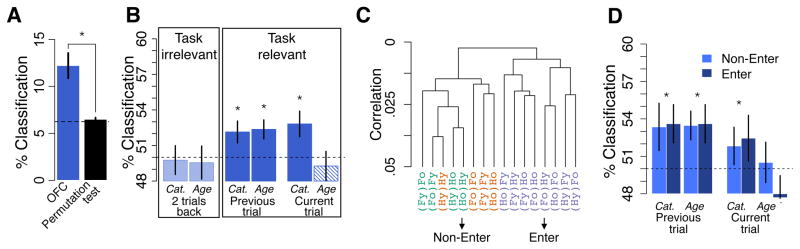
Although the orbitofrontal cortex (OFC) has been studied intensely for decades, its precise functions have remained elusive. We recently hypothesized that the OFC contains a "cognitive map" of task space in which the current state of the task is represented, and this representation is especially critical for behavior when states are unobservable from sensory input. To test this idea, we apply pattern-classification techniques to neuroimaging data from humans performing a decision-making task with 16 states. We show that unobservable task states can be decoded from activity in OFC, and decoding accuracy is related to task performance and the occurrence of individual behavioral errors. Moreover, similarity between the neural representations of consecutive states correlates with behavioral accuracy in corresponding state transitions. These results support the idea that OFC represents a cognitive map of task space and establish the feasibility of decoding state representations in humans using non-invasive neuroimaging.
尽管眶额皮质(OFC)已经被深入研究了几十年,但其确切功能仍然难以捉摸。我们最近推测,眶额皮质包含一个任务空间的“认知地图”,其中表征了任务的当前状态,并且当状态无法从感觉输入中观察到时,这种表征对行为尤为关键。为了验证这一想法,我们将模式分类技术应用于人类执行具有16种状态的决策任务时的神经成像数据。我们表明,不可观察的任务状态可以从眶额皮质的活动中解码出来,并且解码准确性与任务表现以及个体行为错误的发生有关。此外,连续状态的神经表征之间的相似性与相应状态转换中的行为准确性相关。这些结果支持了眶额皮质代表任务空间的认知地图这一观点,并确立了使用非侵入性神经成像在人类中解码状态表征的可行性。