Tilwani R K, Vessillier S, Pingguan-Murphy B, Lee D A, Bader D L, Chowdhury T T
Institute of Bioengineering, School of Engineering and Materials Science, Queen Mary University of London, Mile End Road, London, E1 4NS, UK.
Biotherapeutics Group, National Institute for Biological Standards and Control, South Mimms, Potters Bar, Hertfordshire, EN6 3QG, UK.
Inflamm Res. 2017 Jan;66(1):49-58. doi: 10.1007/s00011-016-0991-5. Epub 2016 Sep 22.
Oxygen tension and biomechanical signals are factors that regulate inflammatory mechanisms in chondrocytes. We examined whether low oxygen tension influenced the cells response to TNFα and dynamic compression.
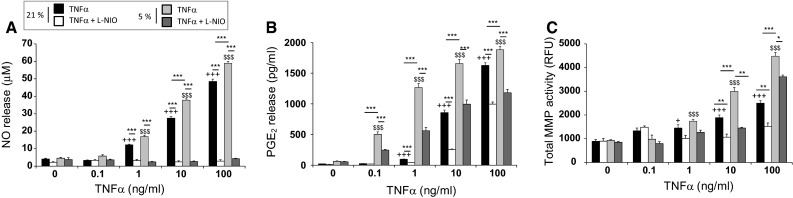
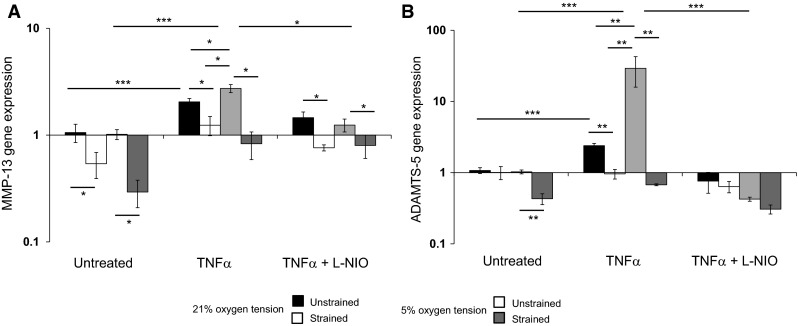
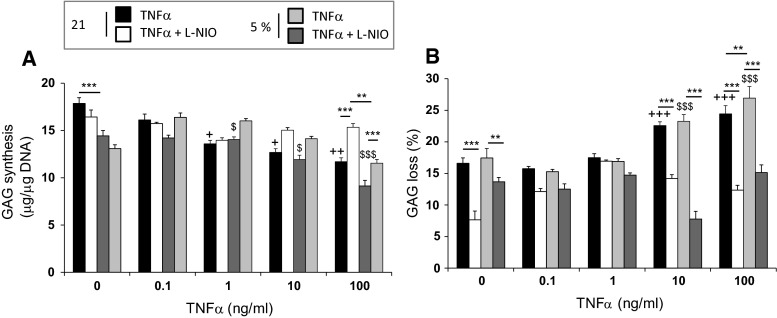
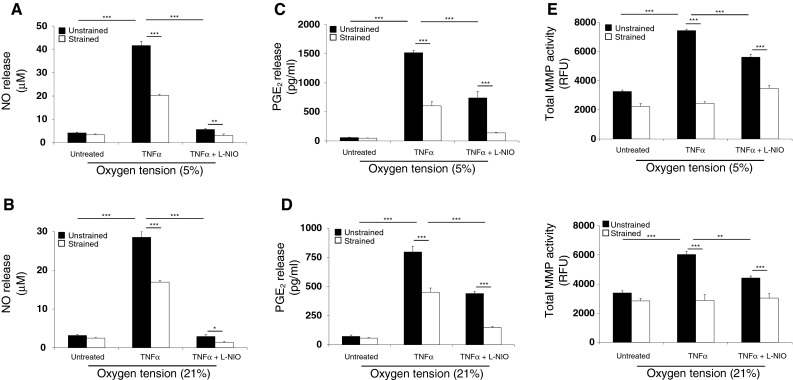
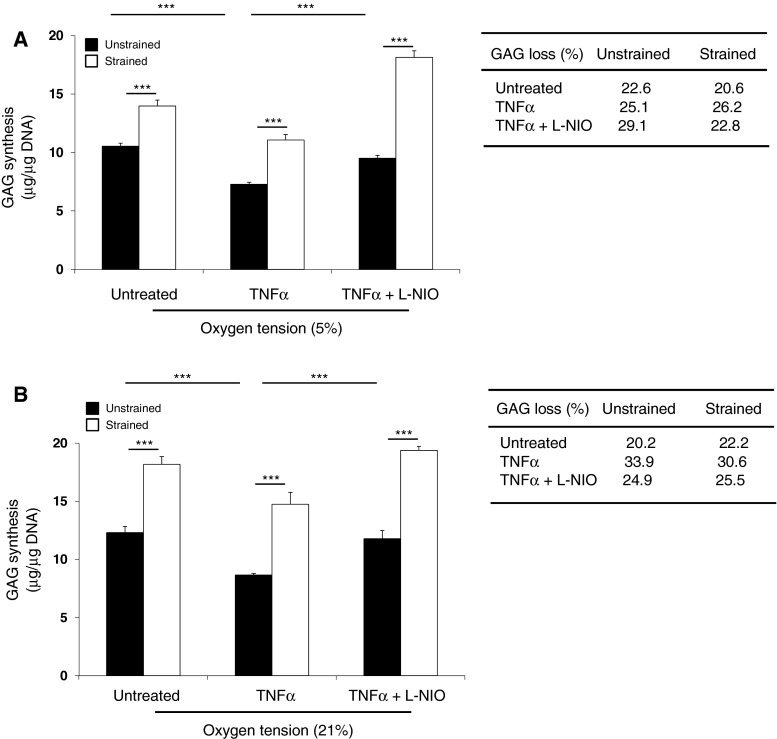
Chondrocyte/agarose constructs were treated with varying concentrations of TNFα (0.1-100 ng/ml) and cultured at 5 and 21 % oxygen tension for 48 h. In separate experiments, constructs were subjected to dynamic compression (15 %) and treated with TNFα (10 ng/ml) and/or L-NIO (1 mM) at 5 and 21 % oxygen tension using an ex vivo bioreactor for 48 h. Markers for catabolic activity (NO, PGE) and tissue remodelling (GAG, MMPs) were quantified by biochemical assay. ADAMTS-5 and MMP-13 expression were examined by real-time qPCR. 2-way ANOVA and a post hoc Bonferroni-corrected t test were used to analyse data.
TNFα dose-dependently increased NO, PGE and MMP activity (all p < 0.001) and induced MMP-13 (p < 0.05) and ADAMTS-5 gene expression (pp < 0.01) with values greater at 5 % oxygen tension than 21 %. The induction of catabolic mediators by TNFα was reduced by dynamic compression and/or L-NIO (all p < 0.001), with a greater inhibition observed at 5% than 21 %. The stimulation of GAG synthesis by dynamic compression was greater at 21 % than 5 % oxygen tension and this response was reduced with TNFα or reversed with L-NIO.
The present findings revealed that TNFα increased production of NO, PGE and MMP activity at 5 % oxygen tension. The effects induced by TNFα were reduced by dynamic compression and/or the NOS inhibitor, linking both types of stimuli to reparative activities. Future therapeutics should develop oxygen-sensitive antagonists which are directed to interfering with the TNFα-induced pathways.
氧张力和生物力学信号是调节软骨细胞炎症机制的因素。我们研究了低氧张力是否会影响细胞对肿瘤坏死因子α(TNFα)和动态压缩的反应。
用不同浓度的TNFα(0.1 - 100 ng/ml)处理软骨细胞/琼脂糖构建体,并在5%和21%的氧张力下培养48小时。在单独的实验中,使用离体生物反应器对构建体施加动态压缩(15%),并在5%和21%的氧张力下用TNFα(10 ng/ml)和/或L - NIO(1 mM)处理48小时。通过生化测定对分解代谢活性标志物(NO、PGE)和组织重塑标志物(GAG、基质金属蛋白酶)进行定量。通过实时定量聚合酶链反应检测含血小板解聚蛋白样金属蛋白酶5(ADAMTS - 5)和基质金属蛋白酶13(MMP - 13)的表达。采用双向方差分析和事后Bonferroni校正t检验分析数据。
TNFα剂量依赖性地增加NO、PGE和基质金属蛋白酶活性(均p < 0.001),并诱导MMP - 13(p < 0.05)和ADAMTS - 5基因表达(p < 0.01),在5%氧张力下的值高于21%氧张力下的值。动态压缩和/或L - NIO降低了TNFα对分解代谢介质的诱导作用(均p < 0.001),在5%氧张力下观察到的抑制作用大于21%氧张力下的抑制作用。动态压缩对GAG合成的刺激在21%氧张力下大于5%氧张力,并且这种反应在TNFα作用下降低或在L - NIO作用下逆转。
本研究结果表明,TNFα在5%氧张力下增加NO、PGE的产生和基质金属蛋白酶活性。动态压缩和/或一氧化氮合酶抑制剂降低了TNFα诱导的效应,将这两种刺激与修复活动联系起来。未来的治疗方法应开发针对干扰TNFα诱导途径的氧敏感拮抗剂。