Kanatani Yasuhiro, Tomita Naoko, Sato Yoko, Eto Akiko, Omoe Hiroe, Mizushima Hiroshi
Department of Health Crisis Management, National Institute of Public Health.
Neurol Med Chir (Tokyo). 2017 Jan 15;57(1):1-7. doi: 10.2176/nmc.st.2016-0135. Epub 2016 Sep 21.
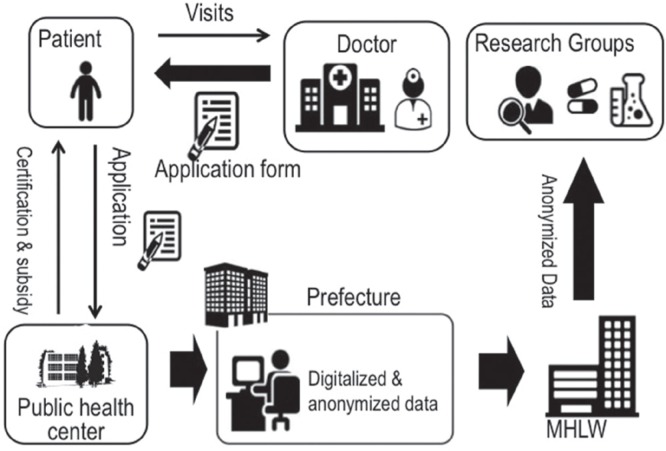
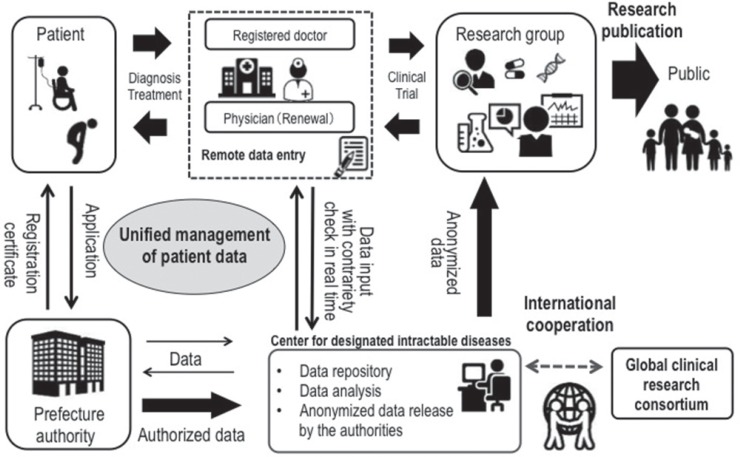
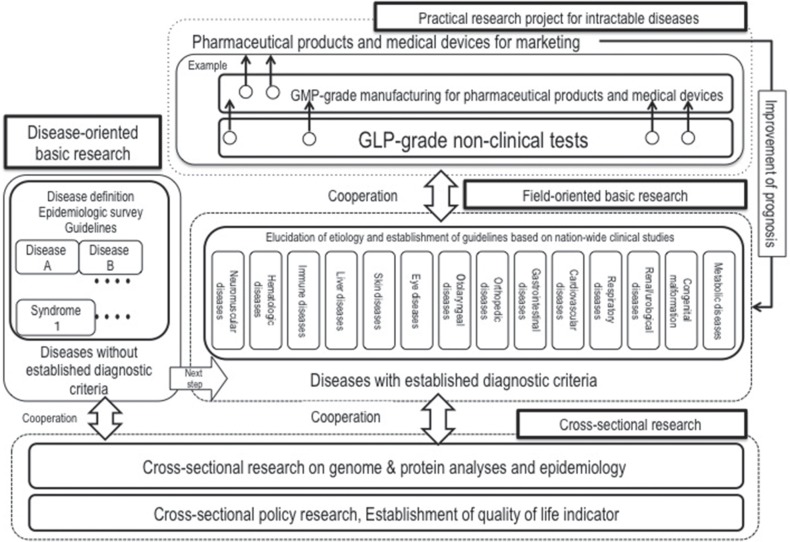
Japan promotes research related to intractable diseases and financially supports patients with these diseases. Intractable diseases are designated as those that fulfill the following criteria: (1) rarity (affecting less than 0.1% of the population in Japan), (2) unknown etiology, (3) lack of effective treatment, (4) necessity of long-term treatment, and (5) existence of objective diagnostic criteria and not necessarily equal to rare diseases in other countries. The construction of a national database is required to promote research to clarify the pathogenesis of these diseases and to develop pharmaceutical products and medical devices. The Ministry of Health, Labor, and Welfare launched an online registration system in 2001, but many problems associated with gathering and utilizing information on patients with intractable diseases remain. In this paper, we describe the present status of the national registry of designated intractable diseases in Japan and discuss future prospects.
日本推动与疑难病症相关的研究,并为患有这些疾病的患者提供财政支持。疑难病症被定义为符合以下标准的疾病:(1)罕见性(在日本影响不到0.1%的人口),(2)病因不明,(3)缺乏有效治疗方法,(4)需要长期治疗,以及(5)存在客观诊断标准,且不一定等同于其他国家的罕见疾病。为了推动旨在阐明这些疾病发病机制以及开发药品和医疗设备的研究,需要建立一个国家数据库。厚生劳动省于2001年推出了一个在线注册系统,但在收集和利用疑难病症患者信息方面仍存在许多问题。在本文中,我们描述了日本指定疑难病症国家登记处的现状,并讨论了未来前景。