Igbinosa Etinosa O, Beshiru Abeni, Akporehe Lucy U, Oviasogie Faith E, Igbinosa Owen O
SAMRC Microbial Water Quality Monitoring Centre, University of Fort Hare, Private Bag X1314, Alice 5700, South Africa.
Applied Microbial Process & Environmental Health Research Group, Department of Microbiology, Faculty of Life Sciences, University of Benin, Private Mail Bag 1154, Benin City 300001, Nigeria.
Int J Environ Res Public Health. 2016 Sep 24;13(10):949. doi: 10.3390/ijerph13100949.
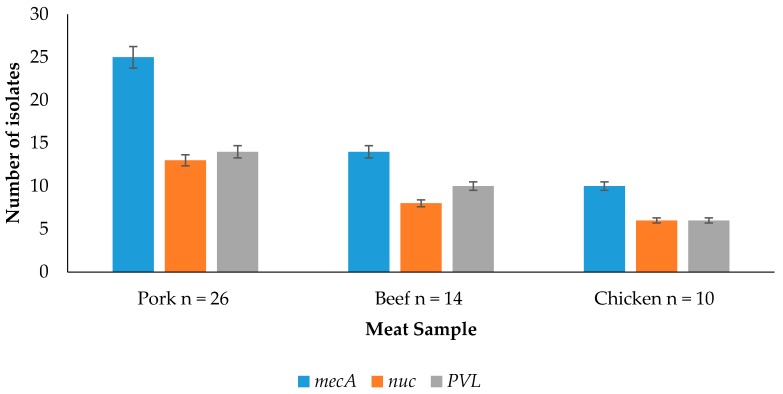
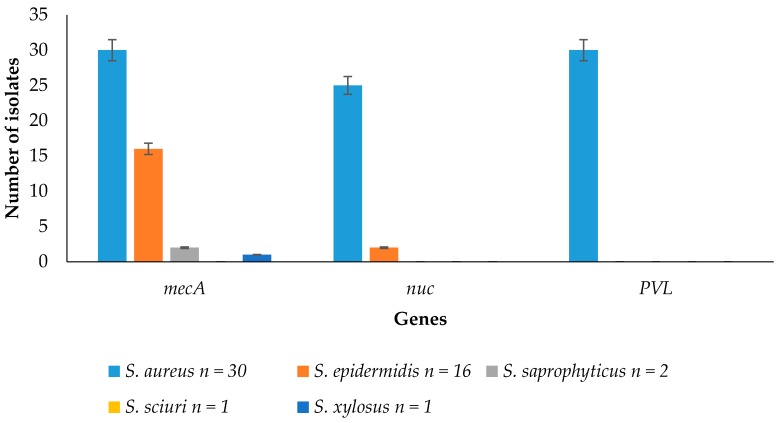
The present study was designed to characterize methicillin-resistant staphylococci from raw meat. A total of 126 meat samples were obtained from open markets between February and April, 2015. Antimicrobial susceptibility testing was carried out using the disc diffusion method. Molecular profiling was conducted using 16S rRNA, mecA, nuc, and PVL gene signatures were detected by polymerase chain reaction assay. Fifty isolates of methicillin-resistant Staphylococcus spp. were detected in 26 (52%) pork, 14 (28%) beef and 10 (20%) chicken samples. The staphylococcal isolates were identified through partial 16S ribosomal ribonucleic acid (16S rRNA) nucleotide sequencing, and BLAST analysis of the gene sequence revealed 98%-100% staphylococcal similarity. All isolates from beef and chicken samples amplified the mecA gene, while 100% of the MRSA isolates amplified the PVL gene. The multidrug resistance profile (resistant to ≥1 antimicrobial agent in ≥3 classes of antimicrobial agents) of the staphylococcal isolates showed that 7 isolates were resistant to methicillin, penicillin, clindamycin, chloramphenicol, trimethoprim-sulfamethoxazole, kanamycin, amoxicillin, cloxacillin, erythromycin, vancomycin, and gentamycin. There was a significant regression effect from the multidrug-resistant profile on the number of isolates (p < 0.05) suggesting a consequence of the dissemination of resistant strains within bacterial populations. The findings of the present study indicate that raw meats in the Benin metropolis were possibly contaminated with pathogenic and multi-drug resistant staphylococci strains and therefore could constitute a risk to public health communities.
本研究旨在对生肉中的耐甲氧西林葡萄球菌进行特征分析。2015年2月至4月间,从露天市场共采集了126份肉类样本。采用纸片扩散法进行药敏试验。利用16S rRNA进行分子分型,通过聚合酶链反应检测mecA、nuc和PVL基因特征。在26份(52%)猪肉、14份(28%)牛肉和10份(20%)鸡肉样本中检测到50株耐甲氧西林葡萄球菌属菌株。通过对部分16S核糖体核糖核酸(16S rRNA)核苷酸测序鉴定葡萄球菌分离株,基因序列的BLAST分析显示葡萄球菌相似度为98%-100%。来自牛肉和鸡肉样本的所有分离株均扩增出mecA基因,而100%的耐甲氧西林金黄色葡萄球菌(MRSA)分离株扩增出PVL基因。葡萄球菌分离株的多重耐药谱(对≥3类抗菌药物中的≥1种抗菌药物耐药)显示,7株分离株对甲氧西林、青霉素、克林霉素、氯霉素、甲氧苄啶-磺胺甲恶唑、卡那霉素、阿莫西林、氯唑西林、红霉素、万古霉素和庆大霉素耐药。多重耐药谱对分离株数量有显著回归效应(p<0.05),表明耐药菌株在细菌群体中传播的后果。本研究结果表明,贝宁大都市的生肉可能被致病性和多重耐药葡萄球菌菌株污染,因此可能对公共卫生社区构成风险。