Xu Dan, Wang Yingshuo, Chen Zhimin, Li Shuxian, Cheng Yungai, Zhang Li, Zhao Lingzhi
Department of Pulmonology, The Children's Hospital of Zhejiang University School of Medicine, 3333 Binsheng Road, Hangzhou, 310003, Zhejiang Province, China.
Department of Internal Medicine, Hangzhou Children's Hospital, 201 Wenhui Road, Hangzhou, 310014, Zhejiang Province, China.
Respir Res. 2016 Sep 27;17(1):122. doi: 10.1186/s12931-016-0439-z.
Asthma is a global problem. Prevalence varies among different countries and cities. We aimed to obtain the prevalence, describe the characteristics, and discover factors that may relate to asthma in Hangzhou.
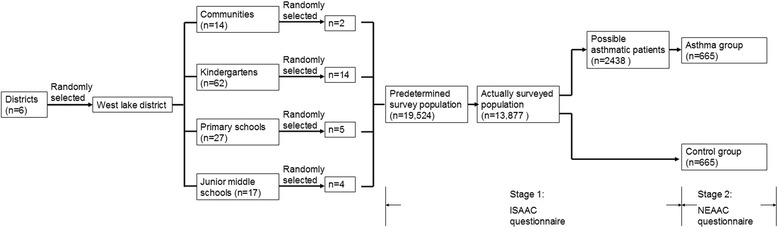
This cross-sectional study was conducted in Hangzhou. The subjects were children aged 14 years and younger. A control group of non-asthma children that matched in age and sex with each asthmatic patient was also randomly selected and interviewed. International Study of Asthma and Allergies in Childhood and National Epidemiology study of Asthma and Allergies in China questionnaires were used in this survey.
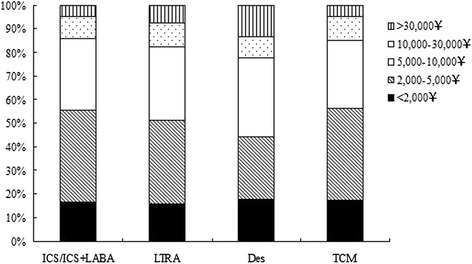
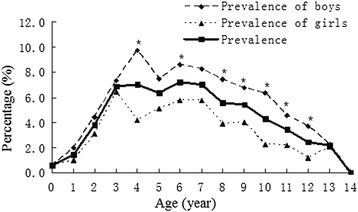
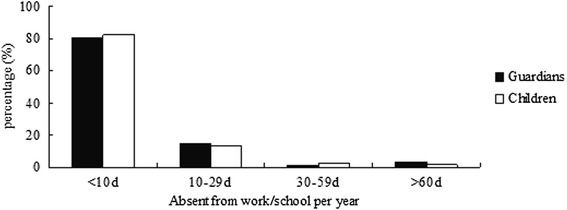
We have questionnaired 13,877 children, and 665 (4.8 %) children were diagnosed asthma. The guardians regarded the cost of asthma management affordable in 49.4 %, tolerable in 46.9 %, and intolerable in 3.7 %. Both guardians and children have been absent from work or school due to children's asthma. Respiratory tract infection was the most common trigger of asthma attacks (85.1 %). Other common causes included cold air, house dust, exercise, fish and shrimp, pollen, and et al. Interestingly, we also found in children 6 years and older, some triggers happened more than that in children 5 years and younger. Those factors included exercise, emotional changes, house dust, pollen, renovation works in the home, mosquito-repellent incense and pets (all the p values were <0.05). We compared some factors may relate to asthma development. Higher percentage of family history of asthma, personal history of allergy (atopic dermatitis, drug allergy and food allergy), comorbidities (allergic rhinitis, sinusitis, adenoidal hypertrophy, and urticaria), caesarean birth and complications ever happened during pregnancy were discovered in asthma children than in non-asthma children (all the p values were <0.05). Exclusive breastfeeding within first 6 months and keeping animals had higher percentage in non-asthma children than in asthma (both the p values were <0.05). Inhaled corticosteroid (ICS)/ICS + long-acting beta2 agonists (LABA) was applied to 46.2 % of patients. Traditional Chinese medicine (TCM) was used in 44.2 % of asthma children, while leukotriene receptor antagonist (LTRA) was used in 36.4 % of them. The adherence scored higher in TCM than in ICS/ICS + LABA (P = 0.003) and LTRA.
In conclusion, we conducted an epidemiology study in Hangzhou. The prevalence of childhood asthma was 4.8 %. Asthma was an economic and social burden to both children and guardians. Risk factors of asthma development may include caesarean birth, personal history of allergy and concomitant allergic diseases. Exclusive breastfeeding within first 6 months and keeping animals might be protecting factors. TCM was really popular in China besides ICS/ICS + LABA and LTRA.
哮喘是一个全球性问题。不同国家和城市的患病率各不相同。我们旨在获取杭州地区哮喘的患病率,描述其特征,并找出可能与哮喘相关的因素。
本横断面研究在杭州开展。研究对象为14岁及以下儿童。同时随机选取与每位哮喘患儿年龄和性别匹配的非哮喘儿童作为对照组并进行访谈。本调查采用了儿童哮喘和过敏国际研究以及中国哮喘和过敏国家流行病学研究问卷。
我们对13877名儿童进行了问卷调查,其中665名(4.8%)儿童被诊断为哮喘。49.4%的监护人认为哮喘管理费用可以承受,46.9%认为尚可忍受,3.7%认为无法忍受。监护人和儿童都曾因儿童哮喘而缺勤或缺课。呼吸道感染是哮喘发作最常见的诱因(85.1%)。其他常见原因包括冷空气、屋尘、运动、鱼虾、花粉等。有趣的是,我们还发现6岁及以上儿童的一些诱因比5岁及以下儿童更多。这些因素包括运动、情绪变化、屋尘、花粉、家庭装修、蚊香和宠物(所有p值均<0.05)。我们比较了一些可能与哮喘发病相关的因素。哮喘患儿中哮喘家族史、个人过敏史(特应性皮炎、药物过敏和食物过敏)、合并症(过敏性鼻炎、鼻窦炎、腺样体肥大和荨麻疹)、剖宫产以及孕期曾发生并发症的比例高于非哮喘儿童(所有p值均<0.05)。非哮喘儿童中前6个月纯母乳喂养和饲养动物的比例高于哮喘儿童(两个p值均<0.05)。46.2%的患者使用了吸入性糖皮质激素(ICS)/ICS + 长效β2受体激动剂(LABA)。44.2%的哮喘儿童使用了中药,36.4%的儿童使用了白三烯受体拮抗剂(LTRA)。中药治疗的依从性得分高于ICS/ICS + LABA(P = 0.003)和LTRA。
总之,我们在杭州开展了一项流行病学研究。儿童哮喘患病率为4.8%。哮喘对儿童及其监护人来说是一项经济和社会负担。哮喘发病的危险因素可能包括剖宫产、个人过敏史和合并过敏性疾病。前6个月纯母乳喂养和饲养动物可能是保护因素。除了ICS/ICS + LABA和LTRA外,中药在中国确实很受欢迎。