Balasubramanian Vimal Kumar, Rai Krishan Mohan, Thu Sandi Win, Hii Mei Mei, Mendu Venugopal
Fiber and Biopolymer Research Institute (FBRI), Department of Plant &Soil Science, Texas Tech University, 2802, 15th street, Lubbock, TX, 79409, USA.
Sci Rep. 2016 Sep 29;6:34309. doi: 10.1038/srep34309.
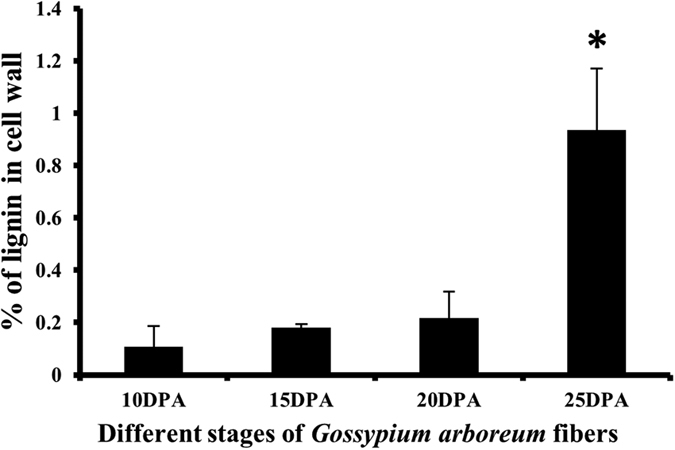
The single-celled cotton fibers, produced from seed coat epidermal cells are the largest natural source of textile fibers. The economic value of cotton fiber lies in its length and quality. The multifunctional laccase enzymes play important roles in cell elongation, lignification and pigmentation in plants and could play crucial role in cotton fiber quality. Genome-wide analysis of cultivated allotetraploid (G. hirsutum) and its progenitor diploid (G. arboreum and G. raimondii) cotton species identified 84, 44 and 46 laccase genes, respectively. Analysis of chromosomal location, phylogeny, conserved domain and physical properties showed highly conserved nature of laccases across three cotton species. Gene expression, enzymatic activity and biochemical analysis of developing cotton fibers was performed using G. arboreum species. Of the total 44, 40 laccases showed expression during different stages of fiber development. The higher enzymatic activity of laccases correlated with higher lignin content at 25 DPA (Days Post Anthesis). Further, analysis of cotton fiber phenolic compounds showed an overall decrease at 25 DPA indicating possible incorporation of these substrates into lignin polymer during secondary cell wall biosynthesis. Overall data indicate significant roles of laccases in cotton fiber development, and presents an excellent opportunity for manipulation of fiber development and quality.
由种皮表皮细胞产生的单细胞棉纤维是纺织纤维最大的天然来源。棉纤维的经济价值在于其长度和品质。多功能漆酶在植物细胞伸长、木质化和色素沉着过程中发挥重要作用,并且可能在棉纤维品质方面发挥关键作用。对栽培异源四倍体(陆地棉)及其祖先二倍体(亚洲棉和雷蒙德氏棉)棉种进行全基因组分析,分别鉴定出84个、44个和46个漆酶基因。对染色体定位、系统发育、保守结构域和物理特性的分析表明,三种棉种的漆酶具有高度保守性。利用亚洲棉对发育中的棉纤维进行基因表达、酶活性和生化分析。在总共44个漆酶中,40个在纤维发育的不同阶段表现出表达。在开花后25天,漆酶较高的酶活性与较高的木质素含量相关。此外,对棉纤维酚类化合物的分析表明,在开花后25天总体上有所下降,这表明在次生细胞壁生物合成过程中这些底物可能被整合到木质素聚合物中。总体数据表明漆酶在棉纤维发育中具有重要作用,并为调控纤维发育和品质提供了绝佳机会。