Tong Tammy Y N, Wareham Nicholas J, Khaw Kay-Tee, Imamura Fumiaki, Forouhi Nita G
MRC Epidemiology Unit, University of Cambridge School of Clinical Medicine, Cambridge, UK.
Department of Public Health and Primary Care, University of Cambridge, Cambridge, UK.
BMC Med. 2016 Sep 29;14(1):135. doi: 10.1186/s12916-016-0677-4.
Despite convincing evidence in the Mediterranean region, the cardiovascular benefit of the Mediterranean diet is not well established in non-Mediterranean countries and the optimal criteria for defining adherence are unclear. The population attributable fraction (PAF) of adherence to this diet is also unknown.
In the UK-based EPIC-Norfolk prospective cohort, we evaluated habitual diets assessed at baseline (1993-1997) and during follow-up (1998-2000) using food-frequency questionnaires (n = 23,902). We estimated a Mediterranean diet score (MDS) using cut-points projected from the Mediterranean dietary pyramid, and also three other pre-existing MDSs. Using multivariable-adjusted Cox regression with repeated measures of MDS and covariates, we examined prospective associations between each MDS with incident cardiovascular diseases (CVD) by 2009 and mortality by 2013, and estimated PAF for each outcome attributable to low MDS.
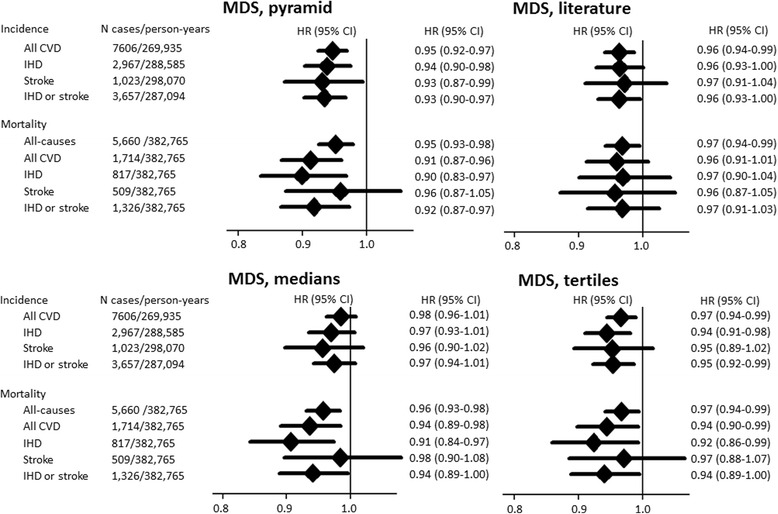
We observed 7606 incident CVD events (2818/100,000 person-years) and 1714 CVD deaths (448/100,000). The MDS based on the Mediterranean dietary pyramid was significantly associated with lower incidence of the cardiovascular outcomes, with hazard ratios (95 % confidence intervals) of 0.95 (0.92-0.97) per one standard deviation for incident CVD and 0.91 (0.87-0.96) for CVD mortality. Associations were similar for composite incident ischaemic heart disease and all-cause mortality. Other pre-existing MDSs showed similar, but more modest associations. PAF due to low dietary pyramid based MDS (<95th percentile) was 3.9 % (1.3-6.5 %) for total incident CVD and 12.5 % (4.5-20.6 %) for CVD mortality.
Greater adherence to the Mediterranean diet was associated with lower CVD incidence and mortality in the UK. This diet has an important population health impact for the prevention of CVD.
尽管地中海地区有令人信服的证据,但地中海饮食对心血管的益处尚未在非地中海国家得到充分证实,且定义依从性的最佳标准尚不清楚。遵循这种饮食的人群归因分数(PAF)也未知。
在英国的EPIC-诺福克前瞻性队列研究中,我们使用食物频率问卷(n = 23,902)评估了在基线期(1993 - 1997年)和随访期(1998 - 2000年)的习惯性饮食。我们使用从地中海饮食金字塔推算出的切点估计了地中海饮食评分(MDS),以及其他三种现有的MDS。通过对MDS和协变量进行重复测量的多变量调整Cox回归,我们研究了到2009年每种MDS与心血管疾病(CVD)发病以及到2013年与死亡率之间的前瞻性关联,并估计了低MDS导致的每种结局的PAF。
我们观察到7606例CVD发病事件(2818/100,000人年)和1714例CVD死亡(448/100,000)。基于地中海饮食金字塔的MDS与心血管结局的较低发病率显著相关,新发CVD每增加一个标准差的风险比(95%置信区间)为0.95(0.92 - 0.97),CVD死亡率的风险比为0.91(0.87 - 0.96)。复合性缺血性心脏病发病和全因死亡率的关联相似。其他现有的MDS显示出相似但更弱的关联。基于饮食金字塔的低MDS(<第95百分位数)导致的PAF在总CVD发病中为3.9%(1.3 - 6.5%),在CVD死亡率中为12.5%(4.5 - 20.6%)。
在英国,更高程度地遵循地中海饮食与较低的CVD发病率和死亡率相关。这种饮食对预防CVD具有重要的人群健康影响。