Campbell Rebecca K, Hurley Kristen M, Shamim Abu Ahmed, Shaikh Saijuddin, Chowdhury Zaynah T, Mehra Sucheta, de Pee Saskia, Ahmed Tahmeed, West Keith P, Christian Parul
Department of International Health, Johns Hopkins Bloomberg School of Public Health, Baltimore, MD.
FHI360, Dhaka, Bangladesh.
Am J Clin Nutr. 2016 Nov;104(5):1450-1458. doi: 10.3945/ajcn.116.135509. Epub 2016 Sep 28.
Complementary food supplements (CFSs) can enhance growth where stunting is common, but substitution for the usual diet may reduce observed benefits.
We aimed to characterize dietary diversity from home foods in a CFS efficacy trial and determine whether supplementation reduced breastfeeding frequency or displaced home foods.
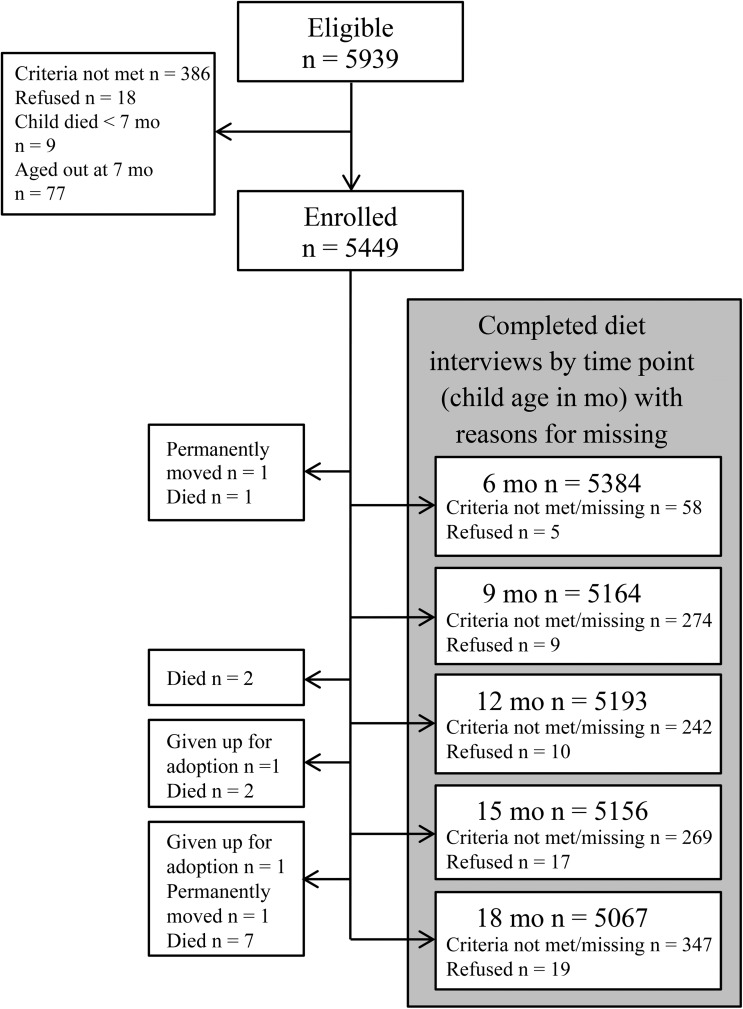
In a cluster-randomized controlled trial in rural Bangladesh, children (n = 5499) received, for 1 y starting at age 6 mo, periodic child feeding counseling for mothers (control) or counseling plus 1 of 4 CFSs fed as a daily snack. Breastfeeding status and past 24-h diet were assessed at enrollment and every 3 mo thereafter until 18 mo of age. A 7-food group dietary diversity score (DDS) was calculated from home foods only, and a DDS ≥4 constituted minimum dietary diversity (MDD).
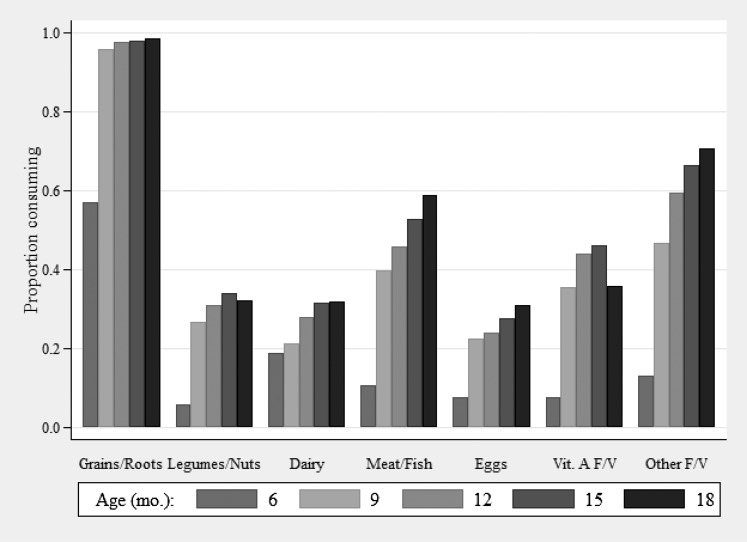
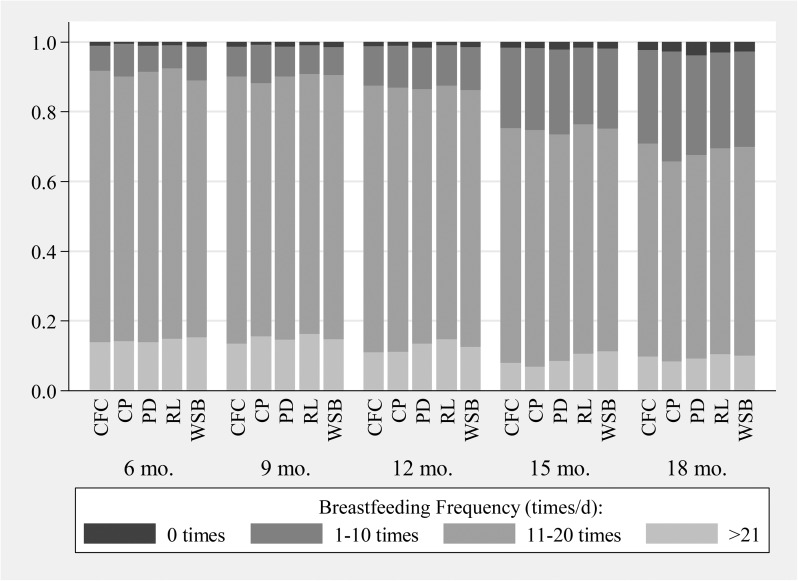
Most children (97%) were breastfed through 18 mo of age, and 24-h breastfeeding frequency did not differ by supplementation group. Child dietary diversity was low; only 51% of children met the MDD by 18 mo. Rice, potatoes, and biscuits (cookies) were the most frequently consumed foods, whereas the legumes, dairy, eggs, and vitamin A-rich fruit and vegetable food groups were each consumed by <50% of children. The odds of meeting the MDD through the consumption of home foods were equal or greater in the supplemented groups compared with the control group at all ages. High socioeconomic status and any maternal education were associated with increased odds of MDD at age 18 mo, whereas child sex and household food security were not associated with MDD.
In a setting where daily complementary food supplementation improved linear growth, there was no evidence that supplementation displaced breastfeeding or home foods, and the supplementation may have improved dietary diversity. Pathways by which supplementation with fortified foods may enhance dietary diversity, such as an improved appetite and increased body size, need elucidation. This trial was registered at clinicaltrials.gov as NCT01562379.
在发育迟缓普遍存在的地区,辅食补充剂(CFSs)可促进生长,但替代日常饮食可能会降低观察到的益处。
我们旨在描述一项CFS功效试验中家庭食物的饮食多样性特征,并确定补充剂是否会降低母乳喂养频率或取代家庭食物。
在孟加拉国农村地区进行的一项整群随机对照试验中,儿童(n = 5499)从6个月大开始接受为期1年的干预,对照组的母亲接受定期儿童喂养咨询,干预组的母亲除接受咨询外,每天还会给孩子提供4种CFSs中的1种作为零食。在入组时以及之后每3个月直至18个月龄时评估母乳喂养状况和过去24小时的饮食情况。仅根据家庭食物计算7食物组饮食多样性得分(DDS),DDS≥4构成最低饮食多样性(MDD)。
大多数儿童(97%)在18个月龄前进行母乳喂养,补充剂组之间的24小时母乳喂养频率没有差异。儿童的饮食多样性较低;到18个月龄时,只有51%的儿童达到了MDD。大米、土豆和饼干(曲奇)是最常食用的食物,而豆类、乳制品、鸡蛋以及富含维生素A的水果和蔬菜食物组中,每种食物的食用儿童均不到50%。在所有年龄段,与对照组相比,补充剂组通过食用家庭食物达到MDD的几率相同或更高。高社会经济地位和母亲接受过任何教育与18个月龄时达到MDD的几率增加相关,而儿童性别和家庭粮食安全与MDD无关。
在每日补充辅食可改善线性生长的环境中,没有证据表明补充剂会取代母乳喂养或家庭食物,而且补充剂可能改善了饮食多样性。强化食品补充剂增强饮食多样性的途径,如改善食欲和增加体型,需要进一步阐明。该试验已在clinicaltrials.gov上注册,注册号为NCT01562379。