The JiVitA Project of Johns Hopkins University, Bangladesh, Gaibandha, Bangladesh.
Center for Human Nutrition, Department of International Health, Johns Hopkins University Bloomberg School of Public Health, Baltimore, MD, USA.
J Nutr. 2020 Jul 1;150(7):1924-1932. doi: 10.1093/jn/nxaa061.
Complementary food supplementation enhances linear growth and may affect body composition in children.
We aimed to determine the effect of complementary food supplements provided from the age of 6 to 18 mo on fat-free mass (FFM) and fat mass (FM) gain among children in rural Bangladesh.
In an unblinded, cluster-randomized, controlled trial we tested the effects of 4 complementary food supplements for 1 y [chickpea, rice lentil, Plumpy'doz, and wheat-soy-blend++ (WSB++)] compared with no supplements on linear growth. Body composition was estimated using weight-length-based, age- and sex-specific equations at 6, 9, 12, 15, and 18 mo and postintervention aged 24 mo. Generalized estimating equations (GEEs) were applied to estimate the effect of each complementary food on mean FFM and FM from 9 to 18 and 24 mo compared with the control, adjusting for baseline measures. Sex interactions were also explored.
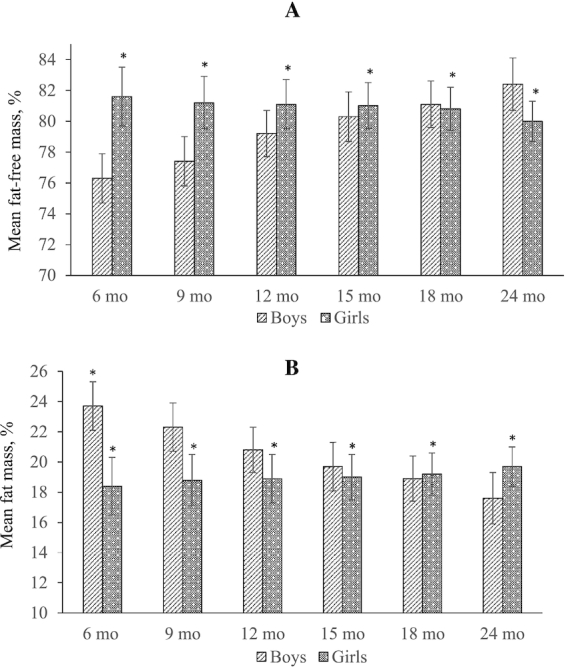
In total, 3592 (65.9% of enrolled) children completed all anthropometric assessments. Estimated FFM and FM (mean ± SD) were 5.3 ± 0.6 kg and 1.4 ± 0.4 kg, respectively, at the age of 6 mo. Mean ± SE FFM and FM from 9 to 18 mo were 75.4 ± 14.0 g and 32.9 ± 7.1 g, and 61.0 ± 16.6 g and 30.0 ± 8.4 g, higher with Plumpy'doz and chickpea foods, respectively, than the control (P < 0.001). Estimated FFM was 41.5 ± 16.6 g higher in rice-lentil-fed versus control (P < 0.05) children. WSB++ had no impact on FFM or FM. A group-sex interaction (P < 0.1) was apparent with Plumpy'doz and rice-lentil foods, with girls involved in the intervention having higher estimated FFM and FM than control girls compared with no significant effect in boys. At 24 mo, FFM and FM remained higher only in girls eating Plumpy'doz compared with the controls (P < 0.01).
In this randomized trial, supplementation effected small shifts in apparent body composition in rural Bangladeshi children. Where seen, FFM increments were twice that of FM, in proportion to these compartments, and more pronounced in girls. FFM increased in line with reported improvements in length. This trial was registered at clinicaltrials.gov as NCT01562379.
补充食物可以促进线性生长,并可能影响儿童的身体成分。
我们旨在确定从 6 至 18 个月龄起补充食物补充剂对孟加拉国农村儿童的无脂肪质量(FFM)和脂肪质量(FM)增加的影响。
在一项未设盲、整群随机、对照试验中,我们测试了 4 种补充食物(鹰嘴豆、大米豆、Plumpy'doz 和小麦-大豆混合粉++(WSB++))与不补充的效果相比,在 1 年时间内对线性生长的影响。在 6、9、12、15 和 18 个月龄以及干预后 24 个月龄时,使用基于体重-长度、年龄和性别特异性的方程估计身体成分。使用广义估计方程(GEE)来估计与对照组相比,每种补充食物从 9 至 18 个月和 24 个月时的 FFM 和 FM 的平均变化,调整基线测量值。还探讨了性别间的相互作用。
共有 3592 名(65.9%的入组儿童)完成了所有人体测量评估。在 6 月龄时,估计的 FFM 和 FM(平均值±SD)分别为 5.3±0.6kg 和 1.4±0.4kg。从 9 至 18 个月的平均±SE FFM 和 FM 分别为 75.4±14.0g 和 32.9±7.1g,以及 61.0±16.6g 和 30.0±8.4g,Plumpy'doz 和鹰嘴豆食品组分别高于对照组(P<0.001)。与对照组相比,食用大米-豆的儿童的 FFM 高出 41.5±16.6g(P<0.05)。WSB++对 FFM 或 FM 没有影响。组间性别(P<0.1)的相互作用在 Plumpy'doz 和大米-豆食品中明显,与对照组相比,参与干预的女孩的 FFM 和 FM 估计值更高,而男孩则没有显著影响。在 24 个月时,只有食用 Plumpy'doz 的女孩的 FFM 和 FM 仍高于对照组(P<0.01)。
在这项随机试验中,补充食物对孟加拉国农村儿童的表观身体成分产生了较小的影响。在可见的情况下,FFM 的增量是 FM 的两倍,与这些隔室成比例,在女孩中更为明显。FFM 的增加与报告的长度改善相一致。本试验在 clinicaltrials.gov 注册,编号为 NCT01562379。