Tang Qiao, Liu Yajun, Li Tao, Yang Xiang, Zheng Guirong, Chen Hongning, Jia Lee, Shao Jingwei
Cancer Metastasis Alert and Prevention Center, Pharmaceutical Photocatalysis of State Key Laboratory of Photocatalysis on Energy and Environment, College of Chemistry, Fuzhou University, Fuzhou, China.
Fujian Provincial Key Laboratory of Cancer Metastasis Chemoprevention, Fuzhou University, Fuzhou, China.
Oncotarget. 2016 Nov 8;7(45):73114-73129. doi: 10.18632/oncotarget.12232.
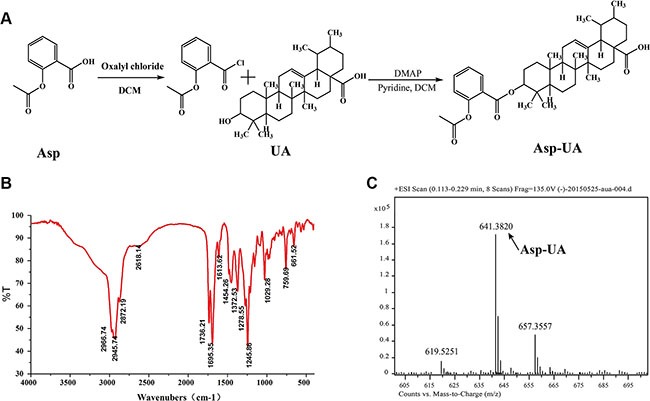
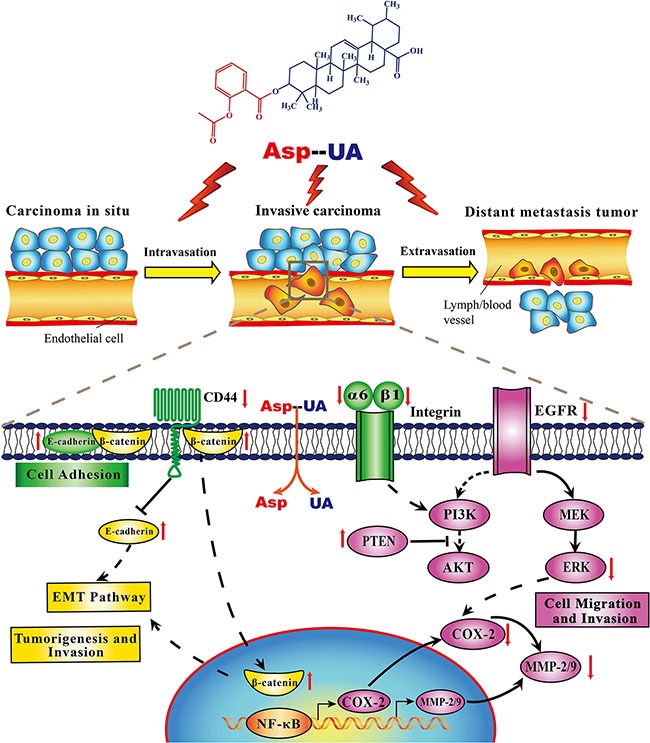
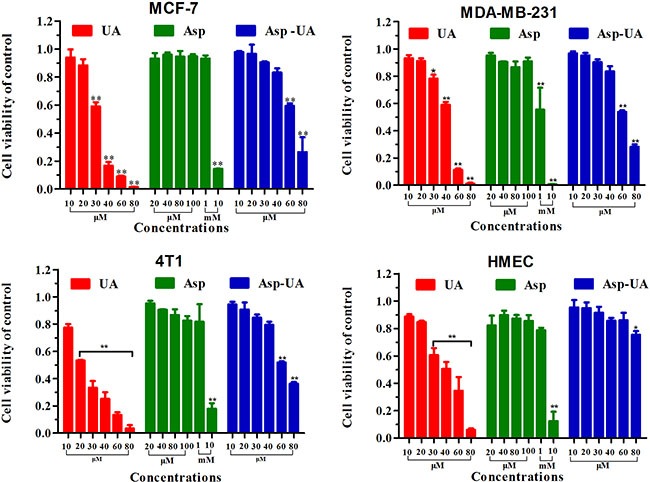
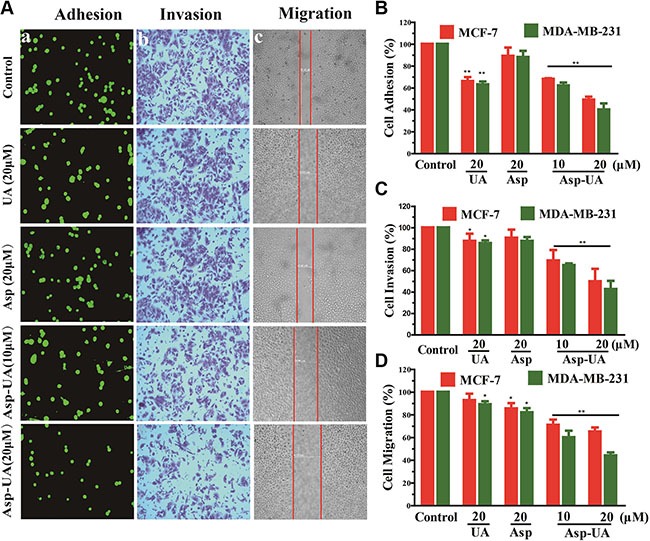
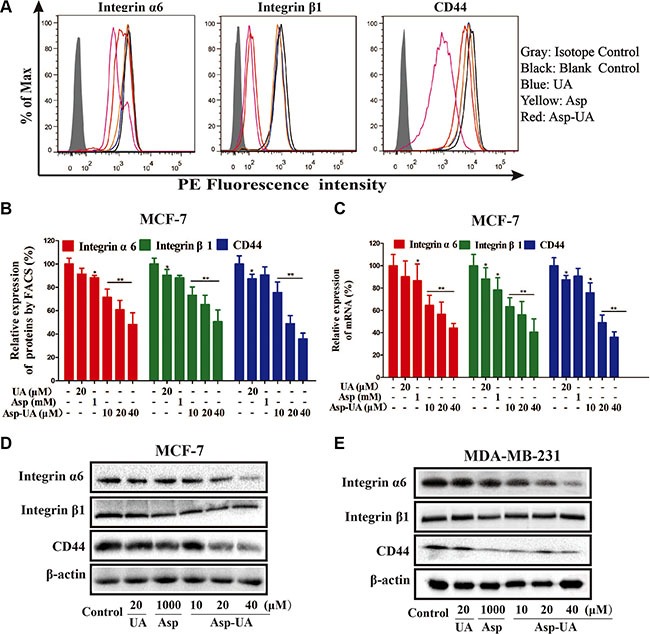
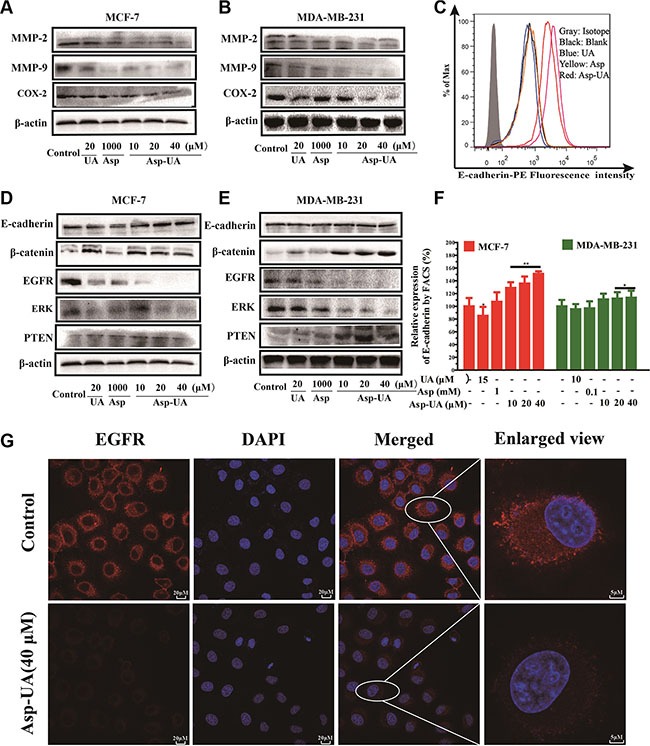
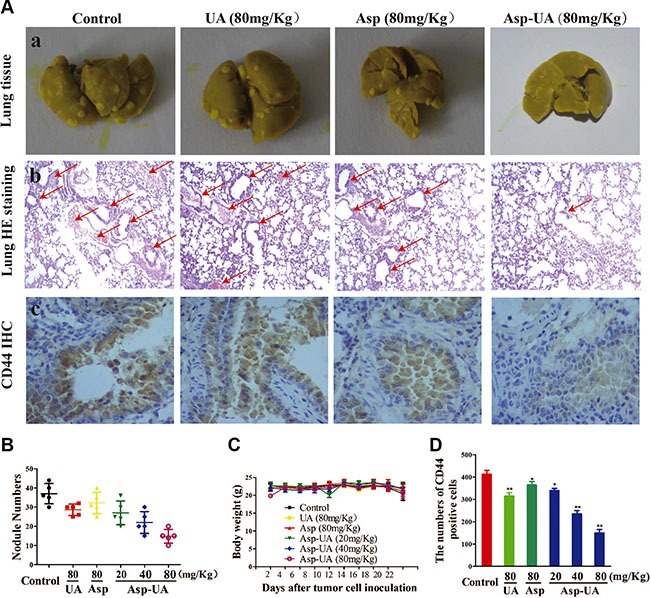
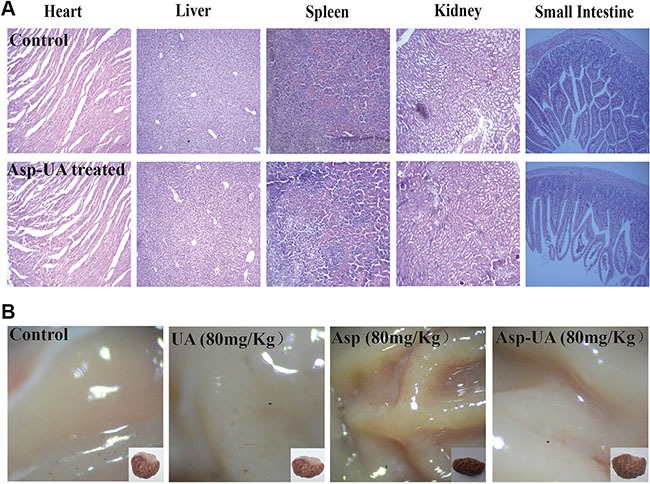
Metastasis currently remains the predominant cause of breast carcinoma treatment failure. The effective targeting of metastasis-related-pathways in cancer holds promise for a new generation of therapeutics. In this study, we developed an novel Asp-UA conjugate, which was composed of classical "old drug" aspirin and low toxicity natural product ursolic acid for targeting breast cancer metastasis. Our results showed that Asp-UA could attenuate the adhesion, migration and invasion of breast cancer MCF-7 and MDA-MB-231 cells in a more safe and effective manner in vitro. Molecular and cellular study demonstrated that Asp-UA significantly down-regulated the expression of cell adhesion and invasion molecules including integrin α6β1, CD44 ,MMP-2, MMP-9, COX-2, EGFR and ERK proteins, and up-regulated the epithelial markers "E-cadherin" and "β-catenin", and PTEN proteins. Furthermore, Asp-UA (80 mg/kg) reduced lung metastasis in a 4T1 murine breast cancer metastasis model more efficiently, which was associated with a decrease in the expression of CD44. More importantly, we did not detect side effects with Asp-UA in mice such as weight loss and main viscera tissues toxicity. Overall, our research suggested that co-drug Asp-UA possessed potential metastasis chemoprevention abilities via influencing EMT and EGFR-mediated pathways and could be a more promising drug candidate for the prevention and/or treatment of breast cancer metastasis.
转移目前仍然是乳腺癌治疗失败的主要原因。有效靶向癌症中与转移相关的途径有望带来新一代的治疗方法。在本研究中,我们开发了一种新型的Asp-UA偶联物,它由经典的“老药”阿司匹林和低毒性天然产物熊果酸组成,用于靶向乳腺癌转移。我们的结果表明,Asp-UA在体外能以更安全有效的方式减弱乳腺癌MCF-7和MDA-MB-231细胞的黏附、迁移和侵袭。分子和细胞研究表明,Asp-UA显著下调了包括整合素α6β1、CD44、MMP-2、MMP-9、COX-2、EGFR和ERK蛋白在内的细胞黏附和侵袭分子的表达,并上调了上皮标志物“E-钙黏蛋白”、“β-连环蛋白”和PTEN蛋白的表达。此外,Asp-UA(80mg/kg)在4T1小鼠乳腺癌转移模型中更有效地减少了肺转移,这与CD44表达的降低有关。更重要的是,我们在小鼠中未检测到Asp-UA的副作用,如体重减轻和主要内脏组织毒性。总体而言,我们的研究表明,联合药物Asp-UA通过影响EMT和EGFR介导的途径具有潜在的转移化学预防能力,可能是预防和/或治疗乳腺癌转移更有前景的候选药物。