Zhang Xu, Li Na, Meng Yan, Zhang Renjing, Bian Jinjun, Yao Ying, Li Jinbao, Deng Xiaoming
Department of Anesthesiology and Intensive Care, Changhai Hospital, Second Military Medical University, Shanghai, China (mainland).
Med Sci Monit. 2016 Sep 30;22:3493-3499. doi: 10.12659/msm.897433.
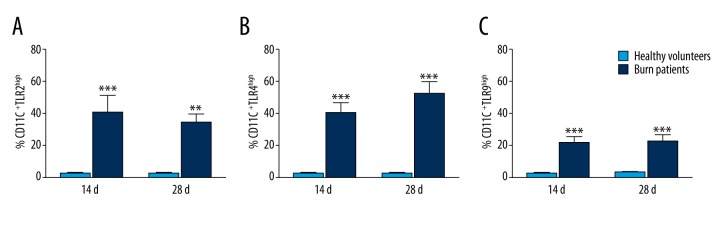
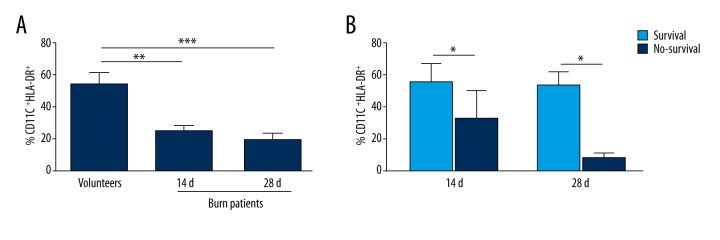
BACKGROUND As a serious clinical problem, severe burn injury disturbs the immune system, resulting in progressive suppression of immune response. TLRs are associated with immune system activation, but the effect of TLRs levels on circulating cDCs of severe burn injury patients has not been fully assessed. MATERIAL AND METHODS Ten patients with total body surface area (TBSA) burned >90% admitted to our institution were enrolled in this study. We analyzed TLR2, TLR4, and TLR9 expression on the circulating cDCs by using multicolor flow cytometric analysis in patients at 14 days to 28 days after burn injury according to mortality, and We also assessed Demographics, clinical outcomes, organ function, and inflammatory and acute-phase responses. RESULTS No difference in TBSA, sex, age, or number of operations before the first 14 days after injury were observed between surviving and non-surviving burn patients. The levels of TLR2, TLR4, and TLR9 in circulating cDCs were significantly and consistently elevated in all patients compared to age-matched healthy volunteers, and survivors exhibited higher TLR2 and TLR4 values than non-survivors. Of the survivors, TLR2 and TLR4 levels were higher at 28 days than at 14 days after injury, while the difference in TLR9 levels was not significant. TLR2 levels of non-survivors at 28 days after injury decreased, and the TLR4 and TLR9 levels showed no significant difference. CONCLUSIONS TLRs levels in circulating cDCs are highly activated in severe burn injury patients up to 28 days after injury. The low expression of TLR2 in cDCs may be useful as a potential marker predicting the poor prognosis of severe burn patients.
背景 作为一个严重的临床问题,严重烧伤会干扰免疫系统,导致免疫反应逐渐受到抑制。Toll样受体(TLRs)与免疫系统激活相关,但TLRs水平对严重烧伤患者循环中的浆细胞样树突状细胞(cDCs)的影响尚未得到充分评估。
材料与方法 本研究纳入了10例入住我院、烧伤总面积(TBSA)>90%的患者。我们在烧伤后14天至28天,根据死亡率,通过多色流式细胞术分析患者循环中cDCs上TLR2、TLR4和TLR9的表达情况,并且我们还评估了人口统计学、临床结局、器官功能以及炎症和急性期反应。
结果 在存活和非存活的烧伤患者之间,未观察到受伤后前14天内的TBSA、性别、年龄或手术次数存在差异。与年龄匹配的健康志愿者相比,所有患者循环中cDCs上的TLR2、TLR4和TLR9水平均显著且持续升高,并且幸存者的TLR2和TLR4值高于非幸存者。在幸存者中,受伤后28天的TLR2和TLR4水平高于14天,而TLR9水平的差异不显著。受伤后28天非幸存者的TLR2水平下降,TLR4和TLR9水平无显著差异。
结论 在严重烧伤患者受伤后长达28天内,循环中cDCs上的TLRs水平高度激活。cDCs中TLR2的低表达可能作为预测严重烧伤患者预后不良的潜在标志物。