Mendonça Nuno, Mathers John C, Adamson Ashley J, Martin-Ruiz Carmen, Seal Chris J, Jagger Carol, Hill Tom R
School of Agriculture Food and Rural Development, Newcastle University, Newcastle upon Tyne NE1 7RU, UK.
Newcastle University Institute for Ageing, Newcastle University, Newcastle upon Tyne NE2 4AX, UK.
Nutrients. 2016 Sep 28;8(10):604. doi: 10.3390/nu8100604.
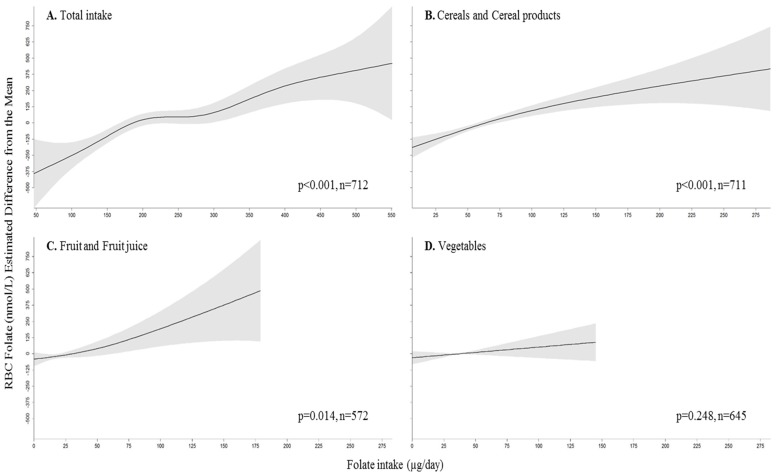
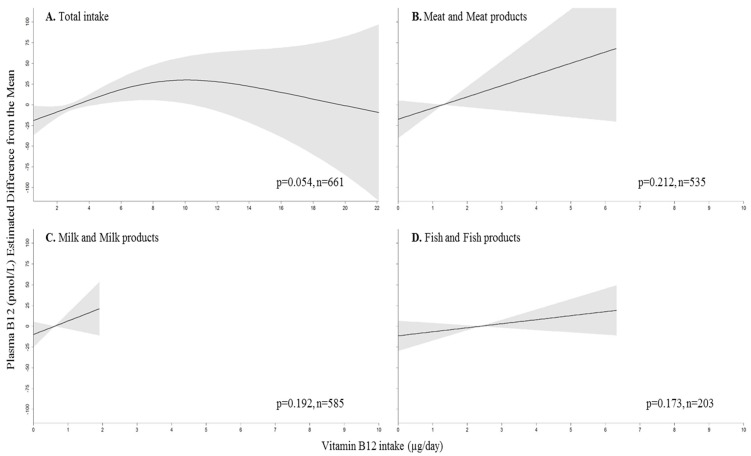
Very old adults are at increased risk of folate and vitamin B12 deficiencies due to reduced food intake and gastrointestinal absorption. The main aim was to determine the association between folate and vitamin B12 intake from total diets and food groups, and status. Folate or vitamin B12 intakes (2 × 24 h multiple pass recalls) and red blood cell (RBC) folate or plasma vitamin B12 (chemiluminescence immunoassays) concentrations were available at baseline for 731 participants aged 85 from the Newcastle 85+ Study (North-East England). Generalized additive and binary logistic models estimated the associations between folate and vitamin B12 intakes from total diets and food groups, and RBC folate and plasma B12. Folate intake from total diets and cereal and cereal products was strongly associated with RBC folate ( < 0.001). Total vitamin B12 intake was weakly associated with plasma vitamin B12 ( = 0.054) but those with higher intakes from total diets or meat and meat products were less likely to have deficient status. Women homozygous for the G allele had higher concentrations of plasma vitamin B12. Cereals and cereal products are a very important source of folate in the very old. Higher intakes of folate and vitamin B12 lower the risk of "inadequate" status.
由于食物摄入量减少和胃肠道吸收功能下降,高龄老年人叶酸和维生素B12缺乏的风险增加。主要目的是确定从总膳食和食物组中摄入的叶酸和维生素B12与身体状况之间的关联。来自纽卡斯尔85岁以上研究(英格兰东北部)的731名85岁参与者在基线时提供了叶酸或维生素B12摄入量(2次24小时多次回顾法)以及红细胞(RBC)叶酸或血浆维生素B12(化学发光免疫分析)浓度。广义相加模型和二元逻辑模型估计了总膳食和食物组中叶酸和维生素B12摄入量与红细胞叶酸和血浆维生素B12之间的关联。总膳食以及谷物和谷物制品中的叶酸摄入量与红细胞叶酸密切相关(<0.001)。总维生素B12摄入量与血浆维生素B12弱相关(=0.054),但总膳食或肉类及肉类制品摄入量较高的人维生素B12缺乏状态的可能性较小。携带G等位基因纯合子的女性血浆维生素B12浓度较高。谷物和谷物制品是高龄老年人叶酸的非常重要的来源。较高的叶酸和维生素B12摄入量可降低“不足”状态的风险。