Fidyt Klaudyna, Fiedorowicz Anna, Strządała Leon, Szumny Antoni
Laboratory of Tumor Molecular Immunobiology, Ludwik Hirszfeld Institute of Immunology and Experimental Therapy, Polish Academy of Sciences, 12 Rudolf Weigl, Wroclaw, 53-114, Poland.
The Faculty of Food Science, Department of Chemistry, Wrocław University of Environmental and Life Sciences, 25/27 C.K. Norwida, Wroclaw, 50-375, Poland.
Cancer Med. 2016 Oct;5(10):3007-3017. doi: 10.1002/cam4.816. Epub 2016 Sep 30.
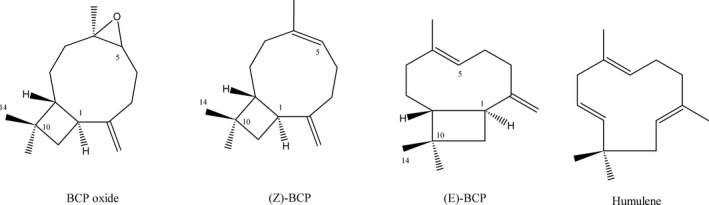
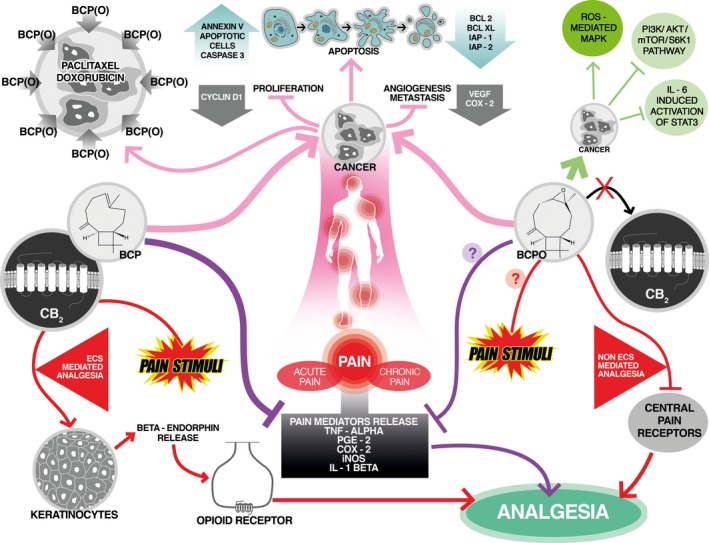
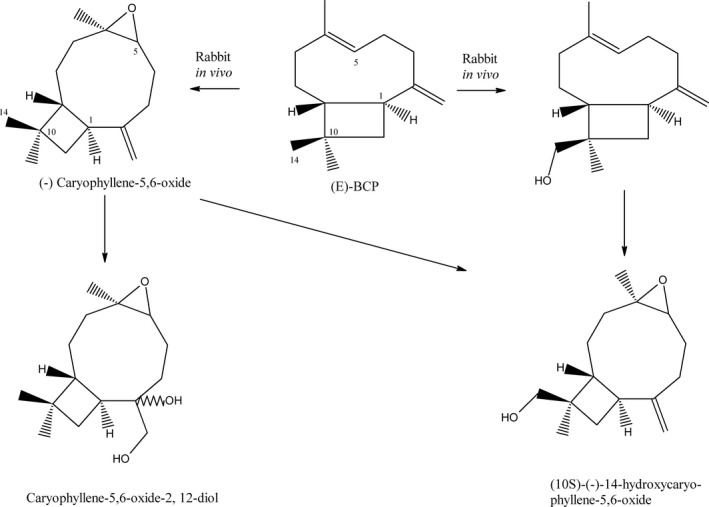
Natural bicyclic sesquiterpenes, β-caryophyllene (BCP) and β-caryophyllene oxide (BCPO), are present in a large number of plants worldwide. Both BCP and BCPO (BCP(O)) possess significant anticancer activities, affecting growth and proliferation of numerous cancer cells. Nevertheless, their antineoplastic effects have hardly been investigated in vivo. In addition, both compounds potentiate the classical drug efficacy by augmenting their concentrations inside the cells. The mechanisms underlying the anticancer activities of these sesquiterpenes are poorly described. BCP is a phytocannabinoid with strong affinity to cannabinoid receptor type 2 (CB ), but not cannabinoid receptor type 1 (CB ). In opposite, BCP oxidation derivative, BCPO, does not exhibit CB binding, thus the mechanism of its action is not related to endocannabinoid system (ECS) machinery. It is known that BCPO alters several key pathways for cancer development, such as mitogen-activated protein kinase (MAPK), PI3K/AKT/mTOR/S6K1 and STAT3 pathways. In addition, treatment with this compound reduces the expression of procancer genes/proteins, while increases the levels of those with proapoptotic properties. The selective activation of CB may be considered a novel strategy in pain treatment, devoid of psychoactive side effects associated with CB stimulation. Thus, BCP as selective CB activator may be taken into account as potential natural analgesic drug. Moreover, due to the fact that chronic pain is often an element of cancer disease, the double activity of BCP, anticancer and analgesic, as well as its beneficial influence on the efficacy of classical chemotherapeutics, is particularly valuable in oncology. This review is focused on anticancer and analgesic activities of BCP and BCPO, the mechanisms of their actions, and potential therapeutic utility.
天然双环倍半萜类化合物,β-石竹烯(BCP)和β-石竹烯氧化物(BCPO),存在于全球大量植物中。BCP和BCPO(BCP(O))均具有显著的抗癌活性,影响多种癌细胞的生长和增殖。然而,它们的抗肿瘤作用在体内几乎未被研究过。此外,这两种化合物通过增加细胞内浓度来增强经典药物的疗效。这些倍半萜类化合物抗癌活性的潜在机制描述甚少。BCP是一种植物大麻素,对2型大麻素受体(CB₂)具有很强的亲和力,但对1型大麻素受体(CB₁)没有亲和力。相反,BCP的氧化衍生物BCPO不表现出CB结合,因此其作用机制与内源性大麻素系统(ECS)机制无关。已知BCPO会改变癌症发展的几个关键途径,如丝裂原活化蛋白激酶(MAPK)、PI3K/AKT/mTOR/S6K1和STAT3途径。此外,用该化合物处理可降低促癌基因/蛋白质的表达,同时增加具有促凋亡特性的基因/蛋白质水平。选择性激活CB₂可被视为疼痛治疗中的一种新策略,没有与CB₁刺激相关的精神活性副作用。因此,BCP作为选择性CB₂激活剂可被视为潜在的天然镇痛药。此外,由于慢性疼痛往往是癌症疾病的一个因素,BCP的双重活性,抗癌和镇痛,以及其对经典化疗疗效的有益影响,在肿瘤学中特别有价值。本综述重点关注BCP和BCPO的抗癌和镇痛活性、它们的作用机制以及潜在的治疗用途。