Kim Woonjung, Jung Jongjin
Department of Chemistry, Hannam University, Daejeon 34054, Korea.
BMB Rep. 2016 Dec;49(12):655-661. doi: 10.5483/bmbrep.2016.49.12.166.
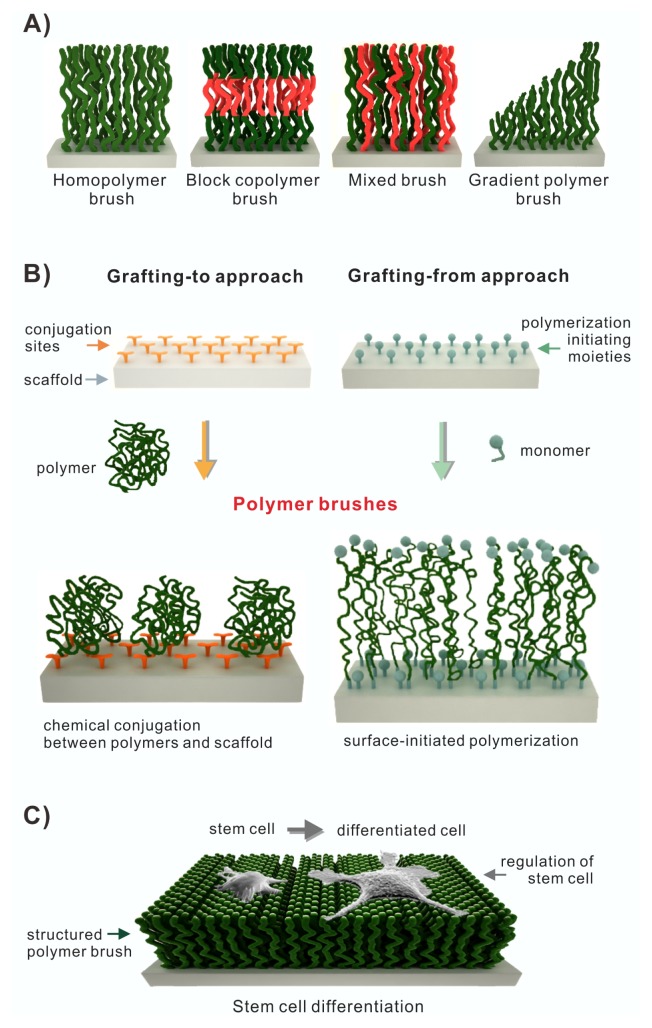
Polymer brush is a soft material unit tethered covalently on the surface of scaffolds. It can induce functional and structural modification of a substrate's properties. Such surface coating approach has attracted special attentions in the fields of stem cell biology, tissue engineering, and regenerative medicine due to facile fabrication, usability of various polymers, extracellular matrix (ECM)-like structural features, and in vivo stability. Here, we summarized polymer brush-based grafting approaches comparing self-assembled monolayer (SAM)-based coating method, in addition to physico-chemical characterization techniques for surfaces such as wettability, stiffness/ elasticity, roughness, and chemical composition that can affect cell adhesion, differentiation, and proliferation. We also reviewed recent advancements in cell biological applications of polymer brushes by focusing on stem cell differentiation and 3D supports/implants for tissue formation. Understanding cell behaviors on polymer brushes in the scale of nanometer length can contribute to systematic understandings of cellular responses at the interface of polymers and scaffolds and their simultaneous effects on cell behaviors for promising platform designs. [BMB Reports 2016; 49(12): 655-661].
聚合物刷是一种通过共价键连接在支架表面的软材料单元。它可以诱导底物性质的功能和结构修饰。由于其制备简便、各种聚合物的可用性、类似细胞外基质(ECM)的结构特征以及体内稳定性,这种表面涂层方法在干细胞生物学、组织工程和再生医学领域引起了特别关注。在这里,我们总结了基于聚合物刷的接枝方法,并与基于自组装单分子层(SAM)的涂层方法进行了比较,此外还介绍了用于表面的物理化学表征技术,如可影响细胞粘附、分化和增殖的润湿性、刚度/弹性、粗糙度和化学成分。我们还通过关注干细胞分化和用于组织形成的3D支架/植入物,综述了聚合物刷在细胞生物学应用方面的最新进展。从纳米长度尺度理解细胞在聚合物刷上的行为,有助于系统地理解聚合物与支架界面处的细胞反应及其对细胞行为的同时影响,从而设计出有前景的平台。[《BMB报告》2016年;49(12): 655 - 661]