Carr David J, David Anna L, Aitken Raymond P, Milne John S, Borowicz Pawel P, Wallace Jacqueline M, Redmer Dale A
Rowett Institute of Nutrition and Health, University of Aberdeen, Greenburn Road, Bucksburn, Aberdeen, AB21 9SB, UK; UCL Institute for Women's Health, University College London, 86-96 Chenies Mews, London, WC1E 6HX, UK.
UCL Institute for Women's Health, University College London, 86-96 Chenies Mews, London, WC1E 6HX, UK.
Placenta. 2016 Oct;46:79-86. doi: 10.1016/j.placenta.2016.08.076. Epub 2016 Aug 19.
Placental vascularity may be important in the development of fetal growth restriction (FGR). The overnourished adolescent ewe is a robust model of the condition, with ∼50% of offspring demonstrating FGR (birthweight >2 standard deviations below optimally-fed control mean). We studied whether placental vascularity, angiogenesis and glucose transport reflect FGR severity.
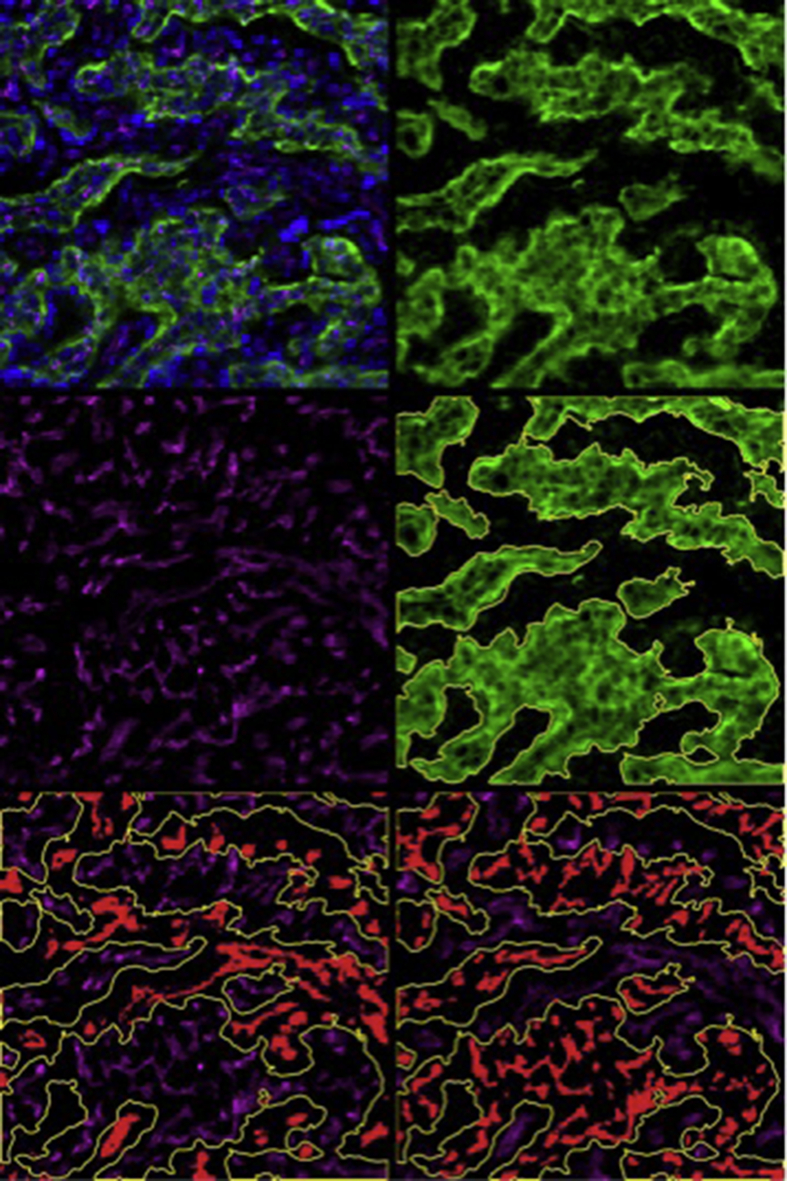
Singleton pregnancies were established in adolescent ewes either overnourished to putatively restrict fetoplacental growth (n = 27) or control-fed (n = 12). At 131d (term = 145d) pregnancies were interrupted and fetuses classified as FGR (n = 17, <4222 g, -2SD below control-fed mean) or non-FGR (n = 10). Placentome capillary area density (CAD), number density (CND), surface density (CSD), and area per capillary (APC) in the fetal cotyledon (COT) and maternal caruncle (CAR) were analysed using immunostaining. COT/CAR mRNA expression of angiogenic ligands/receptors and glucose transporters were measured by qRT-PCR.
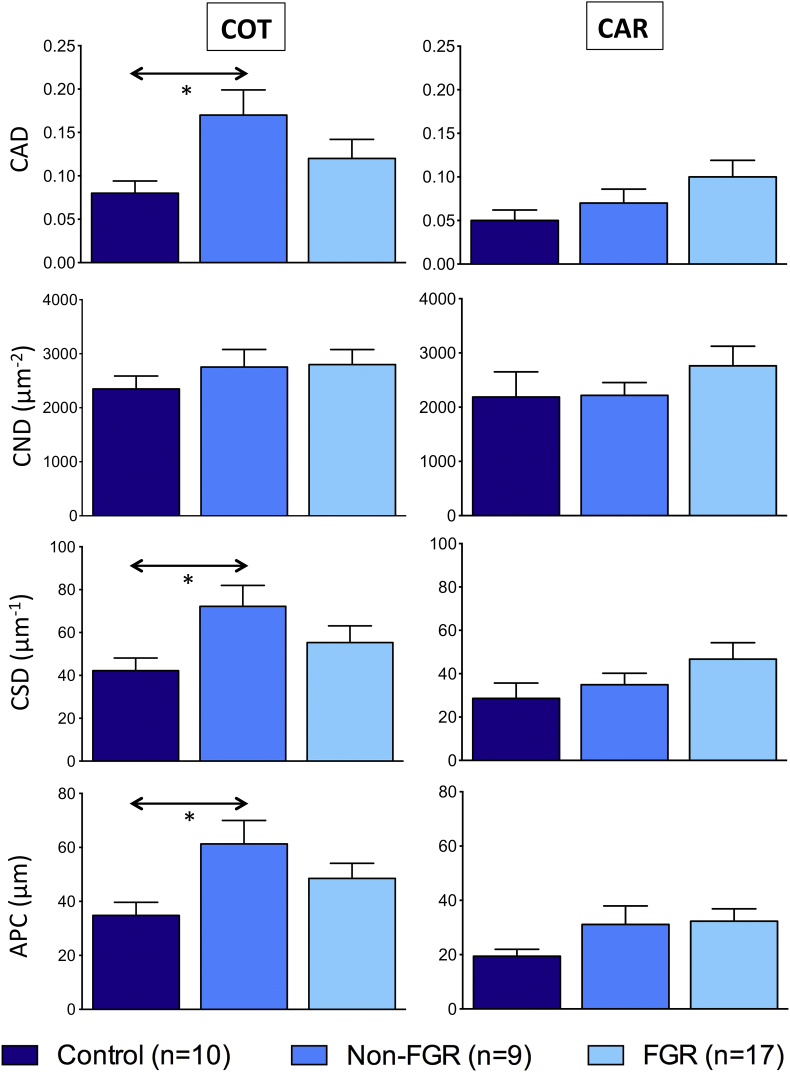
Fetal weight was reduced in FGR vs. Non-FGR/Control groups. Total placentome weight was Control > Non-FGR > FGR and fetal:placental weight ratios were higher in overnourished versus Control groups. COT vascular indices were Non-FGR > FGR > Control. COT-CAD, CSD and APC were significantly greater in Non-FGR overnourished versus Control and intermediate in FGR groups. CAR vascularity did not differ. CAR-VEGFA/FLT1/KDR/ANGPT1/ANGPT2/SLC2A1/SLC2A3 mRNA was lower and COT-ANGPT2 higher in overnourished versus Control groups.
Relative to control-intake pregnancy, overnourished pregnancies are characterised by higher COT vascularity, potentially a compensatory response to reduced nutrient supply, reflected by higher fetal:placental weight ratios. Compared with overnourished pregnancies where fetal growth is relatively preserved, overnourished pregnancies culminating in marked FGR have less placental vascularity, suggesting incomplete adaptation to the prenatal insult.
胎盘血管生成可能在胎儿生长受限(FGR)的发生发展中起重要作用。营养过剩的青春期母羊是该病症的一个可靠模型,约50%的后代表现出FGR(出生体重比最佳喂养对照组均值低2个标准差以上)。我们研究了胎盘血管生成、血管生成及葡萄糖转运是否反映FGR的严重程度。
在青春期母羊中建立单胎妊娠,一组给予过量营养以假定限制胎儿胎盘生长(n = 27),另一组给予对照喂养(n = 12)。在妊娠131天(足月为145天)时终止妊娠,将胎儿分为FGR组(n = 17,<4222 g,比对照喂养组均值低2个标准差)和非FGR组(n = 10)。使用免疫染色分析胎儿子叶(COT)和母体肉阜(CAR)中的胎盘小叶毛细血管面积密度(CAD)、数量密度(CND)、表面密度(CSD)和每根毛细血管面积(APC)。通过qRT-PCR测量血管生成配体/受体和葡萄糖转运蛋白的COT/CAR mRNA表达。
与非FGR/对照组相比,FGR组胎儿体重降低。胎盘小叶总重量为对照组>非FGR组>FGR组,且营养过剩组的胎儿:胎盘重量比高于对照组。COT血管指数为非FGR组>FGR组>对照组。非FGR营养过剩组的COT-CAD、CSD和APC显著高于对照组,FGR组处于中间水平。CAR血管生成无差异。营养过剩组与对照组相比,CAR-VEGFA/FLT1/KDR/ANGPT1/ANGPT2/SLC2A1/SLC2A3 mRNA较低,而COT-ANGPT2较高。
相对于对照摄入妊娠,营养过剩妊娠的特点是COT血管生成增加,这可能是对营养供应减少的一种代偿反应,表现为较高的胎儿:胎盘重量比。与胎儿生长相对保留的营养过剩妊娠相比,导致明显FGR的营养过剩妊娠胎盘血管生成较少,提示对产前损伤的适应不完全。