Wang Peng, Liu Xiangyan, Xu Peng, Lu Jialiang, Wang Runze, Mu Weidong
Department of Traumatic Orthopaedics, Shandong Provincial Hospital Affiliated to Shandong University, Jinan, Shandong 250012, P.R. China; Department of Orthopaedics, Weihai Municipal Hospital, Weihai, Shandong 264200, P.R. China.
Department of Thoracic Surgery, Shandong Provincial Hospital Affiliated to Shandong University, Jinan, Shandong 250012, P.R. China.
Exp Ther Med. 2016 Oct;12(4):2102-2108. doi: 10.3892/etm.2016.3591. Epub 2016 Aug 12.
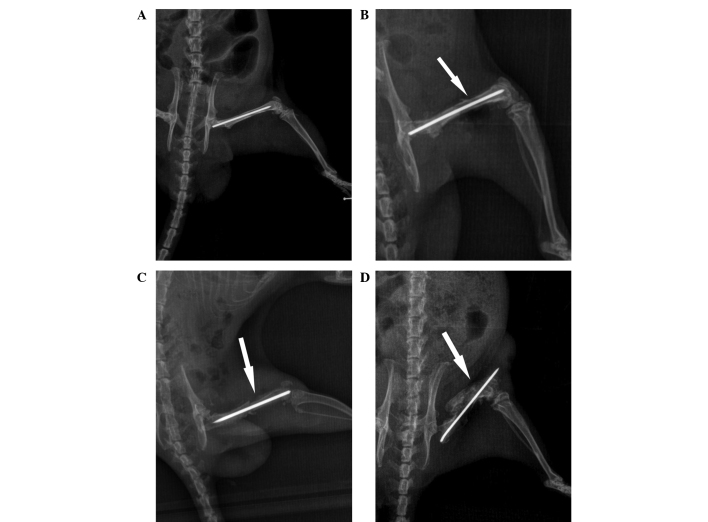
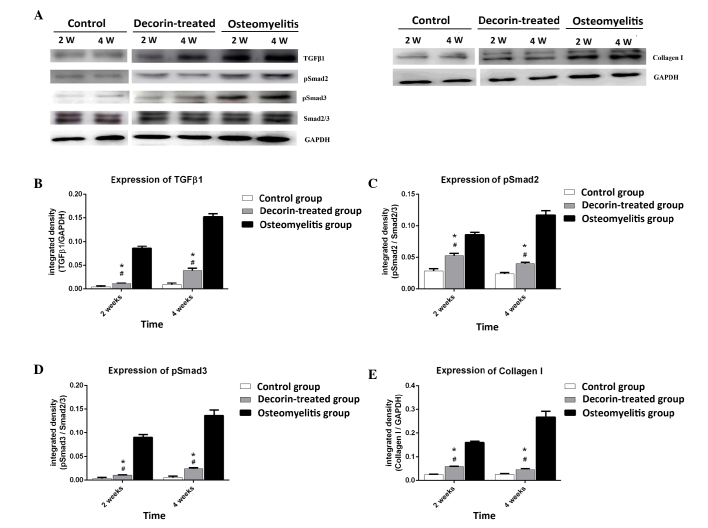
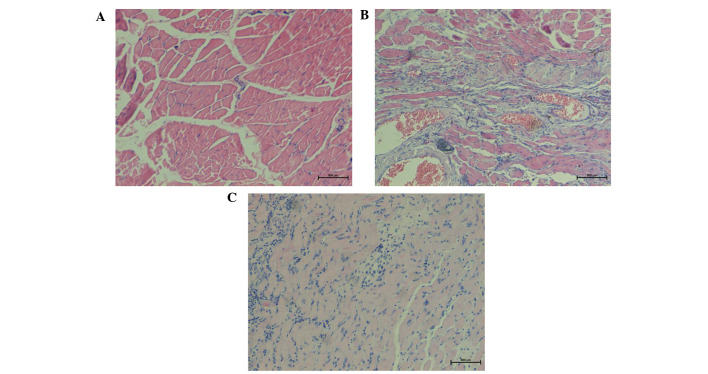
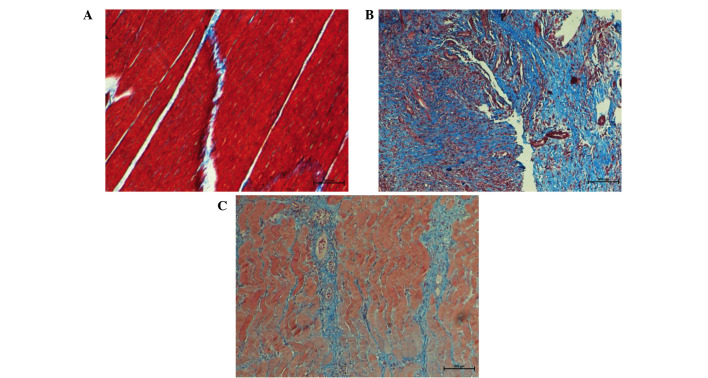
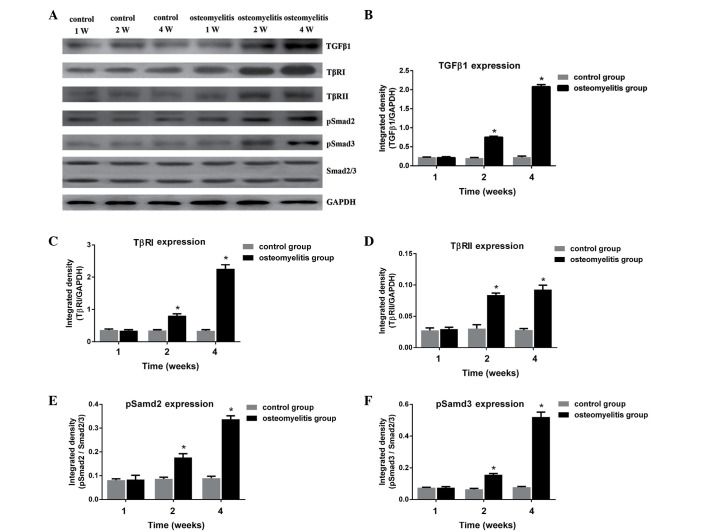
Chronic osteomyelitis is a bone infection that results in hypertrophic scarring of the soft tissue surrounding the infected bone. This scarring can create functional problems and its treatment is challenging. The aim of the present study was to evaluate the efficacy of decorin in treating scar formation in osteomyelitis and the underlying mechanism of its action. A rat osteomyelitis model was used, and animals were divided into three groups, as follows: Group A (control), group B (osteomyelitis model) and group C (decorin-treated). X-ray scans, hematoxylin and eosin (H&E) staining and Masson's trichrome staining were performed to observe changes in femur and muscle tissue. In order to assess the role of the transforming growth factor β1 (TGF-β1)/Smad signaling pathway in scar formation in osteomyelitis, alterations in muscle tissue morphology and in the activation of key members of the TGF-β1/Smad signaling pathway were investigated in groups A and B. According to the results of H&E staining, evident fibrosis in muscle tissue were observed at days 14 and 28 in group B. Simultaneously, the expression levels of key members of the TGF-β1/Smad signaling pathway were increased. Subsequent to treatment with decorin in group C, scarring was reduced, and significant downregulation of collagen I, TGF-β1, phosphorylated (p)Smad2 and pSmad3 protein expression levels was observed at days 14 and 28 compared with the osteomyelitis group. In conclusion, these results suggest that activation of TGF-β1 may serve an important role in the formation of scars in osteomyelitis and that decorin can reduce scar formation in an osteomyelitis rat model through inhibition of the TGF-β1/Smad signaling pathway.
慢性骨髓炎是一种骨感染,可导致感染骨周围软组织的肥厚性瘢痕形成。这种瘢痕形成会引发功能问题,其治疗具有挑战性。本研究的目的是评估核心蛋白聚糖在治疗骨髓炎瘢痕形成中的疗效及其作用的潜在机制。使用大鼠骨髓炎模型,将动物分为三组,如下:A组(对照组)、B组(骨髓炎模型组)和C组(核心蛋白聚糖治疗组)。进行X线扫描、苏木精-伊红(H&E)染色和Masson三色染色以观察股骨和肌肉组织的变化。为了评估转化生长因子β1(TGF-β1)/Smad信号通路在骨髓炎瘢痕形成中的作用,在A组和B组中研究了肌肉组织形态的改变以及TGF-β1/Smad信号通路关键成员的激活情况。根据H&E染色结果,B组在第14天和第28天观察到肌肉组织明显纤维化。同时,TGF-β1/Smad信号通路关键成员的表达水平升高。C组用核心蛋白聚糖治疗后,瘢痕形成减少,与骨髓炎组相比,在第14天和第28天观察到I型胶原蛋白、TGF-β1、磷酸化(p)Smad2和pSmad3蛋白表达水平显著下调。总之,这些结果表明TGF-β1的激活可能在骨髓炎瘢痕形成中起重要作用,并且核心蛋白聚糖可以通过抑制TGF-β1/Smad信号通路减少骨髓炎大鼠模型中的瘢痕形成。