Grazzi Licia, Egeo Gabriella, Calhoun Anne H, McClure Candace K, Liebler Eric, Barbanti Piero
Headache Center, Carlo Besta Neurological Institute and Foundation, Via Celoria 11, 20133, Milan, Italy.
Headache and Pain Unit, Istituto di Ricovero e Cura a Carattere Scientifico, San Raffaele Pisana, Via della Pisana 235, 00163, Rome, Italy.
J Headache Pain. 2016 Dec;17(1):91. doi: 10.1186/s10194-016-0684-z. Epub 2016 Oct 3.
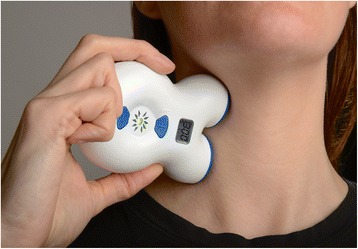
Menstrual migraine and menstrually related migraine attacks are typically longer, more disabling, and less responsive to medications than non-menstrual attacks. The aim of this study was to evaluate the efficacy, safety, and tolerability of non-invasive vagus nerve stimulation for the prophylactic treatment of menstrual migraine/menstrually related migraine.
Fifty-six enrolled subjects (menstrual migraine, 9 %; menstrually related migraine, 91 %), 33 (59 %) of whom were receiving other prophylactic therapies, entered a 12-week baseline period. Fifty-one subjects subsequently entered a 12-week treatment period to receive open-label prophylactic non-invasive vagus nerve stimulation adjunctively (31/51; 61 %) or as monotherapy (20/51; 39 %) on day -3 before estimated onset of menses through day +3 after the end of menses.
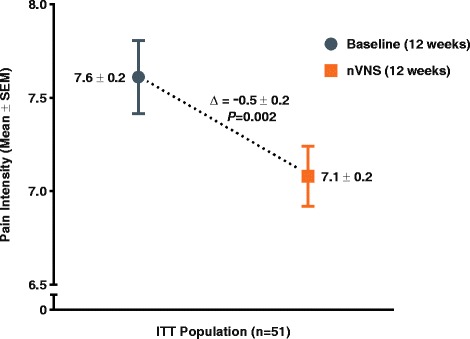
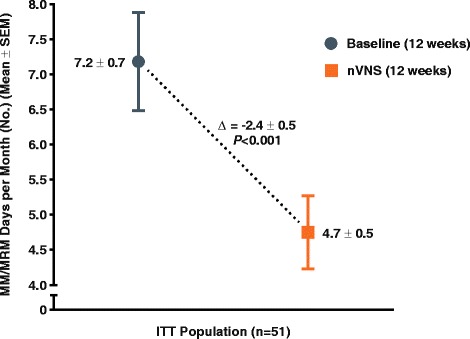
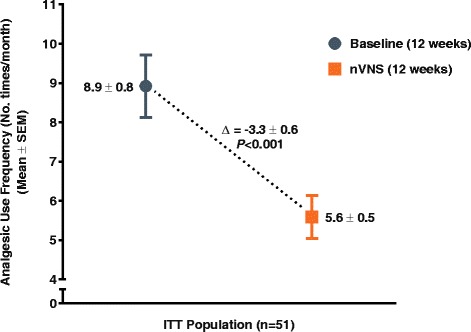
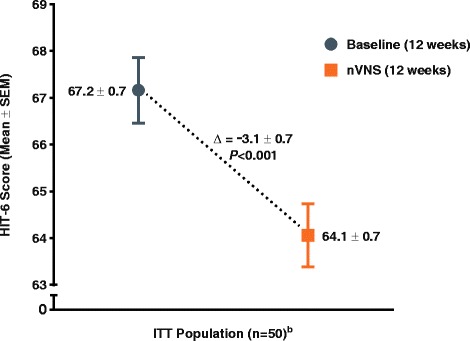
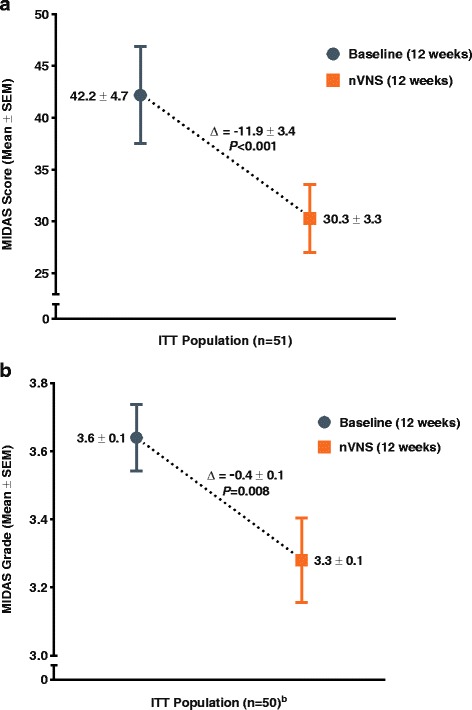
The number of menstrual migraine/menstrually related migraine days per month was significantly reduced from baseline (mean ± standard error, 7.2 ± 0.7 days) to the end of treatment (mean ± standard error, 4.7 ± 0.5 days; P < 0.001) (primary end point). Of all subjects, 39 % (95 % confidence interval: 26 %, 54 %) (20/51) had a ≥ 50 % reduction (secondary end point). For the other secondary end points, clinically meaningful reductions in analgesic use (mean change ± standard error, -3.3 ± 0.6 times per month; P < 0.001), 6-item Headache Impact Test score (mean change ± standard error, -3.1 ± 0.7; P < 0.001), and Migraine Disability Assessment score (mean change ± standard error, -11.9 ± 3.4; P < 0.001) were observed, along with a modest reduction in pain intensity (mean change ± standard error, -0.5 ± 0.2; P = 0.002). There were no safety/tolerability concerns.
These findings suggest that non-invasive vagus nerve stimulation is an effective treatment that reduces the number of menstrual migraine/menstrually related migraine days and analgesic use without safety/tolerability concerns in subjects with menstrual migraine/menstrually related migraine. Randomised controlled studies are warranted.
与非经期偏头痛发作相比,经期偏头痛及与月经相关的偏头痛发作通常持续时间更长、致残性更强,且对药物治疗的反应较差。本研究旨在评估非侵入性迷走神经刺激用于预防性治疗经期偏头痛/与月经相关偏头痛的疗效、安全性及耐受性。
56名入组受试者(经期偏头痛占9%,与月经相关偏头痛占91%)进入为期12周的基线期,其中33名(59%)正在接受其他预防性治疗。随后,51名受试者进入为期12周的治疗期,在预计月经来潮前3天至月经结束后3天接受开放标签的预防性非侵入性迷走神经刺激辅助治疗(31/51;61%)或单一疗法(20/51;39%)。
每月经期偏头痛/与月经相关偏头痛的天数从基线期(均值±标准误,7.2±0.7天)显著减少至治疗结束时(均值±标准误,4.7±0.5天;P<0.001)(主要终点)。所有受试者中,39%(95%置信区间:26%,54%)(20/51)减少了≥50%(次要终点)。对于其他次要终点,观察到镇痛药使用有临床意义的减少(均值变化±标准误,-3.3±0.6次/月;P<0.001)、6项头痛影响测试评分(均值变化±标准误,-3.1±0.7;P<0.001)以及偏头痛残疾评估评分(均值变化±标准误,-11.9±3.4;P<0.001),同时疼痛强度有适度降低(均值变化±标准误,-0.5±0.2;P=0.002)。未发现安全性/耐受性问题。
这些发现表明,非侵入性迷走神经刺激是一种有效的治疗方法,可减少经期偏头痛/与月经相关偏头痛的天数及镇痛药的使用,且对于患有经期偏头痛/与月经相关偏头痛的受试者不存在安全性/耐受性问题。有必要进行随机对照研究。